Titles & paperwork
Car Purchase Agreement: What to Check Before You Sign
Check the vehicle, price, financing, deposits and promises in a car purchase agreement before signing. Includes a worked example and a free review sheet.
Published
Sources checked . How this guide is prepared.
START HERE
The short answer
A car purchase agreement records the terms of a vehicle sale between buyer and seller. Before signing, match the vehicle, parties, itemized price, payment obligations and written promises against the deal you approved. Review related financing, warranty, deposit and delivery documents together. Their names and legal effects can differ by state and transaction.
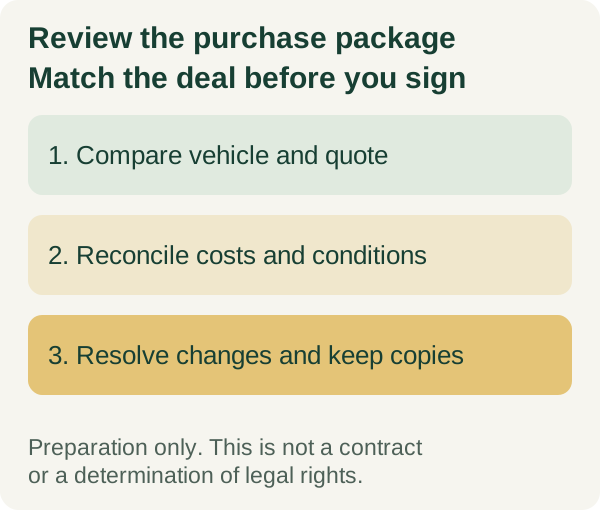
Do not assume a document is nonbinding because someone calls it a worksheet, buyer's order or reservation. Ask what commitment your signature or payment creates and which conditions remain unresolved. If an important term is unclear, settle it before signing or paying.
This guide uses AI-assisted research checked November 19, 2026. CarTruvo operates a vehicle marketplace and has a commercial interest in helping people prepare to buy and sell. It does not provide a state-approved contract or independent legal review. The comparison method and arithmetic example are original preparation tools, not an actual transaction or a determination of your rights.
Start with a record of the deal you actually approved
Keep the advertisement, written quote, relevant messages and any deposit receipt. Write down the exact VIN and the agreed price before comparing them with the documents. A broad description such as “silver sedan” is not enough to distinguish one vehicle from another.
Check the buyer and seller's legal names, the seller's role, the VIN, model year and mileage statement. Compare the VIN with the vehicle and ownership documents. The New York Attorney General's buying guidance specifically recommends checking the vehicle's serial number against the contract and putting verbal promises in writing. Those checks are useful preparation; New York's legal rules do not automatically govern another state's sale.
Mark each difference as one of three things: explained and accepted, corrected in the final documents, or unresolved. Avoid signing a document that still relies on your expectation that someone will fix its price or promises later.
Separate the sales agreement from the other documents
A dealership transaction can involve several related records. Ask the seller to identify each one and explain how they fit together:
- Purchase agreement or buyer's order: vehicle, parties, price and sale terms.
- Finance or retail installment contract: borrowing obligations, costs and payment schedule.
- Title and transfer documents: ownership assignment and the agency's application requirements.
- Warranty or service-contract documents: actual coverage, provider, duration and exclusions.
- Deposit, trade-in or delivery terms: timing, conditions and responsibilities that affect completion.
Document labels overlap. A bill of sale can also serve contractual purposes; there is no universal rule that one name means binding and another does not. For an ordinary private-sale record, use our separate car bill-of-sale preparation guide alongside the state's official forms. This guide focuses on reconciling the complete purchase package before commitment.
Reconcile the price one line at a time
Start with the agreed vehicle price. Add each selected product and charge, then compare the resulting amount with the written quote. Ask which items are government charges, which are seller charges and which are optional products you chose. A label such as “required package” deserves an explanation of who requires it and why.
Use this review sequence:
- Vehicle price and any conditions attached to a discount.
- Taxes and official title or registration charges for your transaction.
- Dealer or document charges and any delivery cost.
- Optional products, each with its own price and cancellation terms where applicable.
- Deposits, cash down and trade-in amounts actually being credited.
- Trade-in payoff and any balance carried into the purchase.
Here is an invented example with no trade-in. A $22,000 vehicle plus $1,700 in assumed taxes and required charges and $300 delivery has a $24,000 acquisition total. If you already paid a $500 deposit credited toward that total, the remaining purchase balance is $23,500. If an unapproved $1,200 product appears, the new total would be $25,200 and the remaining balance $24,700. Ask for correction or a clear decision about that product before signing.
This example has no financing cost and uses hypothetical tax and charge amounts. It does not calculate your tax or imply that every seller accepts deposits on the same terms. Its purpose is to make a changed line item visible instead of hiding it in a monthly payment.
Compare the financing agreement separately
When borrowing, read the credit terms as well as the sales price. The CFPB's Truth-in-Lending explanation describes disclosures including APR, finance charge, amount financed and total of payments. It recommends obtaining and reviewing completed disclosures before signing.
Match the down payment and amount financed with the purchase figures. Compare the APR, number of payments and payment amounts with the financing offer you accepted. Ask about a balloon payment, prepayment terms, late charges or any other obligation you do not understand. Distinguish the amount borrowed from the total you will repay over time.
Ask whether financing is final and which written conditions remain. If the seller proposes delivery before final funding, read what happens if the lender does not accept the transaction. Do not infer your cancellation rights, deposit treatment or trade-in return solely from a salesperson's summary.
Put repairs, equipment and delivery promises into the documents
If a promise matters to your decision, identify the vehicle, work or item, responsible business, completion date and what happens if it is not delivered. “We will take care of it” leaves those questions unanswered. Ask the seller to incorporate the agreed promise into the applicable final records and give you a copy.
Examples of details worth resolving:
- A repair: exact concern, intended work, completion deadline and who pays.
- Included equipment: keys, accessories, charging cables or other agreed items.
- Delivery: place, cost, expected timing and documentation of condition.
- Inspection condition: what must be completed before commitment or handoff.
- Title documents: who supplies them, known liens and the agreed sequence.
Read the actual warranty and any service contract rather than treating a verbal assurance as coverage. Ask about conflicting wording across the sales documents and disclosures. Keep the scope of an independent inspection separate from any seller warranty or state inspection requirement.
Clarify deposits, cancellation and unresolved conditions
Before a deposit, ask what it reserves, how long the reservation lasts, who holds it and whether it is credited toward the price. Get the refund conditions and deadlines in writing. Ask what happens if inspection, financing, title or delivery conditions fail. Keep the receipt and the exact terms that applied when you paid.
Avoid assuming every vehicle purchase includes a three-day cancellation period. State law, the transaction and the written policy matter. New York's official guidance, for example, describes particular deposit and financing circumstances; those conditions should not be treated as a nationwide refund rule. Ask the relevant consumer-protection agency or qualified local adviser when the effect of a signed agreement is uncertain.
If you have already signed and discover a discrepancy, preserve the complete documents and correspondence. Promptly contact the seller in writing, identify the exact issue and ask for its proposed resolution. Check any notice deadline and seek appropriate local help for a disputed legal obligation. Do not alter a signed copy to make it match your recollection.
Free purchase-agreement review record
Use the blank car purchase agreement review sheet to compare the quoted term, final document, discrepancy and resolution. It is not a contract template, electronic signature or replacement for required state disclosures.
Before signing, make sure important blanks and differences are resolved, review the complete final version and retain every signed document. A changed page should be checked together with the rest of the package. Complete the transaction when you understand and accept the actual obligations, rather than relying on an earlier quote that no longer matches them.
BEFORE YOU TAKE THE NEXT STEP
Practical checklist
Check the VIN, ownership record and seller details.
Arrange an independent inspection and review the written terms.
Confirm the total cost and title-transfer process before paying.
CHECK THE DETAILS
Sources and further reading
Follow the source linked beside a claim for its context. For a transaction, confirm current requirements with the relevant agency, lender or provider.
- New York Attorney General's buying guidanceag.ny.gov
- CFPB's Truth-in-Lending explanationconsumerfinance.gov
YOUR NEXT READ