Titles & paperwork
What Is a Lien on a Car? Meaning, Checks and Release Evidence
Understand a car lien, check the relevant records and separate payoff from release evidence. Includes buyer questions and a free lien review record.
Published
Sources checked . How this guide is prepared.
START HERE
The short answer
A lien on a car is a creditor's security interest or legal claim tied to the vehicle. A lender financing a purchase commonly records one to protect its interest in the car. Before buying, establish who owns the vehicle, which interests are recorded and how any required payoff and release will be completed.
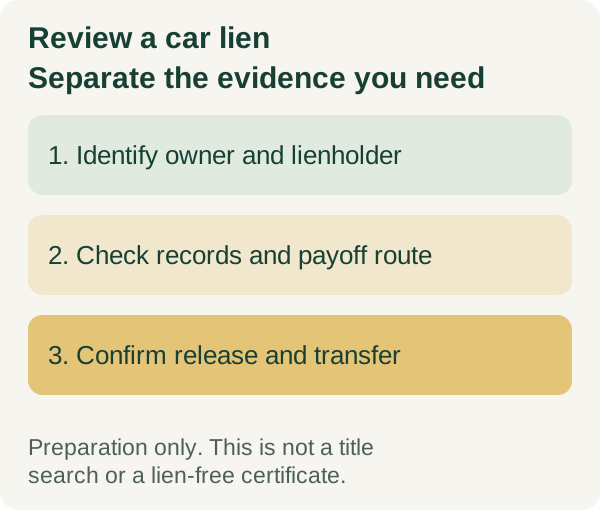
A lien is different from a salvage or rebuilt title brand. It also differs from the vehicle's market value and the borrower's current account balance. Treat ownership, debt, release evidence and condition as separate checks rather than expecting one title photo to answer everything.
This guide uses AI-assisted research checked November 19, 2026. CarTruvo operates a vehicle marketplace and has a commercial interest in helping buyers and sellers prepare. It does not certify title records, resolve liens or hold transaction money. The evidence checklist and scenario below are original preparation material, not an ownership determination, actual transaction or independent legal review.
Identify the owner, borrower and lienholder separately
The person making payments, the owner shown on the title and the creditor with a recorded interest are roles you should identify individually. New York DMV's lienholder explanation describes a lien as a security interest held by someone other than the owner and explains its title and computer-record entries. That is more precise than assuming the lender and borrower are automatically co-owners everywhere.
Ask the seller whose name appears on the current ownership record and whether anyone else must sign or authorize a transfer. If the seller's name differs, review the ownership chain before discussing a handoff. A lien release does not establish that an unrelated seller has authority to convey the car.
Some claims can arise outside an ordinary purchase loan. If a repair, storage, tax or disputed-ownership claim appears, tell the responsible agency the exact facts and ask which process applies. Do not apply a bank-loan payoff checklist to every kind of claim. Contested rights or unfamiliar documents may require qualified local legal assistance.
What does a lien mean for a buyer?
It means you need a documented route from the existing interest to an acceptable transfer, rather than simply a promise that the seller will use your money to pay a debt later. Work out the route with the known lienholder, seller, your lender if applicable and the responsible title agency before committing.
Clarify these questions:
- Which vehicle and interest does the lender's record identify?
- Who may request a payoff and authorize information sharing?
- What amount is valid for the proposed payment date?
- Who receives each part of the purchase money?
- How and when does the lienholder issue the release?
- What documents will the buyer or receiving agency get?
- What happens if the payoff changes or paperwork is delayed?
Verify the lienholder's identity and payment instructions through an established channel. Avoid relying solely on a screenshot or contact details forwarded in an unexpected message. Keep account numbers and full title documents out of public listings and share sensitive records only through appropriate private channels.
How can you check for a recorded lien?
Start with the vehicle's VIN and issuing jurisdiction. Compare the VIN on the vehicle, ownership document and available registration records. Ask the relevant motor vehicle agency which title or lien information it provides and what identifiers or authorization are needed. There is no single preparation step that guarantees a complete nationwide search of every possible claim.
For example, New York's title and lien status service uses the VIN, model year and make. Its displayed results include title issuance information and recorded lien details, while excluding the owner's or registrant's personal information. That is a jurisdiction-specific status check, not a public owner-address lookup or a national clearance certificate.
Save the date and scope of the check. If a document and agency record disagree, ask the agency or lienholder to resolve the discrepancy before payment. A negative result in one system should not be stretched into a guarantee about another jurisdiction, a different type of claim or a record that has not yet been updated.
A vehicle history report can add useful context, but it does not replace the actual release, the seller's authority or the receiving agency's document requirements. Keep the clean-title meaning and the car's present condition separate from the lien review.
Paid loan, released lien and updated record are different milestones
Ask for evidence of each relevant step. A payoff receipt can show that money was received; it is not necessarily the release document the title agency requires. An account balance of zero also does not by itself tell you whether a paper certificate was mailed or an electronic record updated.
In a fictional example, a seller shows a zero-balance loan screen, but the available title still lists the lender. The buyer should ask what release was issued, who received it and which documents the agency will accept. The contradiction needs an explanation and evidence, rather than an assumption that either screen tells the whole story.
State procedures differ. New York's official instructions describe circumstances where the original title and original lien release can accompany a sale, rather than requiring the seller to obtain a newly printed lien-free certificate first. Confirm the procedure for your own transaction. Do not generalize that New York example to every issuer or destination state.
What changes with an electronic title or a missing certificate?
Ask whether the jurisdiction maintains an electronic title, whether a lender holds paper and what happens after release. An electronic record is not a lost paper title merely because the seller has no certificate in a drawer. Our electronic-title sale guide helps prepare that conversation.
If an issued paper certificate was lost, the issuer's replacement process may apply. Texas's certified-copy instructions, for example, address recorded liens and required lienholder participation or release evidence. Requesting a duplicate does not erase an existing security interest. Use our duplicate-title guide for that separate application task.
Ask the issuer where a replacement or released certificate will be delivered and whether an address update is needed. If a prior lienholder has changed names, merged or closed, ask the agency how to establish the appropriate successor or accepted evidence. Do not create a release yourself to fill the gap.
Can a car with a lien still be sold?
Some financed-car sales can be completed through a coordinated payoff, release and transfer process. The actual lender and agency requirements determine the route. The seller also needs a plan if the agreed price does not cover the payoff and transaction expenses. Letting a buyer informally take over payments does not establish that the lender accepted a loan transfer.
Our selling a car with a loan guide covers the seller's dated payoff, funds and closing sequence. This guide explains the lien and evidence questions; it does not replace that closing plan. If the owner is paying off the car while keeping it, use the separate early payoff decision guide.
Free lien-evidence review record
Use the blank car lien review sheet to record the jurisdiction, record checked, named parties, payoff information, release evidence and remaining questions. It is not a title search, lien-free certificate or government form.
Proceed when the relevant parties have established an acceptable release and transfer sequence and you understand what evidence you will receive. Keep the completed records privately. If an interest or ownership question remains unexplained, resolve it before treating the car as ready for an ordinary handoff.
BEFORE YOU TAKE THE NEXT STEP
Practical checklist
Check the VIN, ownership record and seller details.
Arrange an independent inspection and review the written terms.
Confirm the total cost and title-transfer process before paying.
CHECK THE DETAILS
Sources and further reading
Follow the source linked beside a claim for its context. For a transaction, confirm current requirements with the relevant agency, lender or provider.
- New York DMV's lienholder explanationdmv.ny.gov
- New York's title and lien status servicedmv.ny.gov
- Texas's certified-copy instructionstxdmv.gov
YOUR NEXT READ