Titles & paperwork
What Does Car Registration Look Like? Cards, Receipts and Digital Records
Identify registration cards, receipts and digital records using official state examples. Separate registration, renewal notices and ownership evidence with a blank worksheet.
Published
Sources checked . How this guide is prepared.
START HERE
The short answer
Car registration can appear as a state-issued card, receipt or electronic record. Some states also use a vehicle sticker. The document’s layout, labels and required form vary, so compare it with the issuing agency’s current instructions instead of relying on one nationwide sample.
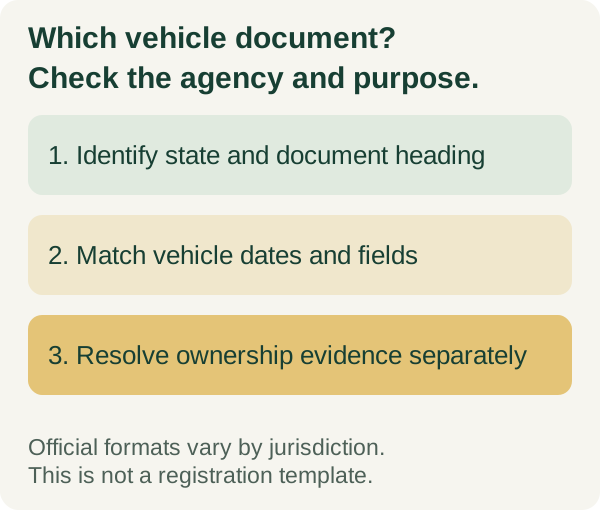
For a vehicle purchase, identify what the record actually establishes: which vehicle is registered, the relevant registration period and who is listed where applicable. Ownership and permission to transfer the car need their own checks, including any state-specific exceptions.
Start with the issuing state and document heading
Look for the issuing agency and the record’s actual heading. Establish whether you have a registration certificate or receipt, a renewal notice, a temporary document, a title or an insurance card. Similar vehicle information can appear on several different documents.
Use the agency’s own website to find the matching example or instructions. Do not assume that a design found in an image search applies to another state, an older document or an electronic record. If the document cannot be identified confidently, ask the issuing agency before relying on it.
This guide’s diagram and worksheet organize identification questions. They are not a registration certificate, a replacement document or a template to reproduce an official record.
See an actual official sample from New York
New York DMV’s sample registration documents show a vehicle registration, a registration window sticker and a renewal notice as separate examples. The page identifies the plate number, registration class code and a registrant-name fragment used on its samples.
Open the official sample matching the document you are trying to identify. Compare the headings and field labels rather than copying the sample’s appearance into your own paperwork. A New York example explains a New York format; it does not define every state’s layout.
A renewal notice may describe an upcoming renewal rather than confirm that it was completed. Read the document’s purpose and period and follow the agency’s instructions for the specific use. Do not turn an upcoming date, a payment receipt or a photograph of a sticker into an assumed current registration record.
Electronic registration changes what you should expect
North Carolina DMV’s digital-registration page states that its system became electronic on October 1, 2026, removing the requirement for printed cards and plate stickers. It also explains how a person can obtain a PDF copy and gives North Carolina’s printed-copy guidance.
That is a current North Carolina example as checked November 21, 2026. It should not be applied to every state. An absent sticker or unfamiliar digital format is a reason to check the applicable system, not enough evidence by itself to declare a vehicle unregistered.
Check the issuing agency’s current instructions for the document you need and any carry or display requirements that apply. Do not assume that a phone screenshot, an official PDF and access to an electronic record are interchangeable for every purpose or jurisdiction.
Which information should you compare?
Use the fields actually present on the record. Depending on its format, you may be able to compare the vehicle identification, plate, registered person or organization, registration class and relevant dates. Ask the agency to explain unfamiliar codes or missing information.
For a purchase, compare the vehicle information with the actual car and the other transaction documents. The make-and-model guide helps keep year, model, trim and configuration details separate. Record an inconsistency instead of silently correcting it in your notes.
Matching printed information is useful, but it does not authenticate a document or establish every transaction requirement. If a seller’s name, company information or vehicle identifier raises a question, obtain an explanation and the appropriate agency guidance before paying.
Registration and title are related but different records
Do not assume an ordinary registration record alone gives someone authority to sell the car. Establish the ownership documents and transfer requirements that apply to that vehicle and state. Equally, avoid the blanket claim that registration can never be ownership evidence.
New York’s acceptable-proofs guidance illustrates the exception: it describes title documents for model-year 1973 and newer cars, trucks and motorcycles and transferable registrations for certain 1972 and older vehicles. Its older-vehicle section specifies the required document form and transfer conditions.
Use that as a named example, not a universal age rule. If an older vehicle or an out-of-state document is involved, have the responsible agency confirm what it accepts for your transaction. A familiar-looking card does not settle an unfamiliar ownership route.
The duplicate-title guide addresses a separate problem when a required title is missing. It is not permission to replace the title with a registration photograph or to skip an ownership step.
An original document-identification example
Imagine a seller sends a picture labeled “registration,” but the heading says renewal notice and the buyer still has no clear ownership document. The vehicle details appear consistent. This is an invented example, not an actual document review or accusation about a seller.
Record three separate questions: what document was supplied, what registration period or status it establishes, and what ownership-transfer evidence is still needed. Ask for the appropriate records and obtain agency clarification where necessary.
Do not call the document fraudulent merely because it was described loosely. Do not treat matching vehicle information as proof that every question is answered either. If an essential record remains unresolved, keep the transaction open rather than paying on an assumption.
Protect the information on the record
Avoid putting complete registration images in a public listing or sending them broadly to strangers. Vehicle records can contain personal identifiers. Share only what is needed through an appropriate channel, and ask the responsible agency or professional how to provide any necessary unredacted record securely.
A redacted image may help an early conversation, but it may not satisfy an agency’s original-document requirements. Keep the purpose of the copy clear. Do not alter an official record or use this guide to manufacture a substitute.
If a registration is expired, that is a different question from identifying its appearance. The expired-registration selling guide covers that owner task. Registration validity, ownership, insurance and current mechanical condition should remain separate checks.
Download the document-identification worksheet
Use the blank car registration identification worksheet for sixteen issuing-agency, record-type, vehicle-match, date and ownership questions. Record the official source and any remaining follow-up alongside each answer.
Start with the state and document heading, compare the actual fields and confirm the intended use with the agency when needed. The goal is to identify the right record and its limits before relying on it in a car transaction.
Source check: November 21, 2026. New York and North Carolina are specific official examples. This guide does not authenticate a document, issue a registration, reproduce an official form or determine the requirements of every state transaction.
BEFORE YOU TAKE THE NEXT STEP
Practical checklist
Check the VIN, ownership record and seller details.
Arrange an independent inspection and review the written terms.
Confirm the total cost and title-transfer process before paying.
CHECK THE DETAILS
Sources and further reading
Follow the source linked beside a claim for its context. For a transaction, confirm current requirements with the relevant agency, lender or provider.
- New York DMV’s sample registration documentsdmv.ny.gov
- North Carolina DMV’s digital-registration pagencdot.gov
- New York’s acceptable-proofs guidancedmv.ny.gov
YOUR NEXT READ
Keep reading