Buying a car
Cheapest State to Buy a Car: Compare Your Real Total Before Traveling
Compare vehicle price, taxes, seller fees, inspections and transport for your actual purchase. State examples and a blank worksheet help check the real total.
Published
Sources checked . How this guide is prepared.
START HERE
The short answer
There is no single cheapest state for every car buyer. The lowest-cost purchase depends on the specific vehicle, seller charges, your tax and registration situation, inspection findings and the cost of getting the car home. A lower advertised price or a state without a general sales tax does not establish your final cost.
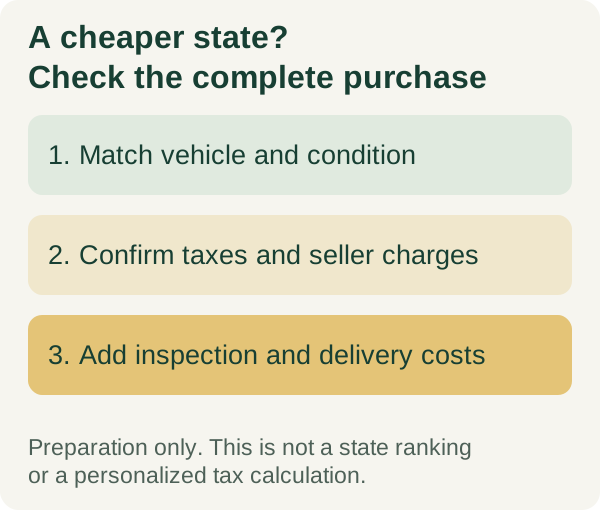
Start with comparable vehicles and written totals for your actual situation. Then calculate whether the distant car's price advantage survives taxes, fees, transport and known repairs. That gives you a decision you can check, rather than a state ranking that may not apply to you.
This guide uses AI-assisted research checked November 19, 2026. CarTruvo operates a vehicle marketplace and has a commercial interest in helping buyers compare vehicles. It does not provide personalized tax advice, arrange transport or certify title eligibility. State examples illustrate official rules, not a nationwide tax calculation or independently reviewed legal opinion.
What does “cheapest” mean for your purchase?
Keep three comparisons separate:
- Lowest asking price: what a seller advertises for a particular vehicle.
- Lowest acquisition total: the vehicle, required charges and costs to inspect, obtain and register it for your situation.
- Lowest cost to own: acquisition cost plus insurance, fuel or charging, maintenance, repairs and eventual resale over your chosen period.
An article can rank states by one measure while you care about another. A low statewide average also cannot tell you whether an individual car has a sound history, acceptable condition or an unusually high dealer fee.
For an initial search, compare the same model year, trim, engine, equipment, mileage range, title history and condition. Record listing dates and seller type. A cheaper rebuilt-title vehicle and a clean-title vehicle are not interchangeable price observations. Use our clean-title guide to understand that label's limits.
Does buying in a no-sales-tax state remove your tax bill?
Do not assume that it does. Your purchase, delivery, use, residence and registration circumstances can affect what is owed and which agency collects it. Ask the relevant state revenue agency and title office about your exact transaction before relying on a tax exemption or credit.
California's official vehicle-use-tax guide says use tax generally applies to vehicles purchased for use in California when California dealer sales tax was not paid, including purchases from out-of-state sellers and private parties, unless an exemption or exclusion applies. Its guidance also describes possible credit for tax paid to another state.
That is a California example, not an instruction for every state. It shows why “the seller's state has no sales tax” is not enough information for a buyer bringing the car home. Do not count the same tax twice if an allowed credit applies, and do not subtract a credit before checking its eligibility and documentation.
Is Oregon automatically the cheapest place to buy?
Oregon's lack of a general sales tax makes it a reasonable state to include in a comparison, but it does not settle the result. The Oregon Department of Revenue explains the distinction between its general tax system and vehicle-specific taxes.
Its vehicle privilege and use tax page describes a one-half-of-one-percent tax on qualifying vehicles and lists the criteria, including dealer status, mileage or origin-document status, weight and prior Oregon titling. Do not apply that tax to every used car or assume every vehicle is exempt. Confirm the applicable rule for the actual purchase.
For a buyer who lives elsewhere, the home-state questions still matter. The same caution applies to online lists promoting New Hampshire, Florida or another state. Without matched vehicle quotes and your own applicable charges, a state name is a search starting point, not a verified saving.
Request a quote that can actually be compared
For each candidate car, ask the seller for a dated itemized quote using the same buyer residence and delivery assumptions. A dealer's advertised price and another dealer's complete quote cover different items unless you reconcile them.
Ask for:
- VIN, vehicle description and confirmation that it is available.
- Vehicle selling price and any financing, trade-in or rebate conditions.
- Dealer documentation, preparation, electronic-filing and other seller charges.
- Optional products identified separately, with their prices.
- Taxes collected, the jurisdiction used and the assumptions behind the estimate.
- Title, registration, inspection, emissions or temporary-permit charges handled by the seller.
- Amount payable to the seller and amounts still payable elsewhere.
- Quote expiration and conditions that could change the total.
For a private sale, confirm the agreed vehicle price and separately establish the buyer's required taxes, transfer documents and registration costs. Do not assign a dealer's process or obligations to an individual seller.
Our dealer documentation-fee guide helps you keep a seller charge separate from government charges. The out-of-state private-purchase guide covers the transfer process after the vehicle comparison.
Add the costs that a seller's quote may leave out
Use the same categories for the local and distant cars:
- Independent inspection and any additional diagnostic work you authorize.
- Travel, lodging, time away from work and a practical backup plan if you decline the car.
- Transport or a lawful drive-home plan, including pickup, insurance and permit arrangements where required.
- Verified title, registration, emissions and tax obligations not already collected.
- Immediate repairs, tires, missing equipment and scheduled maintenance identified for that vehicle.
- Any financing-cost difference, evaluated separately from the vehicle price.
Ask who is responsible for each item and keep included charges from appearing twice. A transport estimate is not a guaranteed delivery contract. Confirm pickup and delivery scope, insurance arrangements, exclusions and payment terms with the provider before committing.
A history report is useful context, but it does not establish the car's present mechanical condition. Use an independent inspection checklist and ask for a written report tied to that VIN. A cheaper car with unresolved condition or ownership questions does not become a bargain merely because shipping is affordable.
Worked example: a $1,500 lower price becomes a higher total
This is an original hypothetical comparison of similar vehicles for one invented buyer. These are not real quotes, state averages, tax rates or transport prices. The combined tax/title/registration estimates are placeholders for this example, not an official calculation.
Local vehicle:
- Vehicle price: $25,000.
- Seller charges: $500.
- Estimated tax, title and registration: $2,000.
- Independent inspection: $200.
- Getting the car home: $0 additional cost assumed.
- Identified immediate repairs: $300.
- Acquisition total: $28,000.
Distant vehicle:
- Vehicle price: $23,500.
- Seller charges: $900.
- Estimated tax, title and registration: $1,900.
- Independent inspection: $250.
- Transport: $1,100.
- Identified immediate repairs: $500.
- Acquisition total: $28,150.
The distant car's advertised price is $1,500 lower, but its assumed acquisition total is $150 higher. Change any real quote or inspection result and you must recalculate. This example excludes loan interest and later ownership expenses; it is a method, not evidence that local purchases always cost less.
How much cheaper does the distant car need to be?
Calculate the extra costs of that route before deciding how far to search. In the example, the distant vehicle has $1,650 more in non-price acquisition costs. Its price would need to be more than $1,650 lower to produce a lower total, assuming all other inputs stay the same.
That is a useful break-even question for your own quotes: “What price advantage do I need just to cover the extra costs?” It is more informative than choosing a search radius from a statewide average.
If an important item is unknown, mark it unknown and obtain the quote or official answer. You can also model a clearly labeled reserve or range, but do not present the result as a confirmed total. Leave enough flexibility to walk away after an inspection rather than treating travel already paid for as a reason to buy a problematic car.
What should you ask the tax and registration offices?
You can prepare this message using the actual facts:
“I live in [state] and plan to buy a [new/used] vehicle from a [dealer/private seller] in [state]. It will be delivered in [state] and used and registered in [state]. Which sales or use taxes, title documents, registration requirements and inspections apply? If the seller collects tax, what documentation and credit rules should I confirm?”
Ask about timing and the specific vehicle's eligibility as well. A title, emissions or registration problem can affect whether the purchase works for you at all. Follow the agency's actual instructions and use truthful ownership and residence information. An address chosen for a lower advertised tax rate does not, by itself, establish eligibility.
Choose a car using a complete, dated comparison
Use the cross-state car-buying worksheet to record two candidate vehicles, seller quotes, official tax answers, inspection findings and delivery arrangements. Its entry cells are blank; it does not calculate personalized taxes or promise a saving.
Keep the vehicle decision separate from the financing offer and the transfer process. Confirm that the lender, if any, accepts the vehicle and seller route before paying for a distant appointment. Verify ownership and payment arrangements before committing.
You can browse CarTruvo vehicles to build a shortlist, then use the same comparison for nearby and out-of-state listings. Choose the specific car and complete terms that fit your needs, with the unknowns resolved before handoff.
BEFORE YOU TAKE THE NEXT STEP
Practical checklist
Check the VIN, ownership record and seller details.
Arrange an independent inspection and review the written terms.
Confirm the total cost and title-transfer process before paying.
CHECK THE DETAILS
Sources and further reading
Follow the source linked beside a claim for its context. For a transaction, confirm current requirements with the relevant agency, lender or provider.
- California's official vehicle-use-tax guidecdtfa.ca.gov
- Oregon Department of Revenue explains the distinctionoregon.gov
- vehicle privilege and use tax pageoregon.gov
YOUR NEXT READ