Buying a car
First-Time Car Buyer Programs: Eligibility, Restrictions and Real Cost
Check first-time buyer program eligibility, seller and vehicle restrictions, required cash and complete loan terms before applying. Includes a free worksheet.
Published
Sources checked . How this guide is prepared.
START HERE
The short answer
A first-time car buyer program is a provider's financing program for applicants who meet its definition of a first-time buyer, often including people with limited borrowing history. The label does not guarantee approval, a low rate or eligibility for every car. Find the actual lender, check its current written requirements and compare its complete offer with other financing you can obtain.
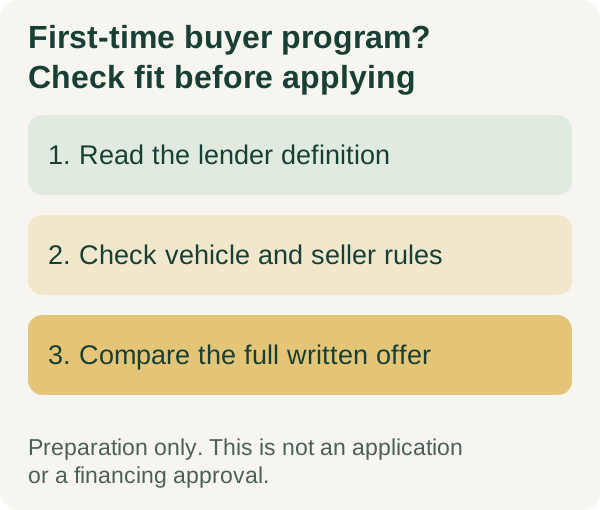
Ask about your purchase route before choosing a car. A program tied to an automaker's dealer network may not fund a private-party purchase. A credit union's direct-loan program may require you to apply with the credit union rather than through a dealership.
This guide uses AI-assisted research checked November 19, 2026. CarTruvo operates a vehicle marketplace and has a commercial interest in helping buyers prepare. It does not offer a first-time buyer loan, decide eligibility or approve financing. Provider examples are research references, not endorsements or an independently reviewed ranking.
Does first-time buyer mean no credit?
Not necessarily. Buying your first car, taking your first auto loan and having no credit history describe different situations. You might have credit-card or student-loan history without ever financing a vehicle. A provider may distinguish that from a report containing missed payments or other adverse information.
Ask how the program defines its target applicant. Do not assume that a loan advertised for limited credit also accepts every form of damaged credit. Likewise, a particular program's score requirement is not a universal minimum across car loans. Our car-buying credit-score guide explains that distinction.
Start with a specific question: “I have [no prior auto loan / limited credit history / another situation]. Does that fit this program's definition, and what would you need to evaluate it?” Share detailed personal records only through the provider's secure process.
Where can you find these programs?
Look at the lender's or automaker finance provider's own website and contact it through an independently verified channel. A dealership page may describe an available route, but you still need to know which lender makes the decision and which offer applies to your actual purchase.
The CFPB explains direct and dealer-arranged auto financing. With dealer-arranged financing, the dealer can submit information to prospective lenders. With direct financing, you work with the lender on its process. Confirm the stage and consent before authorizing an application.
For a credit union, ask about membership eligibility and any geographic or employment connection you need. For an automaker program, check the eligible brand, vehicle condition, dealer participation and current program rules. A search result headed “first-time buyer” is not a substitute for those details.
Three provider examples show why the rules matter
The following pages were checked November 19, 2026. Requirements and availability can change. These examples illustrate differences rather than identify a best loan.
Ford Credit's First-Time Buyer Program lists new and Certified Pre-Owned Ford vehicles. Its published eligibility includes no prior auto credit history, no adverse credit history, at least six months of verifiable current full-time employment, a minimum 620 FICO score and a down payment of $750 or more. Its disclosures say a co-signer or higher down payment may be required under underwriting guidelines. Confirm the complete current terms with the dealer; meeting a short list is not a final approval.
First Commonwealth Federal Credit Union's program lists proof of income, four months at the current employer and no derogatory credit-report information. It states a maximum loan amount of $20,000 including sales tax and tags, requires specified insurance before closing and limits the program to direct credit-union loans. Dealership-submitted applications are not eligible for that program. Ask about membership, the financial-health-check process and the exact vehicle you want.
Reliant Credit Union's program lists an age minimum of 18, twelve months at the current residence, twelve months of full-time year-round employment with income verification, and at least $1,000 down. It also requires the vehicle to be titled and registered in the applicant's name and makes loans subject to approval. Confirm membership and purchase-route eligibility directly.
Do not combine one provider's low down payment, another's maximum amount and a third's promotional rate into an imaginary offer. Keep each program's conditions in its own comparison column.
Check these eligibility questions before applying
Use the program's current disclosures to answer:
- Definition: what counts as a first-time buyer or first auto loan?
- Credit: which history, score model or adverse-record rules apply?
- Income and work: what documentation and employment history are required?
- Residence and membership: which location, tenure or membership conditions apply?
- Cash: how much must you bring, and which costs can be financed?
- Vehicle: which sellers, brands, ages, mileages and title histories qualify?
- Amount: does the lending limit include taxes, registration, fees and selected products?
- Applicant names: is a co-signer or co-borrower allowed or required, and how must title be held?
These are questions to resolve, not a statement that every program requires every item. If the answer is unclear, ask the named lender before committing to that vehicle or paying for travel.
Can a first-time program fund a private-party car?
Check the specific lender. A program advertised at a dealership does not automatically apply to a car sold by an individual. The provider may have a separate private-party loan or may not offer that route at all.
Give the lender the vehicle's year, make, model, mileage, price and seller type. Ask about title brands, existing liens, the funding process and any age or amount restriction. The private-party auto-loan guide covers those transaction questions in more detail.
If the vehicle is outside the program, keep that fact visible in your decision. You can compare another eligible car, another lender or the timing of the purchase. Do not describe a general prequalification as permission to buy a particular private-sale car.
Compare the offer with ordinary financing too
A first-time label explains a program's audience, not its total cost. Request the same written information from each provider you are considering:
- Purchase total and amount financed.
- Down payment and any other cash due before delivery.
- APR, term, payment schedule, finance charge and total payments.
- Optional products selected and their itemized prices.
- Conditions for any promotional discount or later rate change.
- Outstanding verification, vehicle approval and expiration conditions.
The CFPB's offer-comparison guidance explains why amount, APR and term matter beyond the monthly payment. Compare equivalent amounts and terms when evaluating financing cost. Separately decide whether the complete purchase fits your budget.
If a payment is delayed, ask when interest starts accruing, when the first payment is due and how the full schedule changes. Do not assume “no payments for a period” means that period costs nothing. Request the contract's answer instead of calculating from the advertisement alone.
What should you prepare for an application?
Ask the provider for its own document list and secure submission method. You may need to substantiate identity, residence, income, employment, insurance and vehicle details, depending on its requirements. A seller's willingness to accept your offer does not replace the lender's decision.
Before submitting, ask whether this is a rate estimate, prequalification, preapproval or final application; what credit inquiry you are authorizing; who receives the information; and what remains conditional. The names used in advertising do not settle those details.
If a co-signer is proposed, ask the lender to explain each person's responsibility and the loan and title arrangements. Do not treat another person's obligation as a simple eligibility shortcut.
Use a program-fit record to avoid last-minute surprises
Hypothetical example: a buyer finds a $19,500 car and a program advertised with a $20,000 maximum. The buyer cannot conclude that the full purchase qualifies. Taxes, fees, registration and selected products may change the amount needed; the program may also restrict the seller or vehicle. The useful next step is a complete purchase quote and the lender's written answer about what its limit includes.
Use the first-time buyer program worksheet to record each provider's definition, restrictions, required cash, actual offer and unresolved conditions. Mark missing information as unknown. Keep account numbers, full credit reports and identity documents out of the sheet.
Once the financing route is clear, use our seller-question guide and inspection checklist for the car itself. You can browse CarTruvo vehicles to compare suitable listings, then confirm the specific vehicle and seller route with your lender before committing.
BEFORE YOU TAKE THE NEXT STEP
Practical checklist
Check the VIN, ownership record and seller details.
Arrange an independent inspection and review the written terms.
Confirm the total cost and title-transfer process before paying.
CHECK THE DETAILS
Sources and further reading
Follow the source linked beside a claim for its context. For a transaction, confirm current requirements with the relevant agency, lender or provider.
- CFPB explains direct and dealer-arranged auto financingconsumerfinance.gov
- Ford Credit's First-Time Buyer Programford.com
- First Commonwealth Federal Credit Union's programfirstcomcu.org
- Reliant Credit Union's programreliantcu.com
- CFPB's offer-comparison guidanceconsumerfinance.gov
YOUR NEXT READ