Buying a car
Lease or Buy a Car? Compare the Full Cost Over the Same Time
Compare leasing and buying over the same period, including cash due, mileage, payoff and resale. Use a worked example and free planning worksheet.
Published
Sources checked . How this guide is prepared.
START HERE
The short answer
Buy if you want to build ownership, keep the vehicle for a longer period or avoid a lease's mileage restrictions. Consider a lease if a defined period of use fits your plans, its mileage allowance fits your driving and the complete agreement is affordable. Neither route is automatically cheaper. Compare actual offers over the same period, including what you own or owe at the end.
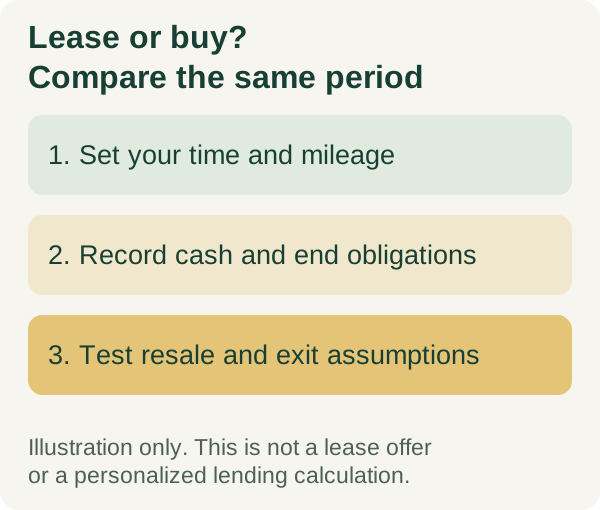
Start with three facts: how long you expect to keep the car, how far you expect to drive and how much cash you can commit without exhausting your repair and emergency budget. A low advertised payment does not answer those questions.
This guide uses AI-assisted research checked November 19, 2026. CarTruvo operates a vehicle marketplace and has a commercial interest in helping people prepare to buy and sell. It is not a lender or lessor. The worked example is an original hypothetical calculation, not a current offer, transaction or independently reviewed financial recommendation.
What changes when you lease instead of buy?
With a purchase, you acquire the vehicle, subject to any lender's interest when you finance it. With a lease, you pay for its use under a contract. The Consumer Financial Protection Bureau's lease-versus-buy explanation describes the differences in ownership, mileage, payments and end-of-term obligations.
Use these distinctions to read the offers:
- Ownership: a completed purchase leaves you with a vehicle. Returning a leased vehicle ends your use of it, subject to the agreement's charges.
- Mileage: a lease specifies its allowance and excess-mileage terms. An owned car has no lease mileage bill, but mileage still affects condition and resale value.
- Condition: a lease can impose return-condition charges. Ownership leaves you responsible for repairs and the effect of condition on what a future buyer will pay.
- Exit: selling a financed vehicle requires resolving the loan and title. Ending a lease early follows the lessor's contract and may be costly.
- Keeping the car: a lease purchase depends on the actual purchase option and its terms. It is a separate decision from returning the vehicle.
For an existing lease, use our leased-car sale and buyout guide. Do not assume you can sell a vehicle owned by the leasing company to any buyer you choose.
When does buying fit better?
Buying deserves a closer look when you expect to keep the car after its loan is repaid, drive unpredictable mileage or want flexibility over its use. The Federal Reserve's ownership comparison explains the ownership and contract distinctions; a financed purchase can still have lender restrictions.
Long ownership is not free ownership. You still need insurance, registration, maintenance and repairs, and the car's value can fall. If you plan to keep a used car for years, compare its condition, inspection findings and expected maintenance with your budget rather than assuming the absence of a lease payment makes every vehicle economical.
A purchase also requires a realistic plan for the down payment and loan. If financing, compare written terms before choosing a price range. Our credit-score guide separates a score label from an actual lender decision.
When can a lease fit your plans?
A lease can fit someone who wants a defined replacement cycle and can reasonably anticipate mileage and use. It deserves extra scrutiny if your commute could change, you might move, your income is uncertain or you may need to end the agreement early.
Before relying on the payment, ask for the full agreement and identify:
- Exact vehicle, negotiated value and lease term.
- Total due at signing, showing which payments and fees it already includes.
- Number of later payments and their amounts.
- Mileage allowance, excess-mile rate and return-condition standards.
- Disposition or return charges and conditions for any waiver.
- Early-termination method and any purchase option, fees and taxes.
A warranty is separate from a lease. Confirm the applicable coverage and exclusions for that vehicle. Do not assume every repair, tire, maintenance visit or return-condition charge is covered merely because the vehicle is newer.
Compare the same time period, not just the payment
Choose a comparison date, such as the end of a 36-month lease. Evaluate both routes at that date. Comparing all 60 payments of a purchase loan with only 36 lease payments can hide the different assets and obligations left over.
For a returned lease, record the nonrefundable cash due at signing, remaining payments during your comparison period and expected return charges. Count a payment included in the signing amount only once. Keep any refundable deposit separate and document the assumptions for its return.
For a purchased car you intend to sell at the comparison date, record the down payment, payments made, dated payoff amount, selling expenses and expected sale proceeds. Subtract the sale proceeds once. Treat a resale estimate as an assumption, not money you are guaranteed to receive.
The CFPB's loan-offer comparison guidance supports comparing amount financed, APR and term alongside the payment. Add ownership expenses to both routes using the same period.
Worked example: a lower lease payment does not settle the comparison
These are invented numbers to demonstrate the method, not a lease advertisement or lending quote. Assume comparable vehicles and a 36-month comparison. The example excludes taxes, registration, insurance, maintenance and fuel from both routes. Real offers need those items added.
Lease assumptions:
- $3,000 total nonrefundable cash at signing, including the first $420 payment.
- Another 35 payments of $420.
- $450 return fee, with no excess-mileage or wear charges assumed.
- Return the car at month 36 and retain no vehicle.
Lease cash cost in this example is $3,000 + (35 × $420) + $450 = $18,150.
Purchase assumptions:
- $30,000 purchase price, $3,000 down and $27,000 financed.
- Fixed 7.5% annual interest, 60 equal monthly payments and no finance fees; APR is assumed to equal 7.5% in this simplified case.
- Monthly payment of about $541.02; 36 payments total about $19,476.89.
- Remaining principal after 36 payments of about $12,022.88, used here as a payoff estimate.
- $19,000 resale proceeds and $500 selling expenses at month 36.
Purchase cost through the assumed sale is $3,000 + $19,476.89 + $12,022.88 + $500 − $19,000 = about $16,000. Calculations use unrounded payments internally; displayed figures and real final payments can differ by rounding. A lender's actual dated payoff may include additional interest or charges.
Now change only the resale assumption to $15,000. The purchase cost becomes about $20,000, above the example's lease cost. That does not predict future values. It shows why the apparent winner depends on assumptions beyond the monthly payment.
What if you plan to keep the purchased car?
A hypothetical sale is a way to compare positions, not an instruction to sell. If you intend to keep the purchased car, show the outstanding debt and estimated vehicle value separately at the comparison date. Also show your cash outflow so far and payments still due.
For a longer comparison, extend both routes. A second lease requires another actual offer and signing costs. Keeping an owned vehicle requires estimates for later maintenance, repairs and resale. Do not repeat today's lease promotion for future years or assume future borrowing will be available at today's terms.
If you might buy the leased car, request a written buyout quote when applicable. Add the purchase-option charges, taxes and any new financing rather than treating the lease payments as a complete purchase price.
Run three stress tests before choosing
Mileage test: estimate normal travel and a realistic higher-use scenario. Use the contract's actual allowance and excess-mile rate. Ask how an early return affects the allowance.
Exit test: ask what happens if you need to change vehicles or end the agreement before the planned date. Request a worked explanation from the provider for your contract instead of assuming a trade-in offer removes the obligation.
Value and repair test: lower the purchase's assumed resale value and add a repair reserve. For the lease, include a plausible return-charge allowance until you understand the standards. Keep uncertain items visible rather than entering zero to make a preferred option win.
Take the same questions to each provider
Ask: “For this exact vehicle and my planned use, can you show total cash due now, every later payment, the comparison-date obligations and what could still change? Which charges are already included, and which depend on mileage, condition, taxes or the final contract?”
Use the lease-or-buy comparison worksheet to keep the assumptions, provider documents and open questions together. It is a blank planning sheet, not a personalized calculator or credit application. Keep account numbers and identity records out of it.
When you have a realistic budget and buying route, browse CarTruvo vehicles and arrange an independent pre-purchase inspection for a used car you are seriously considering. The marketplace listing and the finance or lease agreement answer different parts of the decision.
BEFORE YOU TAKE THE NEXT STEP
Practical checklist
Check the VIN, ownership record and seller details.
Arrange an independent inspection and review the written terms.
Confirm the total cost and title-transfer process before paying.
CHECK THE DETAILS
Sources and further reading
Follow the source linked beside a claim for its context. For a transaction, confirm current requirements with the relevant agency, lender or provider.
- Consumer Financial Protection Bureau's lease-versus-buy explanationconsumerfinance.gov
- Federal Reserve's ownership comparisonfederalreserve.gov
- CFPB's loan-offer comparison guidanceconsumerfinance.gov
YOUR NEXT READ