Inspections & condition
A/C Blowing Warm Air in Your Car: What to Check and Ask a Shop
Separate warm air from weak airflow, understand possible A/C faults, and record the diagnosis, recharge limits and written repair scope before deciding.
Published
Sources checked . How this guide is prepared.
START HERE
The short answer
A car A/C blowing warm air can have several causes, including a refrigerant leak, a condenser or compressor problem, or an electrical or climate-control fault. Warm air alone does not identify which part failed. First distinguish warm airflow from weak airflow, then arrange an appropriate diagnosis.
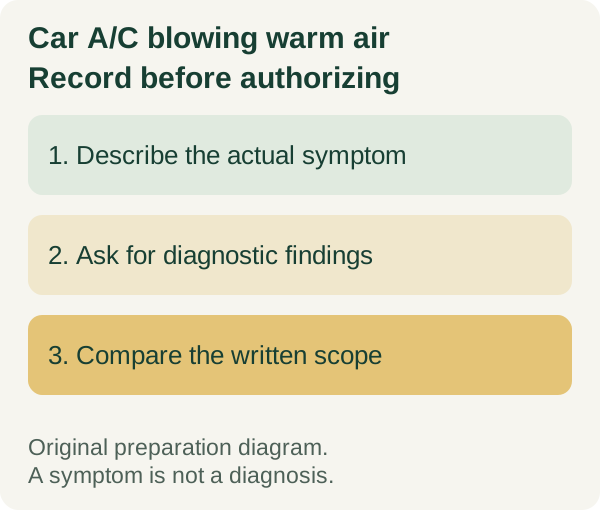
Use this guide to record symptoms and compare the proposed service. It does not provide refrigerant-handling instructions or diagnose a particular vehicle.
Start with the controls and the actual symptom
While safely parked, consult the vehicle’s owner manual and check the selected temperature, A/C mode, fan setting and any separate climate zones. Note what you selected and what happened. Do not perform a prolonged test in an enclosed space or deliberately reproduce an unsafe condition.
Separate these observations in your notes: air is moving but feels warm; very little air is moving; one side feels different; or cooling changes intermittently. Those are descriptions for a technician, not conclusions about a failed component.
If the cabin is becoming unsafe from heat, stop using the vehicle and arrange help. If vehicle warnings appear, follow the owner manual’s response rather than treating them as a routine cabin-comfort issue. A buying decision can wait while a safety or operating concern is assessed.
Possible causes need testing, not a parts guess
Firestone’s A/C explanation discusses refrigerant leaks, blocked or damaged condensers, compressor problems, expansion-valve issues and electrical faults as possible causes of poor cooling. It separately discusses intake or cabin-filter restriction and blower problems when airflow is weak or absent.
These are possibilities, not a diagnosis from vent temperature. A symptom that changes between idle and travel also needs context. Tell the shop what you have already observed; do not perform a special road test simply to force the fault to return.
Ask the technician which finding supports the proposed repair and whether more testing is needed. A quote for a compressor should explain the diagnosis and service scope rather than using “A/C not cold” as the entire finding.
Warm air and weak airflow are different observations
Firestone’s distinction is useful when describing the complaint. A fan that moves substantial warm air is not the same observation as a fan setting that produces little air. Both can still need professional assessment.
Record whether the symptom affects all outlets or a particular side, and whether it is constant or intermittent. If you do not know, write unknown. Do not turn an unmeasured impression into a precise vent-temperature claim.
Keep the conversation practical: “At this setting, I felt strong warm airflow from both sides” gives the shop something to investigate. “It definitely needs refrigerant” asserts a diagnosis that the observation does not establish.
Why a recharge may not resolve the underlying problem
The EPA’s vehicle A/C recharge guidance explains that adding refrigerant or recharging does not permanently fix a refrigerant leak. It also warns that undercharging or overcharging can impair performance and explains how service methods differ.
Ask a qualified shop what the proposed service includes: assessment, any leak investigation, the findings, the appropriate refrigerant and quantity for the vehicle, and what happens if the symptom returns. Get an itemized written scope before authorizing work.
A refrigerant charge and a repaired leak are separate entries in the service record. Do not assume an invoice that says recharge establishes that a leak was found and repaired. Equally, this guide does not say every warm-air complaint is a leak.
This is a service-quality question, not a claim that federal law requires a leak repair before every recharge. EPA’s page explicitly distinguishes those issues. Leave refrigerant selection, recovery, equipment and system work to an appropriately qualified service provider.
Compare the written diagnosis with the written quote
Before agreeing, ask the shop to separate four things: the reported symptom, the observed findings, the recommended work and any remaining uncertainty. Record which parts and services are included and what the price assumes.
Ask whether the amount is for diagnosis only, a particular service or a defined repair. Have the shop explain additional authorization, warranty terms and the next step if further faults are found. This guide does not provide a national repair price or declare one quote reasonable without the vehicle and scope.
For a useful second opinion, provide the same symptom record and available findings. Two prices for different jobs are not a meaningful comparison until you understand the difference in scope.
Buying a used car with recently recharged A/C
Imagine a seller says the system was recharged last week and it feels cold during your visit. This is an invented buying example, not a CarTruvo vehicle inspection or a claim about a real seller.
Ask for the available service invoice and what it actually records. Was the complaint assessed? Was any fault identified? What work was performed, and what remained unresolved? Cold air during one observation does not establish how the system will perform later.
Arrange a suitable independent inspection before committing when the condition matters to your decision. The used-car inspection checklist helps organize the wider inspection; ask the inspector specifically what A/C assessment is included and what its limits are.
If you are selling, describe the known symptom and documented work accurately. Keep “recently recharged,” “a leak was repaired” and “no known current cooling complaint” separate, and use only descriptions you can support. Do not promise a fully repaired system from a temporary improvement alone.
Download the A/C symptom and service worksheet
Use the blank car A/C symptom worksheet for sixteen vehicle, setting, airflow, service-history and follow-up questions. Share relevant records with the shop or inspector, leaving sensitive personal information out of public listing images.
Start with what you observed, obtain the findings and compare the actual proposed work. Keeping those stages separate helps you ask a better repair or purchase question without buying a part on a guess.
Source check: November 21, 2026. No A/C performance test, refrigerant service, vehicle diagnosis, repair estimate or independent mechanic review was performed for this guide.
BEFORE YOU TAKE THE NEXT STEP
Practical checklist
Check the VIN, ownership record and seller details.
Arrange an independent inspection and review the written terms.
Confirm the total cost and title-transfer process before paying.
CHECK THE DETAILS
Sources and further reading
Follow the source linked beside a claim for its context. For a transaction, confirm current requirements with the relevant agency, lender or provider.
- Firestone’s A/C explanationfirestonecompleteautocare.com
- The EPA’s vehicle A/C recharge guidanceepa.gov
YOUR NEXT READ
Keep reading