Inspections & condition
Car Won’t Crank: Separate the Symptom From the Repair
Distinguish no crank from slow crank or crank-but-no-start, check normal starting requirements, and record the evidence before approving a repair.
Published
Sources checked . How this guide is prepared.
START HERE
The short answer
A car that won’t crank does not turn its engine over when you request a start. That differs from an engine that turns over but fails to run. First describe which situation you have, then check the normal starting instructions and arrange appropriate assistance. Working lights do not, by themselves, establish that the battery and starting circuit can crank the engine.
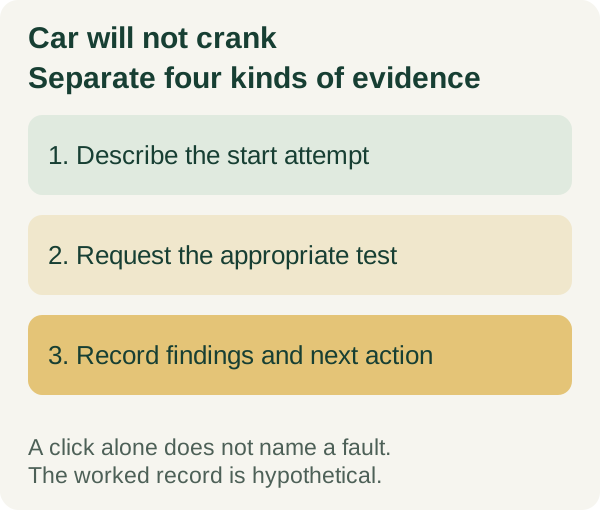
Do not repeatedly try the starter, bypass a safety interlock or replace a part solely because of a click. A useful first report describes what happened and what has actually been tested.
No crank, slow crank or crank but no start?
Listen only during an ordinary start attempt made according to the owner’s manual. You do not need repeated attempts to build a detailed recording. Write down the best description you already have:
- No crank: the engine does not turn over; there may be silence or a click.
- Slow crank: the engine turns over more slowly than expected.
- Crank but no start: the engine turns over but does not begin running.
AAA’s starting-problem guide describes the starter’s role and several possible electrical, key and starting-system problems. Its examples are reasons to seek testing, not a diagnosis of the car in front of you.
When calling a shop, use the behavior rather than only “it won’t start.” If you cannot tell whether the engine turned, say that. A technician can help distinguish the descriptions without requiring you to reproduce the fault beside a busy road.
Check the normal starting conditions
Secure the vehicle and follow its actual manual for the parking brake, transmission position, brake or clutch pedal and key recognition. Read any dashboard message. Do not force a key, bridge electrical terminals or defeat the vehicle’s starting requirements.
Ford’s 2025 F-150 manual example lists insufficient battery charge, transmission or pedal conditions and a temporary starting-system disablement among reasons for no crank. Those instructions apply to the identified vehicle configuration. They do not establish the controls or retry timing for every car.
If a message says no key is detected, locate the model’s documented backup-key procedure rather than trying an internet shortcut. If the normal controls are satisfied and it still will not crank, report that result to assistance. Record what you checked without declaring the underlying system healthy.
What do clicking and dashboard lights prove?
They are observations to report. AAA describes battery, starter and ignition-related possibilities, but the sound alone does not settle which component needs replacement. Record silence, one click or repeated clicking as accurately as you can, along with whether the lights changed during the attempt.
For battery condition, ask for the actual test result and what it establishes. A battery-age estimate and a successful radio test are different evidence from a starting-system assessment. The battery-life guide explains age, records and testing as a separate ownership question.
Avoid buying a starter because someone heard a click over the phone. Ask the technician what battery, connection, control or starter findings support the recommended repair and what could not be checked.
When should you request assistance?
Request help when the car cannot start normally or the location makes further checking unsafe. AAA specifically warns against jump-starting a swollen battery and describes a sulfur-like odor as a concern. Report visible battery damage or unusual odors to the assistance provider and keep away from the affected area.
If a jump is proposed, use the actual vehicle’s instructions and appropriate trained help. A generic cable sequence can be wrong for the model. This guide does not provide jump-start wiring, battery-handling instructions or high-voltage procedures.
Tell the provider the year, make, model, location and symptoms, plus any warnings and previous work you know about. Ask what roadside assessment is available and how a tow would be arranged if the problem remains unresolved. Charges and coverage depend on the provider and your arrangement; obtain the applicable terms.
Use a four-column evidence record
Our original record separates observation, test, finding and next step. This avoids turning an assumption into a repair history.
Here is a hypothetical example. The observation is “dash illuminated, one click, engine did not turn.” The test entry is “technician’s starting-system test report requested.” The finding is “unknown until the report is supplied.” The next step is “approve the agreed diagnostic scope and review the result before parts replacement.”
An incomplete finding is not a failed template. It identifies exactly what information is missing. If a technician later documents a battery fault, add the report and date rather than rewriting the original observation as though you knew the cause at the start.
What if the car starts after a jump?
Record who performed the jump and what happened afterward, then ask what follow-up testing is needed. The immediate successful start does not document every possible cause of the original problem or explain why available charge was low.
Request the actual findings, recommended action and any limitation in the roadside test. Keep receipts for parts and labor separate from the diagnostic explanation. If the concern recurs, the earlier conditions and test record can help the next technician assess the sequence.
Buying or selling a car that won’t crank
For buyers, ask to see the documented diagnosis and arrange an independent assessment. Keep transport, diagnosis and repair assumptions visible in your budget. A seller’s inexpensive battery explanation should remain an unverified claim until supported.
Use the used-car inspection checklist for the wider purchase. Sellers can use the separate electrical-problem selling guide or non-running-car selling guide once the actual condition and options are known.
Download the no-crank evidence worksheet
The blank car-won’t-crank observation and diagnosis worksheet records sixteen symptom, normal-control, test, authorization and repair questions. Complete it from safe observations and supplied records.
Source check: November 21, 2026. No battery test, vehicle diagnosis, jump-start, repair quote or independent mechanic review was performed for this guide. The worked record is hypothetical, and the Ford example is model-specific.
BEFORE YOU TAKE THE NEXT STEP
Practical checklist
Check the VIN, ownership record and seller details.
Arrange an independent inspection and review the written terms.
Confirm the total cost and title-transfer process before paying.
CHECK THE DETAILS
Sources and further reading
Follow the source linked beside a claim for its context. For a transaction, confirm current requirements with the relevant agency, lender or provider.
- AAA’s starting-problem guideaaa.com
- Ford’s 2025 F-150 manual examplefordservicecontent.com
YOUR NEXT READ
Keep reading