Inspections & condition
Car Overheating: Stop Safely and Get the Cause Checked
Stop safely when your car overheats, record the warning and conditions, and compare diagnostic findings and repair scopes before authorizing work.
Published
Sources checked . How this guide is prepared.
START HERE
The short answer
If your car shows an overheating warning, a temperature gauge in the hot zone or steam from the engine area, pull over when it is safe, switch off the engine and request roadside help. Do not keep driving to see whether the warning disappears. Keep clear of hot coolant and steam, and do not open a hot cooling-system cap.
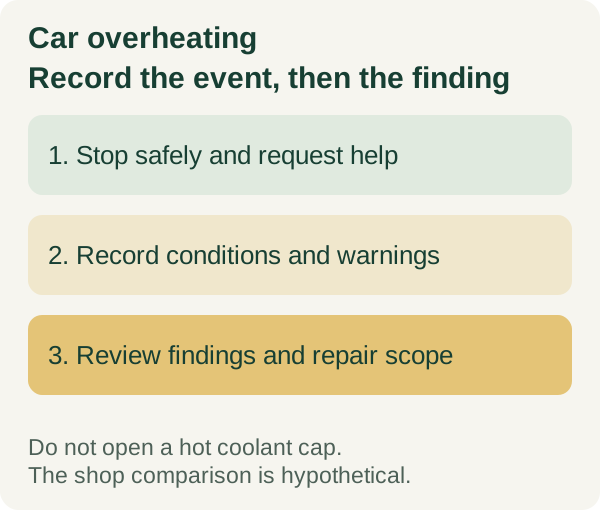
Once everyone is safe, the useful next step is a clear incident record and a diagnosis. A warning tells you something needs attention; it does not identify the failed part or establish the repair price.
What should you do immediately?
AAA’s overheating guidance recommends stopping safely, shutting off the engine and calling for assistance. It warns against adding coolant and continuing the journey because of burn and engine-damage risks.
Give the assistance provider your location and describe any steam, warning or loss of power. Follow emergency responders’ instructions if the car is in a dangerous position. Do not enter traffic or approach the engine to improve a photograph. Report smoke or a suspected fire as an emergency rather than investigating it yourself.
A fixed waiting period does not prove the cooling system is safe to open. Leave cap removal, leak checks and restart decisions to the appropriate assistance provider or technician, using the actual vehicle’s instructions.
Why can a car overheat?
AAA identifies several possible areas: coolant loss or mixture problems, thermostat faults, radiator or hose problems, failed fans, water-pump or relevant belt problems, head-gasket faults and insufficient oil. The applicable components and drive arrangements vary by vehicle.
Ask the shop which finding supports its conclusion. “It got hot” and “it needs a water pump” are different statements. Keep the observed symptom separate from the proposed cause until testing connects them.
For example, an incident occurring in traffic is a condition to report, not proof that the fan failed. A visible puddle is a location and appearance to describe, not a fluid identification made safely from the driver’s seat. You do not need to solve those questions beside the road.
Record the event in three stages
Use an original three-stage record: before the warning, at the warning and after stopping. Complete it from memory once you are safe. Leave uncertain details marked unknown.
Before the warning, record the route, weather, traffic, approximate trip length and any recent cooling-system work. At the warning, record the exact dashboard message or gauge position, any loss of power and what you noticed about steam or odor. After stopping, record when you switched off, whether assistance attended, how the car moved to the shop and any later restart performed by a technician.
This sequence gives the shop context without inventing a temperature or duration. If you do not know how long the gauge was high, write “duration unknown.” A guessed number can make the record look more precise than the evidence.
Ask for a diagnosis and a separate repair scope
Request a written explanation with four parts: the complaint the shop received, the checks it completed, the fault it found and the proposed work. Ask what remains uncertain and whether additional inspection is needed to assess damage from the incident.
Keep the diagnostic authorization separate from permission for further repairs. Before agreeing, ask about the diagnostic charge, what it includes, the point at which the shop will contact you and the total you are authorizing. If the scope changes after inspection, ask for an updated explanation and estimate.
A second estimate is useful only when it addresses comparable work. Compare identified faults, parts, labor, fluids, additional tests and the plan for checking the result. A shorter list with a lower total may leave different work unresolved.
An original comparison of two shop proposals
Imagine two hypothetical proposals without assigned prices. Shop A proposes repairing an identified hose leak, replacing the specified coolant and checking for further leaks and abnormal temperature afterward. Shop B proposes replacing several cooling-system parts but has not documented the test findings.
That example does not establish which repair your car needs or which shop is better. It shows why the next question matters: “Which findings support each item, and what remains unconfirmed?” A documented narrow repair and a broad untested proposal cannot be compared by their totals alone.
Add the answers to your record before deciding. If the shop cannot reproduce the concern, ask it to state that limitation rather than treating an uneventful visit as proof that the problem is resolved.
Buying or selling after an overheating incident
For a purchase, request the incident history, repair invoice and subsequent findings. Arrange an independent inspection that addresses the reported concern before committing to a test drive or purchase. A seller saying it “only needed coolant” does not replace those records.
The used-car inspection checklist helps organize the broader assessment. If an actual diagnosis identifies a head-gasket problem and you are considering selling, the separate head-gasket selling guide addresses that decision.
For a sale, describe known symptoms and documented repairs accurately. Avoid calling the vehicle fixed, roadworthy or free of damage when the available evidence does not establish that. Compare the repair scope with your selling options using the repair-before-selling guide.
Reduce the chance of another incident
AAA recommends following the manufacturer’s maintenance schedule and checking the relevant fluids. Have the shop identify the correct coolant specification, inspection procedure and service interval for the actual car. Keep dated invoices and note any recurrence instead of relying on a generic maintenance interval.
Download the overheating incident worksheet
Use the blank car-overheating incident and shop-comparison worksheet to organize the event, findings, authorization and follow-up. It is an original record template, not a diagnostic test.
Source check: November 21, 2026. No vehicle inspection, temperature test, repair quote or independent mechanic review was performed for this guide. The hypothetical shop comparison describes a way to assess evidence, not a recommended repair.
BEFORE YOU TAKE THE NEXT STEP
Practical checklist
Check the VIN, ownership record and seller details.
Arrange an independent inspection and review the written terms.
Confirm the total cost and title-transfer process before paying.
CHECK THE DETAILS
Sources and further reading
Follow the source linked beside a claim for its context. For a transaction, confirm current requirements with the relevant agency, lender or provider.
- AAA’s overheating guidanceaaa.com
YOUR NEXT READ
Keep reading