Inspections & condition
Car Stereo Repair: Compare Diagnosis, Repair and Replacement Costs
Compare a car stereo diagnosis, mail-in repair and compatible replacement using complete costs, retained features, programming, warranty and downtime.
Published
Sources checked . How this guide is prepared.
START HERE
The short answer
Before paying for car stereo repair, identify the actual unit and symptom, obtain diagnostic findings and compare the complete repair cost with a compatible replacement. No sound, a failed display and a problem limited to one input are different complaints. The symptom alone does not prove the radio itself has failed.
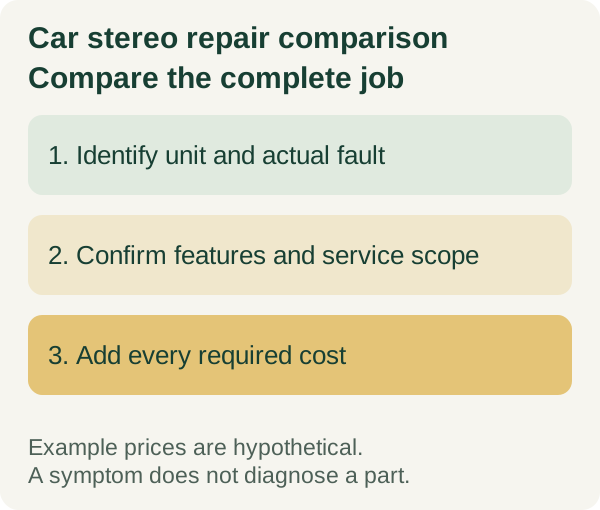
A useful estimate separates diagnosis, the proposed work, removal and installation, any programming and the functions that will work afterward. CarTruvo does not repair radios or arrange the service; this guide helps you compare independent providers and assess a used car.
Describe the problem before naming a failed part
While safely parked, use the owner manual to check ordinary audio settings and the selected source. Record what happens with the controls and inputs you actually use. Keep phone pairing, a particular media source, a display problem and loss of sound as separate observations.
M&R Electronics’ radio-repair page lists varied complaints involving displays, inputs, reception and missing or intermittent audio. The range of symptoms is a reason to describe the actual problem precisely, not evidence that every similar complaint needs the same component.
Ask a qualified technician to assess the car when the fault is unclear. A mail-in service needs the correct component and an appropriate fault description. Removing a radio before establishing the problem may leave the rest of the system unassessed.
Identify the factory or aftermarket system
Record the car’s year, model and fitted audio equipment, plus the unit’s model or part number when safely available in existing documents or an accessible label. Have a technician obtain information that requires removal or disassembly.
Ask the provider whether it handles that exact unit and reported fault. A listing for a similar dashboard or model year is not enough to establish compatibility. Tell it about known prior modifications and provide relevant service records.
If the problem appeared after battery work, a software change or an earlier installation, record that sequence without calling it the cause. Follow the manufacturer’s instructions for security or software issues rather than using a generic reset or code-bypass procedure.
Local diagnosis and mail-in repair cover different work
M&R describes bench testing after receiving a radio and providing an estimate for repair or exchange. It also notes that some exchanged units may require dealer programming. Confirm the actual process for your part before removal or shipment.
CBoardRepair’s radio collection illustrates model- and symptom-specific mail-in services. Its advertised turnaround is measured after arrival and excludes shipping time. A service listing is a starting point for confirming scope, not proof it applies to every unit with no sound.
Ask who is responsible for diagnosis in the vehicle, removal, packaging, shipping, repair authorization, programming and reinstallation. Get the no-fault-found policy, return charges and warranty terms in writing. Keep total downtime separate from the provider’s bench-service period.
Replacement must preserve the functions you need
Crutchfield’s stereo FAQ explains that vehicle-specific fit, wiring interfaces and adapters can matter. It discusses steering-wheel controls, factory options, warning tones and factory-amplifier integration as compatibility questions.
Ask the installer to list which existing functions will remain and which will change with the proposed replacement. Include the functions present in your actual car, such as audio controls, phone integration, camera display or settings accessed through the screen. Have the installer verify compatibility instead of assuming every feature can be retained.
A replacement receiver’s purchase price is only one line of the estimate. Request the mounting parts, interfaces, labor, setup and any programming needed for the agreed result. Keep an unresolved feature on the worksheet until the provider answers it.
An original complete-cost comparison
Imagine these two offers, with the diagnosis already established and the same required functions assumed to work afterward:
- Repair: $220 bench service, $90 removal and reinstallation, and $30 total shipping. Complete assumed cost: $340.
- Replacement: $200 receiver, $85 interfaces and mounting parts, $110 installation and $45 setup. Complete assumed cost: $440.
The replacement receiver is $20 cheaper than the bench service headline, but the complete replacement is $100 more than the complete repair. These are invented figures, not provider prices, national averages or a real quote.
The arithmetic does not choose the better option. Warranty terms, remaining uncertainty, condition, feature compatibility and downtime still need comparison. If a necessary charge is missing, mark the total incomplete rather than treating it as zero.
Ask for findings and authorization limits
Have the provider distinguish the reported symptom from its actual findings. Request the proposed repair or replacement scope and what is still uncertain. If further testing could change the price, ask when it will contact you for additional authorization.
Compare whether each offer repairs your original unit, supplies an exchange unit, installs a used replacement or installs new equipment. Ask about the source and condition of replacement parts, any core-return condition and warranty responsibility.
Keep the written estimate and final invoice together. An invoice should show what was done; it does not establish that every unrelated electrical concern in the vehicle has been investigated.
Buying or selling a car with an audio fault
For a used-car purchase, ask the inspector what audio and infotainment checks are included. The used-car inspection checklist organizes the broader condition review. Record any function that could not be assessed rather than treating a working screen as proof of a fully working system.
If a seller says the fault is a cheap radio replacement, ask for the findings and complete scope supporting that statement. Use your own inspection and written estimates to understand the unresolved work before agreeing to a price.
For an owner preparing a sale, the electrical-problem selling guide addresses accurate disclosure and sale planning. Describe the known audio symptom and documented repairs; avoid promising an easy fix you have not verified.
Download the stereo repair comparison worksheet
The blank car stereo repair worksheet records sixteen identification, diagnostic, feature, price and service questions. Use one copy per proposal and retain the provider’s answers beside each relevant item.
Source check: November 21, 2026. Provider pages illustrate their own processes; verify current unit-specific terms directly. No radio was removed, tested, repaired or priced for this guide, and no independent technician review is claimed.
BEFORE YOU TAKE THE NEXT STEP
Practical checklist
Check the VIN, ownership record and seller details.
Arrange an independent inspection and review the written terms.
Confirm the total cost and title-transfer process before paying.
CHECK THE DETAILS
Sources and further reading
Follow the source linked beside a claim for its context. For a transaction, confirm current requirements with the relevant agency, lender or provider.
- M&R Electronics’ radio-repair pagemnrelectronics.com
- CBoardRepair’s radio collectioncboardrepair.com
- Crutchfield’s stereo FAQcrutchfield.com
YOUR NEXT READ
Keep reading