Buying a car
Car Transport Quote: Compare the Total, Deposit and Service Terms
Compare car transport quotes using matching shipment details, complete totals, deposit treatment, scheduling commitments and carrier information. Includes a blank worksheet.
Published
Sources checked . How this guide is prepared.
START HERE
The short answer
A useful car transport quote identifies the vehicle, route, service, timing assumptions, complete price and payment terms. Give each provider the same information and ask what is estimated, what is committed and what can change before comparing the offers.
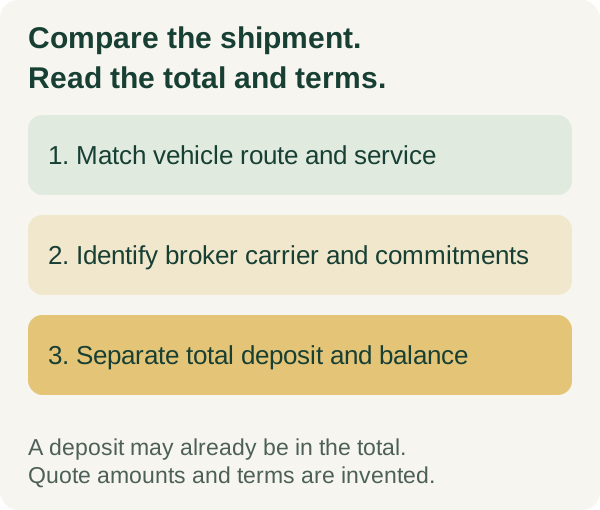
This guide helps compare independently obtained quotes. CarTruvo does not book the shipment or hold your transport payment in escrow. For the wider purchase process, use the online car buying and delivery guide.
Make the request identical for every provider
Write one shipment description before collecting prices. Include pickup and destination areas, the actual vehicle, the earliest ready date and any meaningful scheduling limits. Disclose the vehicle’s operating condition and relevant modifications rather than assuming every car can be loaded the same way.
Ask the provider what it needs to know about starting, steering, braking, rolling, clearance, dimensions and access at each location. Have it identify any special equipment or alternate handoff location required for this actual shipment.
Keep open or enclosed service, pickup flexibility and location assumptions consistent. If an offer changes one of those inputs, mark it as a different service until the provider confirms a matching specification. Do not treat a low estimate for a different shipment as a cheaper offer for yours.
Identify the broker and the actual carrier
FMCSA’s automobile-transporter advisory distinguishes a broker arranging transportation from a transporter moving the vehicle. It calls for checking interstate providers’ registration and being cautious when the business’s role is unclear.
Ask which company is contracting with you, who receives the payment and which carrier will actually move the car. If the carrier has not been assigned, record when its identity will be supplied and which terms depend on assignment. A broker’s name is not automatically the name of the hauling company.
Confirm the actual business and relevant authority through current official information. Resolve a mismatch in legal name, identifiers, contact details or role before authorizing the shipment. A logo, testimonial or emailed certificate is not an independent check.
Use current agency guidance for registration checks
Older screening articles can contain outdated lookup instructions. FMCSA’s registration-status FAQs include a May 2026 warning that legacy Licensing and Insurance records are historical and do not reflect Motus filings. The same collection retains older search directions, making dates and context important.
Start with the agency’s current registration and status guidance and ask FMCSA to resolve an unclear or conflicting record. Do not treat a historical result or a screenshot forwarded by a company as conclusive current authority evidence.
This guide does not verify any particular provider or promise that registration guarantees performance. Identity, authority, shipment terms and applicable coverage are separate questions to resolve for the actual companies involved.
Separate a first available date from a guaranteed pickup
Record the earliest date the vehicle is ready, the quoted pickup window and any delivery estimate separately. Ask what, if anything, is guaranteed and what the written terms provide if timing changes.
For example, Sherpa’s quote form describes its first available pickup date as the date the vehicle is ready for collection. That field is not, by itself, a universal promise that a driver arrives on that date. Read the actual provider’s scheduling and commitment terms.
If a delay would create storage, travel or other costs, discuss those consequences before booking. Do not assume an estimated transit period also includes the wait for pickup or that every provider includes the same remedy for a missed window.
Build the complete price before comparing
Ask for the total charge for the stated shipment, with any extra items identified. Clarify the treatment of non-operating condition, special loading, access changes, storage, additional services, taxes where applicable and other possible charges for your specific request.
Ask whether the stated amount is an estimate, a committed price under defined conditions or something else. Record its validity period and the conditions that permit a change. A price-lock headline should be read with its actual contract terms rather than extended to every possible change in the shipment.
Obtain an explanation of cancellation, rescheduling and refund terms before paying. Keep a quote, booking confirmation, carrier-assignment notice and final payment instructions as separate records. Do not assume they all establish the same commitment.
An original quote and deposit comparison
Imagine two offers for a matching shipment of a disclosed non-operating car. These amounts and terms are invented, not real carrier offers or current market rates.
- Quote A totals $900, including a $150 deposit and a $750 remaining balance.
- Quote B advertises $820, then adds a disclosed $125 loading charge for this car. Total: $945, including a $100 deposit and an $845 remaining balance.
- A is $45 lower overall despite an $80 higher headline price.
The deposits in this example are part of each total. Adding them again would incorrectly produce $1,050 for A or $1,045 for B. In another actual contract, a booking charge could be additional; read the terms instead of assuming the example’s treatment applies.
This arithmetic excludes other unknown charges and does not compare service quality, coverage or scheduling. Replace every amount and assumption with the written offers. Record who receives each payment, when it becomes due and how any cancellation changes the amount owed.
Ask what covers damage to this car
Request the actual carrier information and an explanation of the coverage applicable to the shipment. Ask about limits, exclusions, deductibles, valuation, existing damage, personal items and any other conditions relevant to your vehicle and service.
Do not assume a broker’s registration or financial-security statement answers the cargo-damage coverage question. Ask the responsible provider and insurer to clarify the actual documents and who handles a claim. Keep the explanation with the shipment terms.
Request the condition-record and claims procedures before pickup, including the responsible contacts and applicable deadlines. An acknowledgment at delivery, a condition inspection and a mechanical inspection serve different purposes. Use the pre-purchase inspection guide for the separate vehicle-condition decision before buying.
Confirm the handoff before releasing the vehicle
Make sure the authorized pickup and delivery contacts understand the agreed locations, timing, keys and paperwork. Resolve a change in carrier, price or payment recipient through independently verified contacts before acting on new instructions.
Keep the vehicle purchase and title arrangements separate from the transport booking. A driver arriving does not establish that the sale’s ownership or payment conditions have been satisfied. The out-of-state guides for a private seller or a dealer cover that wider transaction preparation.
This article does not provide one national shipping price, a provider ranking or a guaranteed delivery date. It gives you a consistent way to understand and compare the actual offers you receive.
Download the transport quote worksheet
Use the blank car transport quote worksheet for sixteen shipment, counterparty, commitment, payment and coverage checks. Compare matching inputs and leave missing answers visible.
Choose after the complete price and responsibilities are understood. A clear record of what is promised, by whom and under which conditions is more useful than a low number that describes a different shipment.
Source check: November 21, 2026. FMCSA’s 2015 advisory is used for role and screening principles; current registration guidance is checked separately. Sherpa’s form is a named example, not an endorsement. No shipment, provider verification, insurance decision or actual transport quote was performed for this guide.
BEFORE YOU TAKE THE NEXT STEP
Practical checklist
Check the VIN, ownership record and seller details.
Arrange an independent inspection and review the written terms.
Confirm the total cost and title-transfer process before paying.
CHECK THE DETAILS
Sources and further reading
Follow the source linked beside a claim for its context. For a transaction, confirm current requirements with the relevant agency, lender or provider.
- FMCSA’s automobile-transporter advisoryfmcsa.dot.gov
- FMCSA’s registration-status FAQsfmcsa.dot.gov
- Sherpa’s quote formsherpaautotransport.com
YOUR NEXT READ