Buying a car
Does Car A/C Use Gas? Fuel Use, MPG and a Clear Cost Example
Understand how A/C can affect fuel use, why a 25% MPG drop means more than 25% extra gallons, and how to compare cooling costs over the same distance.
Published
Sources checked . How this guide is prepared.
START HERE
The short answer
Yes. Running the A/C in a gasoline car can increase fuel consumption. The amount varies with the vehicle, weather, trip and settings, so there is no single fuel penalty that applies to every car. Electric vehicles use energy for cooling too, even though they do not burn gasoline to drive.
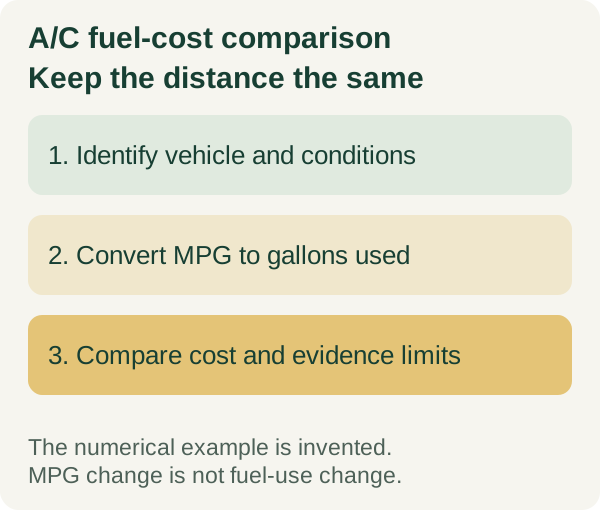
For a useful cost comparison, keep the distance fixed and calculate the fuel or electricity needed for that distance. A percentage change in miles per gallon is not the same percentage change in gallons consumed.
Why air conditioning can increase fuel use
Natural Resources Canada’s fuel-efficiency guidance explains that A/C adds an engine load and that the actual load depends on conditions such as cabin size and outside temperature. System design varies; follow the actual vehicle’s manual when interpreting climate controls.
Do not confuse the gasoline used to power the vehicle with refrigerant service. A fuel-cost question and a cooling-system fault need different evidence. If the vents are blowing warm air, use the separate A/C symptom and service guide rather than assuming a normal fuel penalty explains the problem.
How much can A/C affect MPG?
FuelEconomy.gov’s hot-weather guidance, administered for DOE and EPA, says that very hot conditions can produce a fuel-economy reduction greater than 25% in a conventional vehicle, particularly on short trips. It identifies temperature, humidity and sunlight as relevant factors.
That is a conditional example, not the expected penalty for every trip or a fixed maximum. A short drive in a heat-soaked cabin and a longer drive after the cabin cools should not be assigned an identical percentage without evidence.
Keep any claim about fuel economy tied to its baseline and conditions. A salesperson saying “A/C only uses a little gas” has not provided a measured cost for your intended route, and a dramatic percentage found online does not establish your own result either.
An original example: a 25% MPG drop uses 33% more fuel
Imagine a car is assumed to achieve 40 MPG in one scenario and 30 MPG in another over the same 100 miles. The 10-MPG difference is a 25% reduction from 40 MPG. These are invented comparison inputs, not an A/C test or a claim about any particular vehicle.
Calculate fuel for the same distance:
- At 40 MPG: 100 divided by 40 equals 2.5 gallons.
- At 30 MPG: 100 divided by 30 equals about 3.33 gallons.
- Difference: about 0.83 gallon, roughly 33.3% more than 2.5 gallons.
At an assumed $3.60 per gallon, those modeled fuel costs are $9 and $12, a $3 difference over 100 miles. The arithmetic explains the units; it does not predict your A/C cost or attribute an observed change to A/C alone.
Use this same-distance method when comparing actual information. Record the distance, measured or assumed economy, units and fuel price so another person can follow the calculation.
Are open windows always cheaper than A/C?
No universal rule establishes that. FuelEconomy.gov explains that open windows increase aerodynamic drag and that the effect grows at highway speeds. Its practical guidance favors open windows at lower speeds and A/C at highway speeds, subject to actual conditions.
Use safe, comfortable settings and follow the manual. Do not turn off needed cooling or window-clearing functions to perform a fuel experiment. Cabin comfort and clear visibility matter to driving; an MPG comparison should not create a distraction or unsafe situation.
NRCan’s guidance also recommends shade and letting hot air escape at the start. Use the vehicle’s manual to choose appropriate settings, including recirculation where suitable, while preserving clear windows.
What about hybrids, plug-in hybrids and EVs?
FuelEconomy.gov notes that cooling can have a larger percentage effect on the efficiency of electrified vehicles. For plug-in vehicles, it describes pre-cooling while connected to a charger as a way to preserve driving range.
Follow the actual model’s instructions for preconditioning and charging. It can shift when and where energy is used; it does not make cooling energy free. Use the vehicle’s relevant electricity and fuel records rather than converting a gasoline example into a universal EV range figure.
When buying a used EV, separate the charging arrangement from battery condition and climate-system operation. The used electric car buying guide helps organize that wider assessment. An assumed A/C range effect does not diagnose a degraded battery or a cooling fault.
Keep the other fuel-economy factors visible
FuelEconomy.gov’s broader MPG guidance identifies driving behavior, idling, speed, terrain, load, weather and maintenance as influences. A before-and-after dashboard reading can change for several reasons at once.
For a purchase comparison, start with the exact vehicle configuration and relevant published information. Record your intended driving pattern and the limits of any available real-world evidence. If you log fuel use, do it through ordinary trips and records rather than manipulating controls while driving or provoking a fault.
If a car’s fuel use or cooling behavior raises a concern, request appropriate inspection findings. Keep an observation, a budgeting assumption and a technician’s diagnosis as separate entries.
Download the A/C fuel-cost worksheet
The blank A/C fuel-use comparison worksheet records sixteen vehicle, condition, unit, distance and cost questions. Mark invented assumptions clearly and leave unknown causes unresolved.
Source check: November 21, 2026. The numbers in the worked example are hypothetical. No fuel-economy test, vehicle inspection, refrigeration diagnosis or independent engineering review was performed for this guide.
BEFORE YOU TAKE THE NEXT STEP
Practical checklist
Check the VIN, ownership record and seller details.
Arrange an independent inspection and review the written terms.
Confirm the total cost and title-transfer process before paying.
CHECK THE DETAILS
Sources and further reading
Follow the source linked beside a claim for its context. For a transaction, confirm current requirements with the relevant agency, lender or provider.
- Natural Resources Canada’s fuel-efficiency guidanceprod-natural-resources.azure.cloud.nrcan-rncan.gc.ca
- FuelEconomy.gov’s hot-weather guidancefueleconomy.gov
- FuelEconomy.gov’s broader MPG guidancefueleconomy.gov
YOUR NEXT READ