Buying a car
Electric Car Charger Electrical Requirements: Choose for Your Car and Home
Match a home EV charger to your car, electrical assessment and parking routine. Compare compatibility, installation scope and complete cost before buying.
Published
Sources checked . How this guide is prepared.
START HERE
The short answer
Choose a home electric car charger by matching three things: the vehicle’s charging capability, an electrician’s assessment of the parking location and electrical supply, and how much charging you need during the time the car is parked. A higher advertised output is useful only when the vehicle and installation can support it.
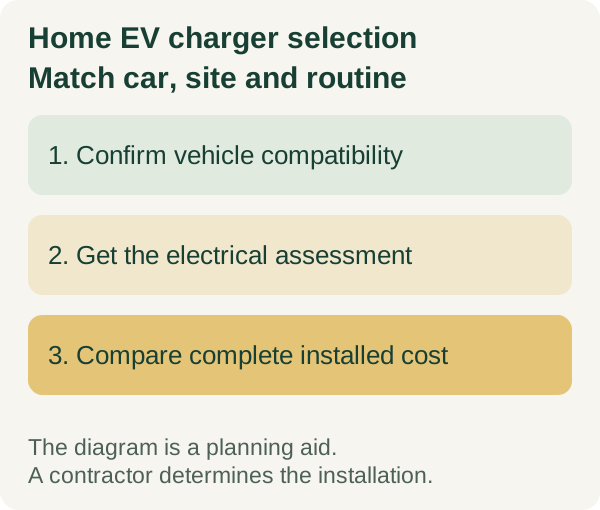
For a used-EV purchase, settle the charging plan before assuming the car will fit your routine. This guide is an equipment-selection and quote checklist. Electrical design and installation belong with a qualified contractor and the responsible permitting authority.
Level 1 or Level 2: start with your parking window
The Department of Energy’s charging-equipment guide describes AC Level 1 as 120-volt charging and residential AC Level 2 as typically 240-volt charging. It also explains that charging time depends on the battery, vehicle’s internal charger and equipment.
Write down your usual arrival and departure times, expected driving and access to charging elsewhere. Ask whether a suitable Level 1 setup can meet that actual routine before paying for a larger installation. If you need more energy in a shorter parking window, have the vehicle manufacturer and electrician explain the appropriate options.
Use the car’s current manual and actual charging specifications. An overnight parking period is an input to the decision, not a promise that every car can fully recharge overnight on any outlet.
Confirm the actual car’s connector and AC limit
Record the model year, exact version, charge-port type and supported home AC charging rate. Check any portable charging equipment included with the sale by its actual model and condition. A seller saying “charger included” does not identify everything you need.
DOE’s equipment guide distinguishes connector types, including J1772 and J3400, also called NACS. For your car and proposed equipment, obtain the manufacturer’s compatibility guidance, including whether an adapter is required and approved for that use.
Keep home AC charging and public DC fast charging separate in your notes. Do not choose home equipment from a public fast-charging number in a vehicle advertisement or assume an adapter works for every charging method.
Ask an electrician to assess the actual installation
DOE’s home-charging guidance recommends safety-certified equipment and electrical-contractor involvement. It explains that home electrical capacity, outdoor equipment ratings and local code and permit requirements matter.
Give the contractor the proposed equipment’s installation documentation, where the car parks and how the cable would reach it. Ask for a written site assessment and scope before buying equipment around an unverified assumption about an existing outlet.
Useful questions include:
- Is the existing electrical service suitable for the proposed charging setup?
- What circuit, installation method and equipment settings does the contractor propose?
- Which permits, inspections or property permissions apply?
- What equipment and labor are included, and what remains conditional?
- Where will the cable and connector be stored without obstructing the parking area?
Have the contractor identify the applicable requirements. This worksheet is not a circuit design, a wire-sizing chart or permission to alter a panel or receptacle yourself.
Plug-in and hardwired equipment have model-specific conditions
ChargePoint’s Home Flex installation FAQ illustrates why the exact product matters. For the listed models, it distinguishes plug-in from hardwired settings and directs a licensed electrician to match the setup to panel capacity and vehicle requirements.
Use that as a product-specific example, not a wiring rule for every charger. Ask the installer to name the exact model and installation method on the estimate. A unit sold with a particular plug should not be assumed suitable for every outlet that looks similar.
ChargePoint also notes that charging speed depends on the car’s onboard charger. Paying for a higher equipment rating does not establish that your vehicle will draw that amount. Resolve the vehicle limit and the installed configuration as separate entries.
Compare the complete installed price
Request an itemized total for the equipment, installation and any associated work. Have the contractor identify conditional items, required approvals and what could change after assessment. Compare quotes for the same parking location, equipment specification and scope.
Ask about commissioning, documentation, warranty responsibility and any ongoing app or service terms. If you want scheduling or other connected features, confirm how they work on the actual product rather than assuming every feature is available without an account, connection or additional terms.
For a rental, condominium or shared parking arrangement, obtain the responsible property party’s written requirements before committing. DOE flags multifamily charging as a separate planning situation; a single-family-home example does not settle shared-space permissions or billing.
An original energy-and-time planning example
Imagine you assume 14 kilowatt-hours of electricity drawn from the wall per day and have six hours available for charging. Dividing 14 by six gives an average of about 2.33 kilowatts over that period. At an assumed flat energy rate of $0.20 per kilowatt-hour, that energy charge is $2.80 per day.
These are invented planning inputs, not a measured car, charging test or utility quote. The wall-energy assumption already represents electricity drawn at the supply; it is not a claim about battery capacity or a universal loss rate. The price excludes other utility charges and any installation or equipment cost.
Use the example to organize questions about your actual energy need, parking window and tariff. It does not specify a circuit, establish achievable power or account for every charging interruption. Have the relevant manufacturer, utility and contractor confirm the real inputs.
Buying a used EV: verify the car separately
A workable home installation does not establish battery health or the condition of the car’s charging system. The used electric car buying guide covers the wider vehicle comparison. Use an appropriate inspection to investigate the actual car, charging equipment and unresolved faults.
If included equipment is missing or its compatibility is uncertain, record the additional purchase or assessment needed. Keep that expense visible alongside the car’s purchase budget, rather than finding out after the handoff that your planned charging route is incomplete.
Download the home-charging selection worksheet
The blank EV charger electrical readiness worksheet records sixteen vehicle, site, usage and complete-cost questions. Keep the supporting manual, contractor estimate and unanswered items with it.
Source check: November 21, 2026. Follow current vehicle and equipment instructions and applicable local requirements. No electrical inspection, installation design, permit approval, charging test or live contractor quote was performed for this guide.
BEFORE YOU TAKE THE NEXT STEP
Practical checklist
Check the VIN, ownership record and seller details.
Arrange an independent inspection and review the written terms.
Confirm the total cost and title-transfer process before paying.
CHECK THE DETAILS
Sources and further reading
Follow the source linked beside a claim for its context. For a transaction, confirm current requirements with the relevant agency, lender or provider.
- The Department of Energy’s charging-equipment guideafdc.energy.gov
- DOE’s home-charging guidanceafdc.energy.gov
- ChargePoint’s Home Flex installation FAQchargepoint.com
YOUR NEXT READ