Inspections & condition
How Long Do Car Batteries Last? Age, Tests and Buying Checks
A 12-volt starting battery commonly lasts three to five years. Learn how age, service records and professional test findings fit into a used-car buying decision.
Published
Sources checked . How this guide is prepared.
START HERE
The short answer
A conventional 12-volt car starting battery commonly lasts about three to five years. Treat that as a planning range, not a replacement deadline or a promise of remaining life. For an actual battery, combine its installation history with a current professional assessment and the vehicle’s operating requirements.
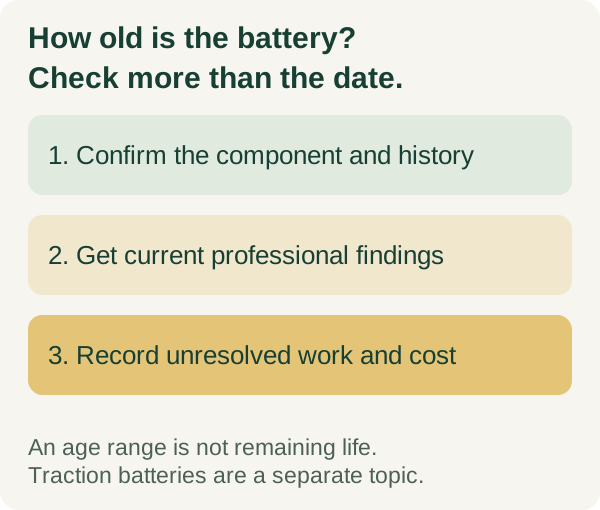
This guide concerns the low-voltage starting or auxiliary battery. It does not apply that three-to-five-year range to the high-voltage traction battery that propels an electric or hybrid car.
Why a battery’s age is only part of the answer
AAA’s battery-life guide identifies time, heat and vibration as important factors. It describes three to five years as a typical wear period, with climate and use affecting the result. Frequent short journeys may leave a battery insufficiently recharged, while long periods parked allow self-discharge.
AAA also notes that charging-system faults can shorten life and recommends annual battery testing beginning in the third year. The appropriate replacement must match the vehicle’s required type and specifications. Use the correct manual and a qualified service professional to establish those requirements.
These are general maintenance findings. They do not establish that a particular three-year-old battery is failing or that a newer one has several reliable years left. A service decision needs evidence about the battery and the car it is installed in.
Installation date, manufacture date and warranty date
Ask for the replacement invoice first. Match the car, installation date, battery description and available warranty information. A dated receipt supports the history of that installation; it does not certify present condition.
If the only evidence is a code on the battery, ask the manufacturer or servicing shop to interpret it. Do not apply an internet date-code chart to every brand. A manufacture date and an installation date answer different questions, and an unreadable sticker should remain an unknown.
Keep the warranty separate as well. Ask what is covered, what documentation is needed and whether coverage applies to a subsequent owner. A warranty term is a contractual condition, not a prediction that the battery will remain healthy until its last day.
What to request from a battery test
Ask the shop for a dated report identifying the vehicle, battery specifications used for the assessment, findings and recommended next step. If starting or charging concerns exist, ask whether the proposed work evaluates those systems or only the battery.
A report is more useful when you understand its scope. Ask whether a recharge and retest is recommended, whether further diagnosis is needed and what the result actually supports. Keep the shop’s findings separate from a seller’s paraphrase such as “tested fine.”
There is no single home voltage reading in this guide that certifies health or years remaining. Likewise, a successful jump-start establishes that the car started under those circumstances. It does not, by itself, explain the original problem or prove that it has been repaired.
If the car starts slowly or needs repeated assistance
Record what happened, when it happened and any warning messages. Arrange qualified assessment rather than repeatedly jump-starting the car as a substitute for diagnosis. Follow the actual vehicle manual and professional guidance for safe handling and assistance.
Do not decide from one symptom that only a battery replacement is needed. Ask the shop to explain the cause it has established and any unresolved questions. A new battery invoice answers a replacement-history question; it does not establish that every charging or electrical concern was resolved.
If the battery appears damaged or the vehicle seems unsafe, avoid handling it and obtain appropriate professional help. This guide does not provide battery-opening, wiring or jump-start procedures.
Buying a used car: build a four-part evidence record
Use four entries for each car you are considering:
- History: the installation invoice, any earlier assistance calls and known storage periods.
- Identity: the actual battery type and the manufacturer requirements for that car.
- Current findings: the dated professional report and what systems it assessed.
- Open work: further diagnosis, recommended service and a written estimate for the actual scope.
Keep unknowns visible. “Recent battery” without a date or document is a claim to clarify. “Starts today” is an observation. Neither should silently become a verified history or a complete condition assessment.
The pre-purchase inspection guide helps you agree on scope before paying for an inspection. Ask whether battery, starting and charging checks are included and what would require an additional diagnostic appointment.
An original two-car example
Imagine Car A has a battery installed one year ago, but the seller reports a recent unexplained no-start. Car B has a four-year-old battery with a current professional report and no reported starting problem. These are invented examples, not actual inventory or test results.
For A, the newer installation does not settle the no-start question. For B, the report does not promise future life simply because the car started normally. Ask the relevant shop to explain current findings and recommended work on each vehicle.
Compare actual written estimates with the rest of the purchase terms once those questions are resolved. Do not automatically credit A with three more years or deduct a universal replacement amount from B. Age is one input; the evidence and actual service scope determine the immediate decision.
Electric-car auxiliary batteries are a separate question
The Department of Energy’s electric-car component guide distinguishes the auxiliary battery powering accessories from the traction battery supplying the electric motor. It also describes a converter that supplies lower-voltage power and recharges the auxiliary battery.
When a seller says an EV has a “new battery,” ask which battery was replaced and request the relevant invoice. Do not interpret an auxiliary-battery replacement as evidence of traction-pack health or apply starting-battery lifespan estimates to the traction pack.
For either kind of car, identify the actual component before comparing condition, service needs or warranty information.
Download the battery evidence worksheet
Use the blank battery age and condition worksheet to record sixteen history, identification, test-scope and follow-up questions. It is an organizer for your evidence, not a battery diagnostic test.
Plan ahead using the general lifespan range, then make the actual service or buying decision with the correct vehicle information and current findings. Keep a copy of any replacement invoice and report so the next assessment starts with a useful history.
Source check: November 21, 2026. This is a source-based maintenance and buying guide. No battery test, inspection, remaining-life calculation or actual replacement quote was performed for this article.
BEFORE YOU TAKE THE NEXT STEP
Practical checklist
Check the VIN, ownership record and seller details.
Arrange an independent inspection and review the written terms.
Confirm the total cost and title-transfer process before paying.
CHECK THE DETAILS
Sources and further reading
Follow the source linked beside a claim for its context. For a transaction, confirm current requirements with the relevant agency, lender or provider.
- AAA’s battery-life guideww1.aaa.com
- The Department of Energy’s electric-car component guideafdc.energy.gov
YOUR NEXT READ
Keep reading