Selling a car
How Much to Paint a Car? Price Ranges, Prep and the Selling Decision
Use published car-painting ranges carefully, compare preparation and coverage, and calculate whether repainting before selling improves proceeds. Includes a blank worksheet.
Published
Sources checked . How this guide is prepared.
START HERE
The short answer
As a published budgeting reference, AAA’s car-painting guide describes basic paint jobs at $300–$1,000, mid-grade work at $1,000–$4,500, and high-end projects at $5,000–$20,000. Those categories represent substantially different work. They are not a current local quote or a promise that your car can be refinished for the bottom figure.
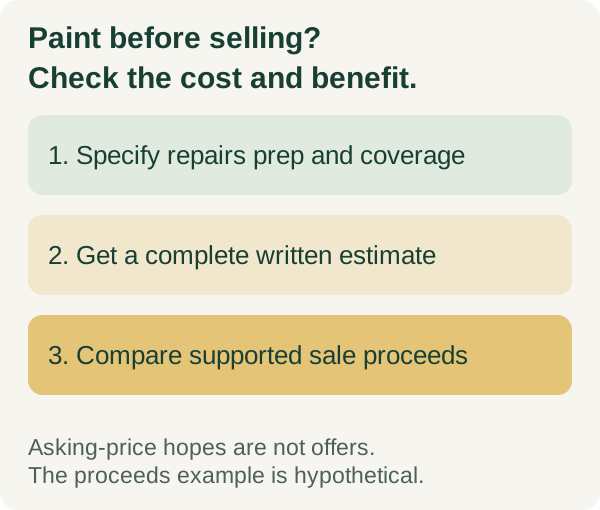
For an actual decision, have a body shop assess the car and quote the preparation, repairs, coverage and finish you want. If you are painting before selling, compare that complete expense with a supported change in sale proceeds rather than assuming every dollar will come back.
What do the published ranges include?
AAA describes basic work as limited preparation and coverage, with non-visible areas often excluded. Its mid-grade and high-end categories describe progressively more preparation and finish work. Use the range to start a scope discussion, not to assign a precise price from a vehicle photograph.
Ask whether the shop is quoting one panel, an exterior repaint, a color change or a restoration project. Those are different jobs. A small repair advertisement and a complete refinishing estimate should not be compared as if they cover the same surface and labor.
Price also does not establish every aspect of the finished result. Review relevant completed work and request the actual material, preparation, workmanship and warranty terms for the project in front of you.
Preparation and body repairs belong in the estimate
Maaco’s painting-cost explanation, updated September 21, 2026, identifies vehicle size, condition, preparation, paint and finish as cost factors. Its discussion of peeling finish, prior repairs and surface preparation helps explain why a car-specific assessment matters.
Ask the shop to separate necessary body repairs from refinishing labor and materials. Describe known dents, corrosion, peeling paint, previous repairs and earlier coatings. Have the responsible professional explain what must be addressed before painting and what remains outside the proposed work.
A new finish should not be treated as evidence that an underlying repair question was resolved. If collision or structural concerns exist, follow the frame-damage buying guide for the separate documentation and assessment task. A paint invoice cannot certify the whole structure.
Keeping the same color versus changing it
Specify the intended result in writing. If changing color, ask which areas will retain the original finish and which will be refinished. Discuss door jambs, openings and other areas you expect to see when the car is used normally.
Maaco’s estimate disclaimer says its color-change estimate is based on standard exterior work and excludes custom or glamour colors, pearl or matte finishes, door jambs and other openings. It also explains that its online figures are non-binding and an official estimate needs an in-person assessment.
Those are Maaco’s stated conditions, not identical terms for all shops. Use them as questions for the provider you choose. An exterior color-change price should not silently become a whole-vehicle transformation budget.
Request a quote you can actually compare
Give each shop the same vehicle information and requested outcome. Record:
- The panels and openings included, with specific exclusions.
- Required repairs and preparation, including the treatment of existing finish problems.
- The proposed paint system, color and finish.
- Agreed removal, masking and reinstallation work.
- Any color-matching or adjacent-area work included in the plan.
- The complete price, taxes and terms for approving additional work.
- The schedule, care instructions and actual warranty conditions.
Ask the shop what must still be determined after inspection or disassembly. Keep an initial estimate, a revised authorization and the final invoice as separate records. Do not present an online starting amount as the final bill if the provider says otherwise.
An original example: painting before selling can reduce proceeds
Imagine you have a documented as-is offer of $6,200. For this invented comparison, assume a second buyer would pay $8,200 after an agreed repaint and the complete repaint bill would be $2,600. Neither offer nor the repair quote is real.
- Selling as-is produces $6,200 before other selling expenses.
- Repainting and then selling produces $8,200 minus $2,600, or $5,600 before other expenses.
- The assumed repaint path leaves $600 less, despite the $2,000 higher sale price.
This is arithmetic, not a valuation or a prediction of buyer behavior. It excludes delay, transport, other repairs and other selling costs. A hoped-for listing price is not a documented offer, and a conditional offer may change if its conditions are not met.
Replace the assumptions with credible evidence and written terms. If nobody has established what the repaint would add to actual proceeds, keep that increase unknown. Cosmetic preference alone does not supply a resale return.
Is a wrap a cheaper substitute?
A vinyl wrap is a different product and service. Ask a qualified installer whether the current surface is suitable before comparing it with refinishing. Neither a wrap advertisement nor fresh paint establishes that damage underneath has been repaired.
The car wrap cost guide explains film, coverage, preparation and removal quotes. Use it for that separate choice. Do not assume a wrap and a paint quote include the same areas or solve the same underlying condition problem.
If your actual aim is to sell the car, compare the justified expense and supported proceeds for each path. This guide does not assign a universal resale premium to a color, paint package or wrapped finish.
Buying a repainted used car
Ask which areas were repainted, why the work was done and which records are available. Match invoices to the vehicle and obtain clarification of vague descriptions such as “paint correction” or “body work.” Do not assume those phrases all mean a complete repaint.
Have the independent inspecting shop explain what it can assess about the finish and any underlying concerns. A glossy photograph cannot establish original paint, repair quality or an accident-free history. Conversely, a disclosed repaint alone does not prove structural damage.
Keep the vehicle-history report, repair documents and current findings separate. Missing history remains unknown rather than evidence that a fresh finish has no earlier story.
Download the repaint decision worksheet
The blank car painting cost worksheet records sixteen preparation, scope, quote and selling-decision questions. It includes space to separate a supported offer from an assumed asking-price increase.
Start with the published ranges, then compare the actual work and complete written cost. Before painting to sell, establish whether the expected benefit is supported well enough to justify the spending and delay.
Source check: November 21, 2026. AAA’s published categories are reference ranges, not a local price survey. Maaco’s conditions are provider-specific examples. No refinishing test, vehicle inspection, real offer, appraisal or actual shop quote is claimed.
BEFORE YOU TAKE THE NEXT STEP
Practical checklist
Confirm ownership and any lender payoff before promising a handoff date.
Prepare current photos and an accurate condition description.
Agree on verified payment and the required transfer paperwork before releasing the car.
CHECK THE DETAILS
Sources and further reading
Follow the source linked beside a claim for its context. For a transaction, confirm current requirements with the relevant agency, lender or provider.
- AAA’s car-painting guideaaa.com
- Maaco’s painting-cost explanationmaaco.com
- Maaco’s estimate disclaimermaaco.com
YOUR NEXT READ
Keep reading