Inspections & condition
Vehicle History Reports for Used Cars: Check NMVTIS Title Records
Use NMVTIS title-history records alongside free VIN checks and an independent inspection. Learn report limits and track unresolved findings with a free worksheet.
Published
Sources checked . How this guide is prepared.
START HERE
The short answer
A vehicle history report helps you investigate a used car’s recorded past. It does not establish that every event was reported, prove the seller can transfer ownership or replace an independent inspection. For title-related checks, the National Motor Vehicle Title Information System, or NMVTIS, provides a specific starting point alongside other reports and records.
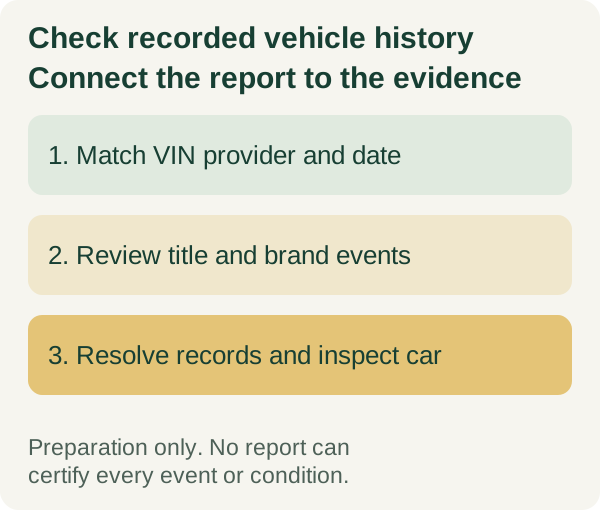
Use the correct VIN, obtain the complete dated report from a legitimate source, and follow any concerning title, brand, odometer, total-loss or salvage entry back to supporting evidence. A summary saying no adverse record was found should not end the investigation.
What does an NMVTIS report show?
The Justice Department’s NMVTIS report explanation identifies five core indicators: current title state and last title date, title brands, odometer information, total-loss history and salvage history. It is a focused title and anti-fraud resource rather than a complete log of everything that has happened to the car.
A title brand is a label applied by a state titling agency, such as salvage, junk or flood. Read the actual description and jurisdiction. A brand-history entry, an insurer’s total-loss record and a salvage-business record are different entries to understand, even when they concern the same vehicle.
Do not treat the five categories as five separate approvals. They organize recorded information and questions. The next step depends on what appears, which source supplied it and whether the current documents are consistent with that history.
Where can you get an NMVTIS vehicle history report?
Start with the official approved-provider list. Select a currently listed consumer provider and review the report’s price, scope and terms before purchasing. This guide does not claim every report containing vehicle information is an NMVTIS report or that an inexpensive VIN search includes a complete history.
Record the provider, full VIN and report-generation date. Keep the complete document or official access, rather than only a seller’s cropped summary. If a report was generated months ago, identify which events and date range it actually covers.
For the separate choice between commercial providers, use our CARFAX-versus-AutoCheck guide. That page compares provider features and reports. This guide focuses on NMVTIS title evidence and what to verify beyond the initial result.
Can a clean report miss damage or another problem?
Yes. The NMVTIS consumer guidance explains that reporting gaps, timing and differences among jurisdictions can affect the result. It also distinguishes a total-loss determination from a state’s decision to apply a title brand. Do not turn one blank field into proof that no damaging event ever occurred.
The NMVTIS FAQ says the system does not contain a vehicle’s detailed repair history and explains the role of obtaining the current state’s fuller title record. A report can therefore raise a repair question without showing whether the work was completed or how well it was done.
Use the report with available invoices, vehicle records, a test drive and an independent inspection. The FTC’s used-car buying guidance also distinguishes history research from an independent mechanical inspection. An absence of reported damage is not a substitute for checking the actual car.
Read the title history as a sequence
Match the report’s VIN to the car and current ownership documents before interpreting events. Our VIN location guide helps with that identity check. Use the make-versus-model guide if the naming fields also need clarification.
Then record the title jurisdiction, event date, brand wording and available source for each material entry. Separate the event date from the report-generation date. A report printed today can contain an older event; the print date does not mean the vehicle acquired that history today.
For an unexplained brand or title transition, ask the relevant motor vehicle agency what record and process apply. Keep that response with the report. If the concern is the seller’s authority to transfer ownership, verify the required ownership and lien documents separately rather than expecting a history report to substitute for them.
A hypothetical brand-history discrepancy
Imagine an invented report contains a salvage-brand entry from an earlier state, while the seller presents a later document from another state that appears to show no brand. The seller says the later document proves the earlier entry no longer matters.
Do not decide the legal status from that statement or this example. Request the current state’s complete title record and ask the relevant agency to explain the prior brand and later document. Ask the report provider about a suspected reporting error through its official correction process. If repairs are involved, obtain the available records and an inspection appropriate to that concern.
The scenario does not describe an actual vehicle or prove title washing, fraud, safe repair or lawful registration. It demonstrates why a later document and an earlier event need reconciliation. The rebuilt-versus-salvage title guide covers that separate buying decision.
What can free VIN tools add?
NICB’s free VINCheck checks participating insurers’ records for relevant unrecovered-theft and salvage-related information. Its own limitations explain that it does not query every insurer or law-enforcement record and is not a comprehensive vehicle history report. A negative result does not establish a clean history.
NHTSA’s recall lookup addresses another question: whether a VIN has an unrepaired recall within the tool’s coverage. The page explains exclusions, including some recently announced recalls and older recalls. It is useful safety research, not a title or accident-history report.
Use each source for its actual purpose. Record the date and result without treating several limited searches as a guarantee that the vehicle has no problems. This guide does not claim a free tool supplies every record available in a paid report or state file.
Turn report findings into specific requests
For each material entry or discrepancy, write down the question it raises, the evidence needed and who can supply it. A title issue may need an agency record; a repair concern may need an invoice and inspection; a suspected report error needs the provider’s correction route.
Ask the seller for the documents actually relevant to the concern. Avoid substituting an unrelated service receipt for evidence of a particular repair. If the provider says an event has been corrected, obtain the updated record or report rather than relying solely on a verbal assurance.
Keep unresolved items visible before paying a deposit or arranging transfer. If the seller will not allow an appropriate independent inspection, account for that missing evidence in your decision. Our inspection checklist helps organize the separate condition review.
Keep a report-to-record audit sheet
Download the vehicle history evidence worksheet. It separates the VIN, provider, report date, core title-history fields, supporting records and unresolved next actions.
Your next step is to match the VIN and get the complete report through an official or verified provider route. Use it to direct further checks until the recorded history, current documents and actual condition can be assessed together.
BEFORE YOU TAKE THE NEXT STEP
Practical checklist
Check the VIN, ownership record and seller details.
Arrange an independent inspection and review the written terms.
Confirm the total cost and title-transfer process before paying.
CHECK THE DETAILS
Sources and further reading
Follow the source linked beside a claim for its context. For a transaction, confirm current requirements with the relevant agency, lender or provider.
- Justice Department’s NMVTIS report explanationvehiclehistory.bja.ojp.gov
- official approved-provider listvehiclehistory.bja.ojp.gov
- NMVTIS consumer guidancevehiclehistory.bja.ojp.gov
- NMVTIS FAQvehiclehistory.bja.ojp.gov
- FTC’s used-car buying guidanceconsumer.ftc.gov
- NICB’s free VINChecknicb.org
- NHTSA’s recall lookupnhtsa.gov
YOUR NEXT READ
Keep reading