Inspections & condition
Car Frame Damage: What to Check Before Buying a Repaired Car
Check damage descriptions, repair records, title history and independent assessment before buying a repaired car. Includes a blank structural-repair evidence worksheet.
Published
Sources checked . How this guide is prepared.
START HERE
The short answer
Car frame damage concerns the vehicle’s supporting structure. On a body-on-frame vehicle, that includes a separate frame; on a unibody vehicle, structural elements are integrated with the body. A used-car buyer needs to establish what was damaged, what work was performed and what a qualified assessment can say about the current vehicle.
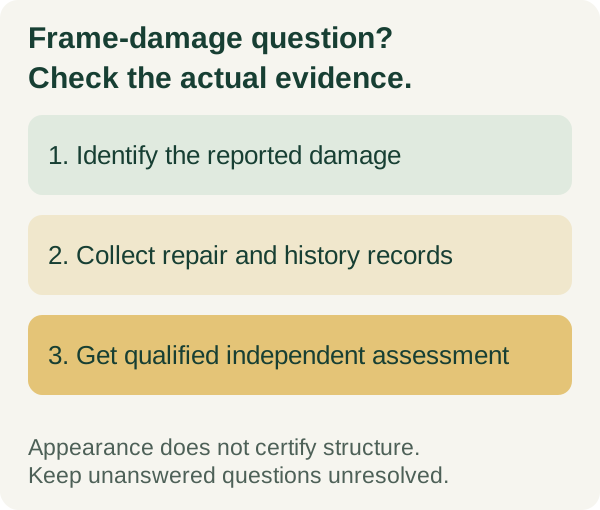
Do not infer structural condition from fresh paint, a straight-looking photograph, a clean-sounding title description or a short drive. Equally, a report entry is not a complete description of the damage or the repair. Resolve the actual evidence before deciding whether the car meets your needs.
What counts as frame or structural damage?
Car-O-Liner’s frame-damage explanation describes the supporting structure and distinguishes unibody and separate-frame construction. The equipment manufacturer also explains why professional inspection and dimension-measuring tools can matter when assessing structural concerns.
Ask which structural areas were affected and what the source means by frame damage. A summary label, repair estimate and detailed assessment can describe different amounts of information. Do not assume a cosmetic repair description settles a structural question, or that every collision caused the same kind of damage.
The crossover-versus-SUV guide helps identify construction and configuration. Its category distinction does not certify that an individual vehicle has never been damaged or that a repair restored the required condition.
Treat possible warning signs as questions for the inspector
Unusual gaps, uneven tire wear, pulling or visible irregularities can justify further assessment. They are not a reliable home diagnosis of frame damage. Tire, suspension and other issues can also produce some of those observations.
Car-O-Liner’s guidance identifies such concerns while emphasizing qualified inspection. If something suggests the car may be unsafe, stop the test drive and arrange appropriate professional assessment or safe transport. Do not conduct high-speed handling checks, crawl beneath an unsupported vehicle or attempt a structural repair during a viewing.
Record what you actually observed and when. A specific description gives the inspecting professional more to work with than declaring the frame good or bad from a distance.
Request the damage and repair records
Ask for available pre-repair photographs, damage assessments, itemized repair invoices and completion records matched to the VIN. Request relevant information with unrelated personal details redacted where practical.
Have the qualified collision-repair professional explain which manufacturer repair information applied and what evidence is available for the work performed. Ask about measurements, replaced or repaired structural areas, joining methods and other procedures where relevant to that actual repair.
This is a request for documentation and assessment, not a do-it-yourself repair checklist. There is no universal acceptable bend, gap, measurement tolerance or straightening method in this guide. The vehicle’s construction, materials and manufacturer instructions matter.
An alignment receipt is not the entire structural assessment
A wheel-alignment invoice answers a different question from a record describing the condition and repair of the vehicle’s structure. Ask the assessing professional what each supplied document establishes and what it leaves unanswered.
Similarly, “it drives straight” is a limited observation, not proof of crash performance or complete repair quality. A seller’s assurance, shop certification or piece of equipment should not be treated as a guarantee about every part of this car.
Agree on the specific scope of an independent inspection. Ask whether it includes collision-repair assessment and relevant structural measurements, and what further access or specialist work would be needed. The pre-purchase inspection guide explains how to establish scope before relying on a general inspection.
Check associated safety systems and repair questions
Ask about air bags, restraints, warning lights and any driver-assistance systems affected by the damage or repair. Have a qualified shop determine what inspection, diagnostic or calibration procedures apply to the actual vehicle and work performed.
Do not assume a cleared warning light or a successful ordinary drive proves all required procedures were completed. Request the available records and an explanation of remaining limitations. Do not disable a warning or accept an unexplained safety-system fault as an ordinary feature of a repaired car.
The lane keep assist buying guide explains how to separate fitted equipment, operating limits and condition questions. Driver-assistance equipment does not replace the underlying vehicle assessment.
Title status and repair quality are separate questions
Obtain the actual title-history information and resolve any discrepancies with the responsible agency and relevant documents. Do not infer that a structural-damage entry automatically means a particular title brand, or that an unbranded title proves there was no structural work.
The vehicle-history report guide explains how history evidence fits alongside fuller records and inspection. Missing history is unknown; it should not be converted into proof that a seller’s account is complete.
If a branded title is involved, use the rebuilt-versus-salvage title guide for that separate paperwork and provider decision. A registration or title document does not, by itself, answer every question about current condition or repair quality.
An original conflicting-records example
Imagine a report that mentions structural damage while the seller says only an outer panel was repaired. The seller provides a paint invoice but no earlier assessment or structural completion records. This is an invented example, not a finding about an actual car or seller.
The right next step is to resolve the discrepancy. Request the underlying available records and have a qualified independent professional assess the vehicle and explain the limits of the evidence. Do not declare fraud from the conflicting descriptions, and do not treat the smaller invoice as proof that no other damage existed.
You can decide that an unresolved structural question is outside your risk tolerance. If you investigate further, keep documented facts, professional findings and unanswered questions separate. A lower price does not fill the documentation gap.
Compare the complete deal only after essential questions are answered
Obtain any necessary insurance and financing decisions for the actual VIN and disclosed history. Ask what coverage, conditions and exclusions apply rather than assuming an ordinary quote fits the repaired vehicle.
Use written findings and actual estimates for identified work. This guide provides no universal frame-repair cost, discount or resale forecast. The FTC’s used-car buying guidance recommends an independent inspection and complete written dealer-price comparisons; both remain useful when a repaired car looks attractively priced.
Download the structural-repair evidence worksheet
The blank car frame-damage buying worksheet records sixteen damage, repair, history, inspection and provider checks. It helps identify who must supply the missing evidence and the next follow-up date.
Buy only when the actual vehicle, its evidence and the complete terms meet your needs. If the condition cannot be assessed to your satisfaction, keep shopping. If you already own the vehicle and are deciding how to sell it, the separate frame-damage selling guide addresses that task.
Source check: November 19, 2026. This guide organizes a buying assessment. It does not certify structural safety, diagnose a vehicle, perform collision measurements or report an actual repair quote.
BEFORE YOU TAKE THE NEXT STEP
Practical checklist
Check the VIN, ownership record and seller details.
Arrange an independent inspection and review the written terms.
Confirm the total cost and title-transfer process before paying.
CHECK THE DETAILS
Sources and further reading
Follow the source linked beside a claim for its context. For a transaction, confirm current requirements with the relevant agency, lender or provider.
- Car-O-Liner’s frame-damage explanationcar-o-liner.com
- FTC’s used-car buying guidanceconsumer.ftc.gov
YOUR NEXT READ
Keep reading