Buying a car
Car Wrap Cost: Compare the Full Quote Before You Book
Compare car wrap quotes by film, coverage, preparation, removal and warranty. Includes a clearly hypothetical total-cost example and blank quote worksheet.
Published
Sources checked . How this guide is prepared.
START HERE
The short answer
Car wrap cost depends on the vehicle, film, coverage, surface condition and installation work. There is no single reliable price for every full color-change wrap. Get a written quote for your actual car and compare matching coverage and preparation before deciding which offer costs less.
As a limited reference, Avery Dennison’s vehicle-wrap FAQ gives a $2,000–$4,000 average for a standard vehicle in its discussion of advertising wraps. That is a manufacturer-published reference in a commercial-wrap context, not a current local quote or a universal color-change average. Custom finishes and additional coverage need their own pricing.
What kind of wrap are you pricing?
Define the job before collecting numbers. Are you requesting a full exterior color change, selected panels, printed business graphics or a different protective-film product? State the desired finish and identify any existing film that must come off first.
A roof-only quote and a full exterior quote are different purchases. Likewise, vinyl color-change film, paint protection film and a repaint should not be treated as interchangeable items merely because each changes or covers the surface.
3M’s car-personalization support says wrap pricing depends on vehicle size, coverage and selected film and directs customers to an installer for an individual quote. Its separate wrap-film and paint-protection-film sections are a useful reminder to identify the actual product being offered.
The factors to put in every quote request
Send each installer the same vehicle identification, photographs and requested outcome. Ask what still requires an in-person inspection before the figure becomes firm.
Record these items separately:
- Film: manufacturer, exact product, color, finish and any custom printing or design.
- Coverage: the specific exterior panels, roof, mirrors, bumpers and other included areas.
- Edges and openings: whether door jambs or other normally hidden painted areas are included.
- Preparation: cleaning and any surface work the installer identifies before application.
- Existing material: removal of old film and any related adhesive-cleanup work.
- Labor and access: any agreed component removal, reinstallation or additional complexity.
- Final bill: taxes, authorized extras, payment terms and the conditions for a price change.
Do not assume “full wrap” means every exposed surface you have in mind. Ask the installer to mark inclusions and exclusions, particularly where the original color may remain visible when a door or hatch opens.
Why custom work can change the price substantially
Avery Dennison’s color-change Q&A distinguishes commercial and custom work. Its experts identify location, material, vehicle size and complexity as pricing factors and note that door jambs and additional interior areas add work. Premium finishes or intricate custom designs belong in a specific project quote.
That explains why two attractive online starting prices may describe very different jobs. Ask what vehicle, film and coverage the advertised figure assumes. Request the full price for your choices before paying a deposit.
Use a standard specification for the first comparison. If you later upgrade a finish or expand coverage, obtain an updated written total so the change remains visible in your budget.
An original example: the lower headline price costs more
Imagine two installers quoting the same film, exterior coverage and agreed work for a car that already has old film. The following amounts are invented solely to show the comparison method. They are not market averages or real shop offers.
- Quote A: $2,800 installation, plus $300 to remove the existing film and $400 for agreed surface preparation. Total before tax: $3,500.
- Quote B: $3,300 including that same existing-film removal and surface preparation. Total before tax: $3,300.
- B is $200 lower for the assumed matching scope, even though its headline figure is $500 higher.
The removal in this example happens before the new wrap is installed. Eventual removal of the new wrap is a separate future expense, not included in either total. Taxes, repair surprises and differences in warranty or workmanship are outside this arithmetic.
Replace every assumption with written terms for your actual car. If the films or coverage differ, resolve that difference before treating the totals as comparable.
Paint condition, removal and repair questions
Have the installer assess the underlying finish before committing. Disclose any known repaint, repair, peeling finish or existing film. Ask which concerns affect suitability, preparation, removal and responsibility for damage.
3M’s guidance specifically flags poorly cured repaints as more vulnerable and recommends professional removal. It also describes product- and application-dependent warranty terms. Do not convert a general removability statement into a promise that every underlying paint finish will remain undamaged.
A wrap is not documentation that a dent, corrosion or collision repair has been corrected. If you are buying an already wrapped car, request available pre-wrap photographs and repair records and discuss the inspection’s limits. The frame-damage buying guide addresses unresolved structural concerns separately.
Ask about warranty, care and the later removal bill
Request the actual film warranty and the installer’s workmanship terms. Ask who handles a claim, which surfaces and conditions are covered, what exclusions apply and whether a later owner receives any coverage. Keep the product identification and installation invoice.
Obtain the care instructions for that exact film. A generic lifespan claim should not replace the applicable product terms, exposure conditions and maintenance instructions. Warranty length and expected appearance are different questions.
Ask how eventual removal will be assessed and priced. An estimate today may have conditions or change over time, so record what it assumes rather than treating it as a guaranteed future bill. Include the possible expense in your ownership planning without inventing a universal removal charge.
Should you wrap a car before selling it?
Decide what problem the spending would solve and whether it is justified by actual evidence. A personal color preference is different from a needed repair. There is no guaranteed resale gain in this guide, and the wrap bill should not automatically be added to an asking price.
For an existing wrapped car, describe the film, installation history and known underlying condition accurately. Do not present a fresh appearance as proof that the car has original paint or no repair history. The vehicle-history report guide explains why records and inspection answer different questions.
Before choosing a shop, review relevant completed work, discuss your actual vehicle and agree on the quote and change-authorization process. A familiar film brand helps identify a material; it does not establish every term of the installation contract.
Download the wrap quote worksheet
The blank car wrap quote worksheet gives you sixteen prompts for product, coverage, preparation, removal, warranty and complete-price comparisons. Use a copy for each installer with the same requested specification.
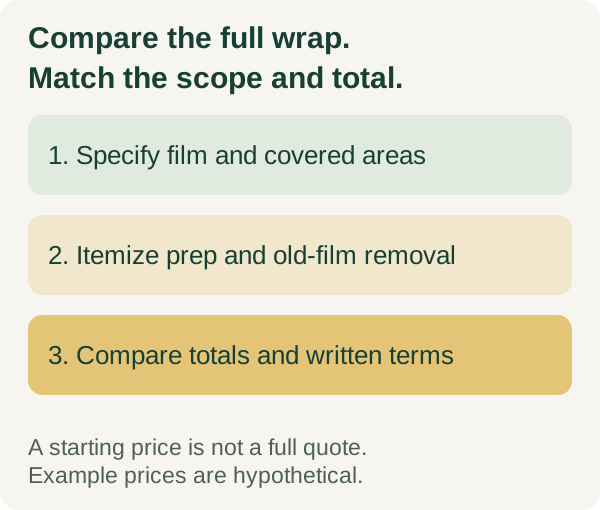
Compare the final written scope and total, then choose based on the work and terms you understand. A low starting price only becomes useful after you know what it includes.
Source check: November 21, 2026. Published manufacturer references are attributed with their scope. No current local price survey, actual installer quote, film test or resale outcome is claimed.
BEFORE YOU TAKE THE NEXT STEP
Practical checklist
Check the VIN, ownership record and seller details.
Arrange an independent inspection and review the written terms.
Confirm the total cost and title-transfer process before paying.
CHECK THE DETAILS
Sources and further reading
Follow the source linked beside a claim for its context. For a transaction, confirm current requirements with the relevant agency, lender or provider.
- Avery Dennison’s vehicle-wrap FAQgraphics.averydennison.com
- 3M’s car-personalization support3m.com
- Avery Dennison’s color-change Q&Aaverydennison.com
YOUR NEXT READ