Buying a car
What Credit Score Is Needed to Buy a Car?
Understand car-loan score requirements, why lenders see different scores, and how to compare written offers with a free worksheet.
Published
Sources checked . How this guide is prepared.
START HERE
The short answer
There is no single credit score required to buy a car or qualify for every auto loan. If you need financing, each lender decides whether your credit profile, income, debts, down payment and chosen vehicle meet its requirements. A score alone cannot tell you whether a loan will be approved or affordable.
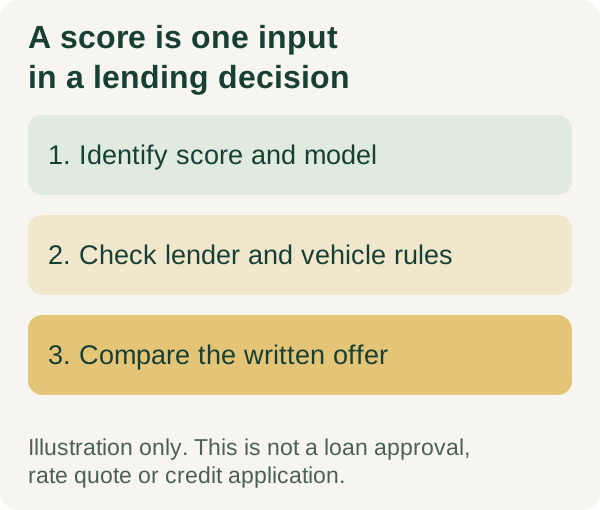
Start by identifying which score you are looking at, then ask a lender about the actual car and purchase route. That is more useful than treating a number from a credit app as permission to shop at a particular price.
This guide uses AI-assisted research checked November 18, 2026. CarTruvo operates a vehicle marketplace and has a commercial interest in helping people prepare to buy and sell. CarTruvo is not a lender and does not approve loans. No independent financial review or personal lending experience is claimed.
Is there a minimum credit score for a car loan?
Chase's explanation of auto-loan credit requirements says there is no fixed score required across car loans. A lower score does not automatically disqualify every applicant, and a higher score does not guarantee approval.
The Consumer Financial Protection Bureau explains that lenders consider credit history, income, debts, loan amount, term, down payment relative to vehicle value, and the vehicle itself when setting terms.
Ask about your intended purchase before authorizing an application. A lender may offer dealer financing but not private-party loans, or may exclude the age, mileage or title history of the car you chose. Our private-party auto-loan guide explains how to check those restrictions.
What is a good credit score to buy a car?
FICO's general credit-score guide uses these reference categories for the common 300–850 score scale:
- Below 580: Poor.
- 580–669: Fair.
- 670–739: Good.
- 740–799: Very Good.
- 800–850: Exceptional.
These are general score labels, not an auto lender's approval rules or promised interest rates. A lender can use its own criteria and a different scoring model. Do not treat the start of a category as a universal pass mark.
A useful target is a complete offer you understand and can afford. Record the actual APR, amount financed, term, cash needed and total payments. A loan with an acceptable payment can still cost more than you expected if the term is extended or products are added.
Why do some guides say 661 and others say 670?
The labels describe different systems. FICO calls 670–739 “Good” on its general base-score scale. Experian's auto-finance explanation uses 661–780 as the “prime” group in a table based on VantageScore 4.0 data. Neither boundary is a universal minimum for buying a car.
Before using an online rate table, check its score model, reporting period, new-versus-used distinction and whether the figures are averages. A historical group average is not your rate quote. A lender may use another model and evaluate a different vehicle, amount and term.
Why might the dealer see a different credit score?
FICO explains that lenders use different score versions. Auto-specific FICO scores can use a 250–900 range, while base FICO scores use 300–850. Lenders choose which models and versions to use.
When checking a score, write down four details:
- Score model and version, if provided.
- Credit bureau supplying the underlying report.
- Date calculated.
- Whether it is the score used in the actual lending decision or a monitoring score.
Compare the same model over time when possible. A difference between an app and a lender is not, by itself, proof that either figure is wrong. Ask which score was used and review the underlying report for factual errors.
Do not send your Social Security number, credit reports or bank login details to an individual vehicle seller to ask whether you qualify. Use the lender's own secure application process.
Can you buy a car with a 600, 650 or 700 credit score?
A score of 600 or 650 does not answer the question on its own. Some lenders may consider the application; others may not. The vehicle, income, debt, down payment and lending program still matter. A score of 700 also does not guarantee a particular loan amount, APR or approval.
If you have little credit history or no score available, explain that to the lender before applying. Ask whether it considers applicants in that situation and what documentation it needs. No score and a low score describe different starting points; neither tells you the outcome without the lender's requirements.
Avoid a seller or advertisement that turns one number into a universal promise. Ask for the lender's actual requirements and a written offer for your circumstances.
If a co-signer is proposed, treat that as a separate financial commitment. Ask the lender what responsibility each person takes on and which names will appear on the loan and title. Do not assume that agreeing to help is a formality.
For the wider process of shopping with a weaker credit history, use our bad-credit car-buying guide. This article focuses on interpreting scores and lender requirements rather than repeating that buying checklist.
Check your reports before choosing a loan
The CFPB recommends reviewing your credit reports before shopping and disputing inaccurate information. Use the report-access link in its auto-loan preparation guidance.
If a report contains an account you do not recognize, a wrong balance or an incorrectly reported payment, investigate it with the appropriate reporting company and information provider. Correcting an error is different from paying someone to promise a specific score increase.
Keep your purchase deadline realistic. No one can promise how many points a particular action will add or that a change will be reflected before your next application.
Use a score-to-offer record before applying
Keep the score you saw separate from the lending decision. For each candidate lender, record:
- What you know: score model, bureau, date and any report issue still unresolved.
- What the lender requires: purchase route, eligible vehicle, documentation and down payment conditions.
- What you are authorizing: an estimate, prequalification or application, including whether a credit inquiry occurs.
- What was offered: lender name, APR, amount financed, term, finance charge, payment schedule and total payments.
- What remains conditional: income or identity verification, vehicle approval, expiration and final underwriting.
Here is a message you can adapt before sharing sensitive documents:
I plan to buy a [year, make, model] from a [dealer/private seller] for about [price], with [down payment]. Do you finance that purchase route and vehicle? What stage is this process, what credit inquiry would I authorize, and what could still change before a final written offer?
An answer of “we work with all credit types” leaves those questions open. Record the lender's specific answer instead of treating the advertising language as a decision.
Our Auto Navigator vs. Carvana comparison shows how to keep online estimates, prequalification, dealer quotes and final contracts separate.
Use the score-to-offer worksheet to organize this information. Record document references rather than account numbers or identity information.
Does a higher score mean you can afford a more expensive car?
Approval and affordability answer different questions. Build a budget that includes insurance, registration, maintenance, fuel or charging, and likely repairs alongside the loan payment. Leave room for costs that are not yet quoted.
Compare equivalent loan amounts and terms before deciding which offer costs less. Read the written disclosures for finance charge and total payments. Do not add the amount financed to total payments, since that would count the borrowed principal twice.
A lower payment can still mean a higher borrowing cost
This original calculation illustrates loan length, not the rate any credit score will receive. Assume $20,000 borrowed at a fixed 10% annual interest rate, equal monthly payments and no fees. With no fees in this simplified example, assume APR also equals 10%.
- 60 months: approximate monthly payment: $424.94; total loan payments: $25,496.45; interest over the term: $5,496.45.
- 72 months: approximate monthly payment: $370.52; total loan payments: $26,677.21; interest over the term: $6,677.21.
The longer term lowers the payment by about $54.42 but adds about $1,180.75 in interest and twelve payments. Both examples assume payments on schedule. Totals use the unrounded monthly calculation; actual contracts can adjust the final payment and calculate interest differently. Neither includes a down payment, insurance, vehicle taxes, registration or ownership costs.
Use this distinction when reviewing offers: first compare the same amount and term to understand differences in borrowing cost, then decide whether the complete purchase fits your budget. Do not select a longer loan solely because its payment fits a target.
Do you need a credit score if you pay in full?
When you pay the agreed price entirely with your own available funds, you are not asking a lender for that purchase loan. If any part of the purchase depends on borrowing or a credit product, check that provider's requirements separately.
You still need to verify ownership, condition, payment arrangements and the title-transfer process. Use the cash-buying guide for those checks.
When your budget and financing route are clear, browse cars on CarTruvo. Ask the seller about the specific vehicle and arrange an independent inspection before committing. The seller's willingness to accept an offer does not establish your loan eligibility.
BEFORE YOU TAKE THE NEXT STEP
Practical checklist
Check the VIN, ownership record and seller details.
Arrange an independent inspection and review the written terms.
Confirm the total cost and title-transfer process before paying.
CHECK THE DETAILS
Sources and further reading
Follow the source linked beside a claim for its context. For a transaction, confirm current requirements with the relevant agency, lender or provider.
- Chase's explanation of auto-loan credit requirementschase.com
- Consumer Financial Protection Bureauconsumerfinance.gov
- FICO's general credit-score guidemyfico.com
- Experian's auto-finance explanationexperian.com
- FICO explains that lenders use different score versionsmyfico.com
YOUR NEXT READ