Titles & paperwork
Where to Sign a Car Title When Selling: Find the Correct Seller Fields
Find the correct seller fields, check state and co-owner rules, and prepare title-signing questions before your vehicle handoff.
Published
Sources checked . How this guide is prepared.
START HERE
The short answer
Sign in the seller or registered-owner release section of the title issued for your vehicle, following that state's instructions and the labels on your actual document. There is no single signature location that works for every state, title version or ownership situation. Read both sides before writing, and check whether a notary, lien release or additional owner's signature is required.
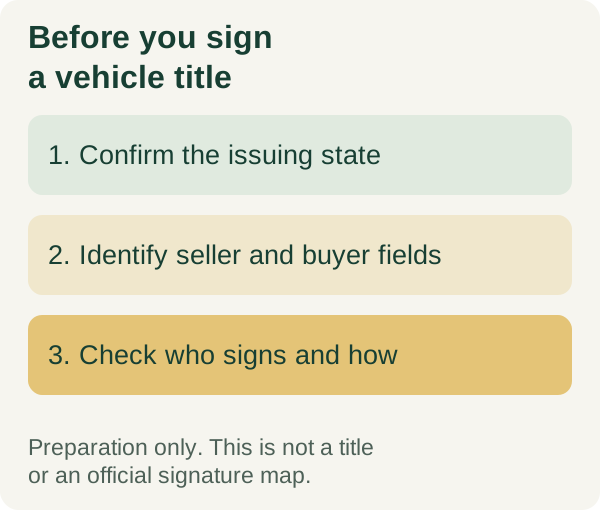
Do not sign a buyer field or a dealer-only reassignment section just because it has an empty signature line. Confirm who is selling, who is buying and which title is being transferred before the first signature.
This guide uses AI-assisted research checked November 18, 2026. CarTruvo operates a vehicle marketplace and has a commercial interest in helping people prepare to sell. It does not replace instructions from the issuing title office or claim independent legal review.
Start with the state that issued the title
Find the issuing state's name on the title. It may differ from where you live now or where the buyer plans to register the car. Open that state's official transfer instructions and compare its sample with your document.
Use this three-part check:
- Document: Which state issued this title, and does its layout match the official example?
- Role: Which fields are for the current owner, the buyer, the lienholder and a dealer?
- Signing conditions: Who must sign, and must a notary or authorized agent be present?
If the document is an electronic title, follow the issuer's release process. Do not assume printing an online account page creates a transferable paper title. Our electronic-title selling guide explains that separate situation.
The seller signature is not always in the same place
Official examples show why a universal “sign on the back” instruction can cause trouble:
- Missouri: The Department of Revenue's annotated title instructions identify the seller fields on the back. They direct all owners listed on the face to sign and print their names, and mark separate assignment areas for registered dealers.
- California: The DMV's basic transfer instructions identify line 1 for the registered owner's release, a separate lienholder-release step, and new-owner information. The manual also describes alternative forms and special cases, so confirm which document applies.
- North Carolina: NCDMV's vehicle-title instructions describe completing the back of the original title with seller and recipient information. A North Carolina title must be notarized; NCDMV recognizes the issuing state's requirements for an out-of-state title.
A private-sale reader should also separate the seller's release from an odometer signature. Completing one field does not establish that every required field is complete. Read the applicable instructions for both.
These examples identify the correct official resources. They are not a replacement for checking your own title version. For another state, use our state selling instructions to find the relevant starting point.
Which owner has to sign?
Match the names printed on the title with the people completing the sale. If a business, trust, estate, power of attorney or deceased owner is involved, ask the title office which authority documents and signatures it requires.
For co-owned vehicles, read the connecting wording and confirm the state's rule. California's manual requires each owner to sign for “and” or slash-separated names, allows one owner for “or” or “and/or,” and requires each owner for its joint-tenants-with-right-of-survivorship designation. Do not transfer California's rule to another state.
Missouri's annotated example instructs all owners listed on its face to sign. This is another reason to check the issuer rather than assume one co-owner's signature is enough everywhere.
If the person negotiating the sale is not the named owner, resolve that discrepancy before handoff. Do not invent a signature or change ownership names to make the transaction fit the paperwork.
Seller, buyer, lienholder and dealer fields do different jobs
Use this role check alongside the actual document, not as a substitute for its labels:
- Seller or registered owner: what to confirm before writing: The person releasing ownership is the named owner or has accepted authority to act..
- Printed seller name: what to confirm before writing: Follow the form's name instructions; a printed name and signature may be separate fields..
- Buyer or purchaser: what to confirm before writing: The actual recipient and required buyer information are settled..
- Odometer disclosure: what to confirm before writing: Read the separate mileage and acknowledgment instructions, including any applicable exemption..
- Lienholder or legal owner: what to confirm before writing: The recorded lender's release or continuation requirements are resolved..
- Dealer reassignment: what to confirm before writing: The section is appropriate for your role; an empty dealer field is not an invitation for a private seller..
A seller signature does not, by itself, prove that a recorded lien has been released. If a lender is listed, arrange its release and title process before promising the buyer a complete transfer packet. Use our selling a car with a loan guide to prepare the lender questions.
A bill of sale records the transaction, but you should not assume it replaces a required title assignment. Our bill-of-sale starter template helps organize the separate sale record.
What should you check before signing?
Set out the title and required supporting documents together. Check:
- Vehicle VIN against the title and sale records.
- Current owner names and each required signer's authority.
- Actual buyer name and the required address information.
- Actual sale date and price, entered where the form requires them.
- Odometer reading and any required mileage disclosure or exception instructions.
- Lien release and additional forms, if applicable.
- Notarization or agent requirements before anyone signs.
Illinois' official buying-and-selling guidance tells sellers to sign and date a valid title when the sale is final and give it to the buyer at delivery. It also warns buyers that alterations and erasure marks invalidate a title.
Use the title-signing preflight checklist to organize questions. It is a preparation sheet, not a transfer document or a substitute title.
What if the title is missing or the layout is different?
Ask the issuing office which replacement or transfer process applies. A registration card and a title serve different purposes; do not assume that replacing the registration solves a missing-title problem. For example, California DMV directs owners to REG 227 when a title is missing, with requirements that depend on the situation.
A title image from another seller or an older online article can be useful context, but its signature locations may not match your document. Do not copy an unfamiliar layout. Ask the office to identify the seller release and any separate odometer fields on your version.
What if you signed in the wrong place or made a mistake?
Stop and ask the issuing title office how to correct that exact document. Explain what was entered, where it appears and whether any signatures were notarized. Ask whether it needs a correction form, supporting statement or replacement title.
Do not use whiteout, erase information or cross out a name on the assumption that the office will accept the change. Do not buy a second form from an unofficial source merely because it looks similar.
If you need to send a document for the office to inspect, use its official channel and ask how to protect personal information. A public marketplace listing is not the place to upload a full title, identity document, signature or lender account number.
What if the buyer wants you to leave their name blank?
Keep the actual buyer and required transaction details in the transfer process. A promise that someone will finish the form later does not resolve missing information or establish that the transfer will be accepted.
Hypothetical example, not an actual CarTruvo transaction: a buyer asks the seller to sign a blank assignment because another person will collect the car. The seller pauses the handoff and confirms the named buyer, collector's authority and title-office instructions before completing the paperwork.
Do not copy the buyer's signature yourself. If the buyer cannot be present, ask the title office about the permitted process for that situation.
What should you ask the title office?
Have the document in front of you when you contact the official office. You can say:
I am selling a vehicle with a title issued by [state]. The owner names are joined by [word or symbol], and [a lien is/is not] shown. Which seller and mileage fields apply to this version, who must sign, and must signatures be witnessed or notarized? The buyer plans to register in [state]. What additional documents should we confirm before delivery?
For a mistake, add a description of the affected field and ask for the accepted correction process before changing anything. Keep a private record of the office, date, instructions and unresolved questions. A buyer registering in another state should separately confirm that state's requirements for accepting the transfer packet.
After signing, finish the rest of the handoff
A signed title is one part of the sale. Confirm payment through the agreed process, provide the required originals, keep permitted copies securely, and complete the seller's state reporting steps. Check plate, insurance and pickup requirements separately rather than assuming that signing the title resolves them.
For example, Illinois' guidance separately instructs sellers to remove their plates and complete the Notice of Sale. Follow your own state's rules and retain the transaction records it requires.
Prepare these answers before the appointment so paperwork does not become a last-minute surprise. Use our seller paperwork guide for the complete document set, then prepare your CarTruvo listing with accurate vehicle details and useful photos. Keep sensitive title and identity records out of the public description and images.
BEFORE YOU TAKE THE NEXT STEP
Practical checklist
Check the VIN, ownership record and seller details.
Arrange an independent inspection and review the written terms.
Confirm the total cost and title-transfer process before paying.
CHECK THE DETAILS
Sources and further reading
Follow the source linked beside a claim for its context. For a transaction, confirm current requirements with the relevant agency, lender or provider.
- Department of Revenue's annotated title instructionsdor.mo.gov
- DMV's basic transfer instructionsdmv.ca.gov
- NCDMV's vehicle-title instructionsncdot.gov
- Illinois' official buying-and-selling guidanceilsos.gov
- California DMV directs owners to REG 227 when a title is missingdmv.ca.gov
YOUR NEXT READ