Titles & paperwork
Bonded Car Title: Eligibility, Bond Amount and Buying Questions
Understand bonded car title eligibility, face amount versus premium, state-specific deadlines and buying questions. Includes a free planning worksheet.
Published
Sources checked . How this guide is prepared.
START HERE
The short answer
A bonded car title is a state-issued vehicle title supported by a surety bond when the applicant cannot supply the usual ownership evidence and meets that state's requirements. The bond provides financial protection for qualifying claims under its terms. Buying a bond alone does not issue a title, erase a lien or establish that the vehicle is safe to drive.
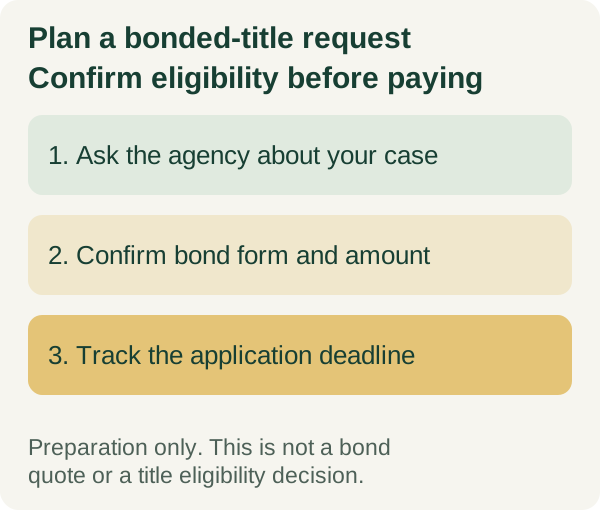
Before paying a bond seller, ask the responsible motor vehicle agency whether your specific vehicle and ownership situation qualify. A lost certificate already recorded in your name may call for a duplicate instead. An unresolved ownership dispute, lien or ineligible vehicle may need a different process.
This guide uses AI-assisted research checked November 19, 2026. CarTruvo operates a vehicle marketplace and has a commercial interest in helping people prepare to buy and sell. It does not issue surety bonds, decide title eligibility or provide an independent legal review. The calculation below is hypothetical preparation material, not a bond quote or actual transaction.
What the bond does and what remains to be checked
A title bond and an auto insurance policy address different problems. The bond supports the title process and the claims covered by its terms. It is not collision coverage, a mechanical warranty or a refund promise to the applicant. Read the bond and any indemnity agreement before signing, including who can claim, what the surety can recover from you and how disputes are handled.
The Texas Department of Insurance's bond resources identifies the certificate-of-title surety bond used for a bonded vehicle title and describes a three-year effective period in Texas. Do not apply that duration to every state's process or assume a notation disappears automatically without any agency action. Ask the issuing agency what happens at the end and what a later buyer will receive.
Keep ownership evidence separate from condition evidence. A bonded designation concerns the title's ownership-evidence process; it does not, by itself, tell you whether the car has collision, flood, salvage or odometer history. Other brands and restrictions may also matter. Our rebuilt-versus-salvage guide addresses those separate damage-related categories.
First decide whether replacement, correction or bonding fits
Describe the problem precisely when contacting the agency:
- A title was issued in your name and the paper was lost: ask about a duplicate title.
- A lender holds the title or a lien still appears: ask the lender and agency about release or electronic-title steps.
- You received incomplete ownership evidence: ask which missing documents can be obtained and whether a bond route is available.
- The seller's name differs from the named owner: explain the whole ownership chain, including each actual sale and assignment.
- The vehicle is abandoned, has a disputed owner or has a restricted title status: ask which dedicated procedure applies before buying any bond.
Prepare a factual file rather than selecting a process from a title-service advertisement. Include the VIN, available ownership papers, purchase and payment records, seller contact details, known liens and the reason the usual documents are unavailable. Identify what is known, what is only a seller's statement and what still needs agency confirmation.
State examples show why eligibility comes first
Texas's bonded-title instructions require qualifying residency or military status, possession and an eligible complete vehicle. The agency reviews ownership evidence and lien issues before issuing a determination stating the required bond amount. Its instructions restrict eligibility where a qualifying recorded lien cannot be released. The process is not simply “buy a bond, then get a title.”
Georgia's bonded-title guidance has its own conditions, including Georgia residency, a vehicle requiring a Georgia title and exclusions for abandoned vehicles and 1985-or-older models. It calls for designated forms, inspection and history evidence, available ownership papers and any required lien release. These are examples from two states, not a national eligibility checklist.
Use your agency's current instructions for the specific vehicle. If a title-service provider proposes applying through another jurisdiction, ask the agency how that route would comply with your facts, residency and eventual registration requirements. A service's willingness to take payment does not establish eligibility.
Bond amount is different from the price you pay
The bond amount is the financial amount written into the required bond. The premium is the price quoted for issuing it. Title, inspection, tax and registration charges are separate. Get an itemized written quote showing which amount is which and whether any service fee or refund condition applies.
Texas determines the vehicle value for its process and requires a bond equal to 1.5 times that value. Georgia instead specifies twice the department-established average retail value, with a $5,000 minimum bond. Those formulas should not be substituted for one another, and your purchase price is not necessarily the agency's assigned value.
Here is an invented Texas-style arithmetic example: if the agency determines an $8,000 value and the 1.5 multiplier applies, the required face amount would be $12,000. That does not mean the premium is $12,000. It also does not tell you the premium, approve the vehicle or estimate its resale price. Obtain the actual determination and licensed issuer's quote before budgeting the transaction.
Ask the bond provider for the exact principal name, VIN, required form, surety authorization, premium, extra charges and any indemnity obligations. Check those against the agency's requirements. If you have not yet received a required eligibility determination, avoid buying a speculative bond with the wrong wording or amount.
Build an application calendar from the official instructions
Record the steps in their actual order: agency review, any required records or inspection, value determination, bond purchase, title application and follow-up. Some tasks can happen together; others depend on a document being issued first.
For example, Texas specifies application within 30 days after purchasing the bond. Georgia specifies applying for title within six months of the bond's issue date. Read the complete current instructions for the starting point and required submissions. Do not treat either example as a deadline for every state or assume that buying a second bond fixes an expired application.
Keep a dated copy of the agency checklist, determination and submitted packet. Ask where to send originals and what copies you should retain. Track any additional-document request separately from the original submission receipt. A receipt shows submission, not necessarily approval or authorization to operate the vehicle.
Questions before buying a car that already has a bonded title
Ask to see the actual current title and identify the issuing state, VIN, named owner, bonded notation and any other brands or liens. Ask the seller why bonding was needed, when the title was issued, what supporting records are available and whether there have been competing ownership claims. Record unanswered questions rather than treating an explanation as proof.
Then contact the agency that would issue your title. Ask whether it accepts the current certificate, what additional documents are required, whether the bond or notation affects transfer and what happens if a claim arises. Ask your proposed lender and insurer about that exact vehicle and title status before making a nonrefundable commitment. Agency acceptance does not guarantee financing or coverage.
Research the vehicle's history and arrange an independent inspection. A valid ownership document and acceptable mechanical condition are different requirements. Do not price the car as an ordinary unbranded example merely because it can be registered somewhere. Conversely, do not infer unrepaired collision damage solely from a bonded notation; investigate the actual history.
Free bonded-title preparation record
Use the blank bonded-title planning worksheet to record the agency's eligibility answer, required evidence, official valuation, face amount, quoted premium, deadlines and unresolved questions. It contains no approval, price forecast or government application.
For sellers, accurately describe the current title status and available documents. For buyers, complete the title, insurance, financing and condition checks before committing. The next useful result is a confirmed state-specific path and complete evidence file, followed by the agency's actual decision.
BEFORE YOU TAKE THE NEXT STEP
Practical checklist
Check the VIN, ownership record and seller details.
Arrange an independent inspection and review the written terms.
Confirm the total cost and title-transfer process before paying.
CHECK THE DETAILS
Sources and further reading
Follow the source linked beside a claim for its context. For a transaction, confirm current requirements with the relevant agency, lender or provider.
- Texas Department of Insurance's bond resourcestdi.texas.gov
- Texas's bonded-title instructionstxdmv.gov
- Georgia's bonded-title guidancedor.georgia.gov
YOUR NEXT READ