Titles & paperwork
How to Get a Duplicate Car Title: Owner, Lien and Application Checklist
Prepare a duplicate car title request with the right issuing state, applicant, lien evidence and documents. Includes state examples and a free checklist.
Published
Sources checked . How this guide is prepared.
START HERE
The short answer
To get a duplicate car title, contact the motor vehicle agency in the state that issued the title, confirm who may request it, and submit that agency's current replacement application, identification, supporting documents and fee. First establish whether a paper title was lost, a lender holds it, or the state maintains an electronic title. Those situations can require different actions.
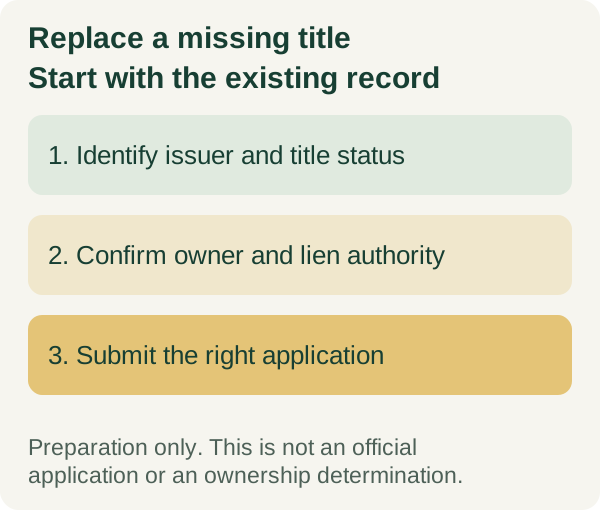
A replacement request should reproduce the existing ownership record. If you bought a car but never received a properly assigned title, ask about completing or correcting the transfer instead. Requesting a duplicate in your own name is not a shortcut around a missing ownership link.
This guide uses AI-assisted research checked November 19, 2026. CarTruvo operates a vehicle marketplace and has a commercial interest in helping people prepare to buy and sell. It does not issue titles or determine legal ownership. The checklist is original preparation material, not an official application or independent legal review.
Step 1: identify the issuing state and the actual problem
Start with the last title record, not simply the state where the vehicle is parked. Gather your registration, any title copy, purchase records and loan information. Compare the vehicle identification number on those records with the vehicle. If the documents disagree, record the discrepancy and ask the issuing agency what it needs before submitting an application.
Choose the description that fits:
- Lost or damaged paper certificate: ask for the issuer's duplicate, replacement or certified-copy process.
- Active loan or recently paid loan: ask the lender whether it holds a paper title, participates in electronic titling, or has sent the required release.
- Electronic title with no missing paper: ask about obtaining a paper certificate or completing the state's electronic transfer process.
- Seller never supplied the title: ask the agency to review the purchase and ownership chain.
- Incorrect owner, lien or vehicle information: ask whether a correction or transfer must accompany or precede replacement.
For the broader sale decision, see selling a car without a title. This guide focuses on preparing a replacement request for an existing title record.
Step 2: confirm who can apply and who must sign
Do not assume the person keeping or driving the car can request its title. Tell the agency the recorded owners, any lienholder, and whether the applicant is an owner, agent, business representative, trustee or estate representative. Ask what authority and identification that particular role requires.
State differences matter. Texas's certified-copy instructions require all recorded owners to sign and provide identification. Its instructions also address lienholder participation and an original lien release when applicable. Michigan's duplicate-title guidance says any listed owner can apply and only one owner needs to sign. Michigan also describes a separate appointment-of-agent process.
These are examples of why a generic instruction to “get every owner notarized” can be wrong. Use the actual issuer's form and instructions to determine signatures, witnessing or notarization. If someone is deceased, a business has closed, or an owner cannot participate, explain that fact before choosing a form. A relative's permission by text is not a substitute for whatever authority the agency requires.
Step 3: resolve the lien and delivery questions
A paid loan and a cleared title record are separate facts. Ask the lender for the payoff date, release status, release method and destination of any certificate. Keep the lender's response with your request record. If the agency still shows a lien, ask which release document or electronic confirmation it accepts.
Before paying for replacement, settle these questions:
- Is the title paper or electronic, and who currently controls it?
- Does the recorded lienholder need to apply, sign or release its interest?
- Where will the replacement be mailed, and whose address is currently on file?
- Must an address update happen separately before the request?
- Does a recent title issue date create a waiting period?
- What happens if the original turns up after a replacement is issued?
Keep your full identification documents, signatures and title numbers out of public listings. Share sensitive application records through the agency's designated channel, rather than sending them to someone offering to “fix” the title in a marketplace message.
Step 4: assemble the current application packet
Open the application from the official state website yourself. Avoid using a saved form from an old forum post. Record the form number, current instructions and the date you checked them. Verify that a search advertisement has not taken you to a paid intermediary.
Prepare an application record with these fields:
- Issuing state, official page and application name.
- VIN, year, make and the existing title or registration details requested.
- Recorded owner names and the applicant's authority.
- Lienholder status and required release evidence.
- Required identification, signatures and any witnessing or notarization.
- Mailing address, accepted payment and submission channel.
- Agency contact, confirmation number and follow-up date.
Read combined forms carefully. California DMV's title guidance directs applicants with a missing title to REG 227, the Application for Replacement or Transfer of Title. The form name includes two tasks; it does not mean every applicant completes every transfer section. Follow the instructions for your actual transaction and lien situation.
Before submission, compare the application with the source records one field at a time. Keep a private copy of what you submitted and a payment receipt. If a field is uncertain, ask the agency instead of guessing an owner name, signing for another person or altering an old assignment.
Step 5: choose a submission method and realistic timeline
Online, mail and office service are not interchangeable in every state or for every applicant. Michigan, for example, distinguishes ordinary duplicate service, office-only instant titles and a mail route limited to specified out-of-state applicants. Check your eligibility for the channel before arranging a sale around it.
Separate three dates in your notes: when you may apply, when the agency expects to process the request, and when the document should reach the authorized recipient. A published estimate is not a guaranteed closing date. Texas currently specifies a waiting period after a title was last issued; read its current instructions before filing another request.
Ask what confirmation you will receive and how to follow up. If selling, describe the status precisely: “replacement requested” and “replacement received” are different statements. For a paper-title closing, arrange the handoff after the necessary document is available unless the responsible agency confirms another permitted process for your case.
What if you bought the car and the title is still in someone else's name?
Pause the duplicate request and describe the actual sequence to the title office: who sold the car, who is named on the certificate, who signed, and which documents you received. Keep the listing, messages, purchase agreement and payment evidence. Do not ask someone to create a signature or replace the true purchase date.
Our title-jumping guide explains how to review that ownership chain. A bonded title is a separate, state-specific possibility for some deficient-evidence cases, not the standard replacement process and not an automatic solution. The agency must identify an eligible route based on the facts.
Free duplicate-title preparation record
Use the blank duplicate-title checklist to record the issuer's requirements, the responsible person and what remains unresolved. It opens in spreadsheet software and contains no prefilled eligibility decision. It is not a government form. Keep a blank copy separate from the private copy containing your vehicle details.
Once the replacement arrives, check the VIN, owner names, lien information and document status before scheduling a transfer. If you are selling, use our title-signing preparation guide alongside the issuer's actual instructions. The next step is an accurate, usable ownership document, followed by the correct transfer for your transaction.
BEFORE YOU TAKE THE NEXT STEP
Practical checklist
Check the VIN, ownership record and seller details.
Arrange an independent inspection and review the written terms.
Confirm the total cost and title-transfer process before paying.
CHECK THE DETAILS
Sources and further reading
Follow the source linked beside a claim for its context. For a transaction, confirm current requirements with the relevant agency, lender or provider.
- Texas's certified-copy instructionstxdmv.gov
- Michigan's duplicate-title guidancemichigan.gov
- California DMV's title guidancedmv.ca.gov
YOUR NEXT READ