Titles & paperwork
What Is Title Jumping? Check the Ownership Chain Before Buying
Learn what title jumping means, check a seller’s ownership documents and ask the title office about missing links before paying. Includes a free review record.
Published
Sources checked . How this guide is prepared.
START HERE
The short answer
Title jumping commonly means reselling a vehicle without properly recording an intermediate ownership transfer. A private seller may hand you a title naming an earlier owner and ask you to fill in the blank buyer space. That leaves a question you should resolve before paying: what documents establish this seller's authority to sell and your ability to title the car?
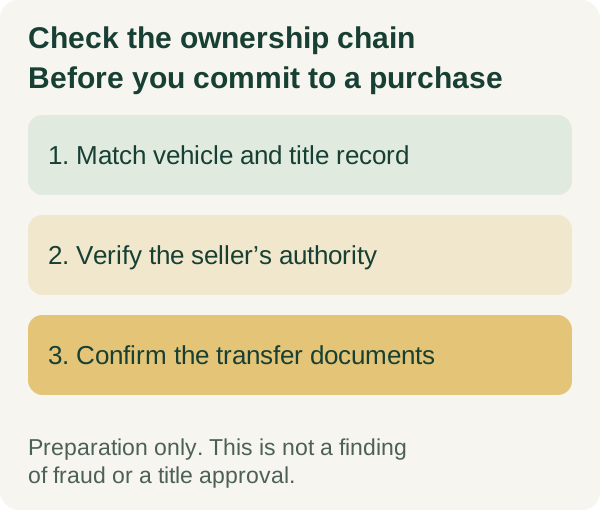
A name mismatch needs an explanation and an agency-approved documentation path. It does not, by itself, prove a crime. Licensed dealer reassignments, authorized representatives and estate transactions can involve different paperwork from an ordinary owner-to-buyer private sale. Do not accept “everyone does it” as the explanation.
This guide uses AI-assisted research checked November 19, 2026. CarTruvo operates a vehicle marketplace and has a commercial interest in helping buyers and sellers prepare. It does not certify ownership or decide whether a particular person violated state law. The examples are hypothetical preparation scenarios, not documented transactions or independent legal review.
Recognize the ownership gap
Consider this invented example: Jordan is named on the certificate. Casey says they bought the car from Jordan and now want to sell it to you. Casey offers Jordan's signed title with the buyer section empty. Before treating that certificate as transferable to you, establish how the issuing and receiving agencies require Casey's purchase and resale to be documented.
Do not put yourself into a blank space simply because a signature is already present. The issue is the true transaction sequence, including assignments, disclosures, liens, taxes and any required intermediate transfer. A bill of sale describes a transaction; whether the available documents are sufficient to issue your title is a separate agency determination.
Start by asking: “Whose name is on the current title, what is your role, and what documents connect that owner to this sale?” Ask before traveling or sending a deposit. If the seller has only a photo of a certificate, arrange to examine the actual required documents before committing.
Check four links before discussing payment
Use four lines in your notes: vehicle, recorded owner, seller authority and proposed buyer transfer. Each needs evidence that fits the actual transaction.
- Vehicle: compare the VIN on the vehicle with the certificate and purchase documents. Record discrepancies for the title office.
- Recorded owner: identify the name shown on the available ownership document and whether a newer title or electronic record may exist.
- Seller authority: establish whether you are dealing with that owner, a licensed dealer or someone acting under recognized authority.
- Buyer transfer: ask the responsible agency which assignments, releases, applications and disclosures this exact sequence needs.
Virginia DMV's used-car buying guidance recommends comparing the title owner's name with the identification of the person signing the bill of sale. It also recommends history research and a mechanic's inspection. A successful identity check answers one question, not the car's condition or every transfer requirement.
You can inspect identification without posting a copy of it or the seller's signed title in a public discussion. Keep transaction records private and share them only with the people or agencies that need them.
Distinguish a private resale from a documented exception
An unexplained mismatch is a reason to pause. A documented role is a reason to ask the right follow-up questions. Ask a dealer for its legal business name, license details and the reassignment documents required for the sale. Ask an agent, trustee or estate representative which documents establish signing authority. Verify those details through the relevant agency rather than relying on an online profile.
State instructions can address intermediate sellers directly. California DMV's private-party registration page says a seller who is not the owner named on the title requires a bill of sale signed by both that seller and the named owner. That is a California document requirement, not a nationwide permission to skip transfers or a promise that one bill of sale resolves every case.
For a transaction crossing state lines, describe the sequence to the agency that will issue your title and ask whether documents from the prior jurisdiction are acceptable. Do not infer a legal exception from another state's website. Avoid online claims that every mismatch carries the same criminal classification or penalty in all states.
Use a title-office question that includes the actual facts
Prepare a short factual description before calling or visiting. For example: “I am considering buying a vehicle titled in State A. The certificate names Jordan. Casey says they purchased it and are now reselling it. I have these documents. What additional records, transfers or signatures would your office require before issuing my title?”
Then ask:
- Which office should review these documents before the purchase?
- Does an intermediate owner need to complete a transfer first?
- Are any dealer reassignments or representative-authority documents acceptable here?
- What evidence is needed for a recorded lien or a missing original certificate?
- Are vehicle inspections, odometer records or another jurisdiction's records required?
- What remains uncertain until a complete application is reviewed?
Record the office, date, staff instructions and any case number. Ask for the official page or written checklist when available. Preliminary guidance is useful for preparation; it is not an issued title or a guaranteed approval.
What a vehicle history report can and cannot answer
Use history research alongside the ownership review. The federal NMVTIS consumer information page explains the system's title, brand and related vehicle-history purpose. A report can help surface information worth investigating, but it is not the seller's identification, an executed assignment or an agency decision to issue your title.
Keep three questions separate: can this seller convey the required ownership interest, what brands or history are recorded, and what is the vehicle's present condition? A clean-looking certificate or an uneventful report does not complete all three checks. Use our clean-title explanation for title terminology and arrange an independent inspection for condition.
If you already paid for a car with an ownership gap
Preserve the documents as received, including envelopes, messages, the listing, seller contact details and payment records. Write down the actual transaction dates and who gave you each document. Keep the vehicle and documents available for the checks the agency requests.
Ask the issuing or receiving title office to review the complete sequence. If the seller can provide missing lawful documentation, get the agency's instructions for that correction. If the facts suggest fraud or the seller disappears, ask the appropriate motor vehicle enforcement or consumer-protection office how to report it. For a disputed ownership or recovery claim, consider qualified local legal assistance.
Texas's missing-title guidance describes a possible bonded-title route with eligibility and lien restrictions. It does not establish that every ownership gap qualifies. Do not pay a title service or bond seller before the relevant agency identifies the proper route. Never alter a signature, erase an assignment or backdate a sale to make the story fit a form.
If you are the seller
If your own ownership was never properly recorded, resolve that issue before promising a normal title handoff to the next buyer. Explain the facts accurately to the title office. If you are the recorded owner and simply lost the certificate, use the separate duplicate-title checklist.
When you complete a sale, accurately identify the buyer and follow the issuer's assignment and seller-reporting instructions. Our title-signing preparation guide helps organize those questions. Keep a private record of the actual sale rather than handing over an open assignment for unknown future buyers.
Free ownership-chain review record
Download the blank title-chain question record. Use it to separate a seller's statement, supporting evidence, the office that can confirm it and the next unresolved step. It is preparation material, not a legal determination or government application.
If the seller cannot explain the ownership chain or allow the necessary checks, leave the purchase unresolved and keep shopping. A price reduction does not supply a missing assignment, release or lawful signing authority. Complete the documentation review before turning a paperwork uncertainty into a paid purchase.
BEFORE YOU TAKE THE NEXT STEP
Practical checklist
Check the VIN, ownership record and seller details.
Arrange an independent inspection and review the written terms.
Confirm the total cost and title-transfer process before paying.
CHECK THE DETAILS
Sources and further reading
Follow the source linked beside a claim for its context. For a transaction, confirm current requirements with the relevant agency, lender or provider.
- Virginia DMV's used-car buying guidancedmv.virginia.gov
- California DMV's private-party registration pagedmv.ca.gov
- NMVTIS consumer information pagevehiclehistory.bja.ojp.gov
- Texas's missing-title guidancetxdmv.gov
YOUR NEXT READ