Buying a car
Bumper-to-Bumper Warranty: What It Covers and What to Check
Understand bumper-to-bumper warranty coverage, exclusions and repair costs. Use a four-part coverage check and a free worksheet before buying.
Published
Sources checked . How this guide is prepared.
START HERE
The short answer
A bumper-to-bumper warranty generally covers defects across a broad range of vehicle systems for a stated time and mileage. It does not mean every part, every repair or every reason a part fails is covered. Before buying a car, identify the actual warranty, its remaining period, the failed component and the exclusions that could affect a claim.
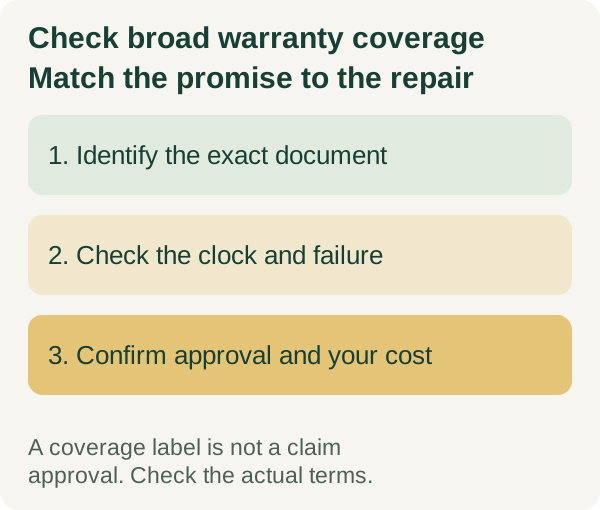
The useful question is more specific than “Does it have bumper-to-bumper coverage?” Ask: “Which written agreement would pay for this particular failure, on this VIN, at this date and mileage?” That question works for a new-car offer, a used-car listing and an optional protection quote.
What does a bumper-to-bumper warranty cover?
Manufacturer coverage commonly addresses defects in materials or workmanship. As a concrete example, Chevrolet’s warranty page describes its Bumper-to-Bumper Limited Warranty as three years or 36,000 miles, whichever comes first, including parts and labor for covered defects. That is a Chevrolet example, not a universal coverage period for other brands or every model year.
A broad warranty can reach systems outside the engine and transmission. Whether a particular sensor, screen, air-conditioning repair or electrical fault qualifies still depends on the applicable booklet and what caused the failure. A component being installed on the vehicle is only the starting point.
For a used vehicle, ask the manufacturer’s dealer to identify the original warranty start date and remaining coverage using the VIN. Buying the vehicle used should not be treated as proof that a fresh coverage period starts. Ownership rules also matter: the Hyundai warranty guide explains a manufacturer example where the owner’s status changes the powertrain answer.
What does it usually leave out?
Read the exclusions alongside the covered-system list. In the Chevrolet example, routine maintenance and damage caused by accidents, misuse or insufficient maintenance are excluded. Its page distinguishes tire defects from ordinary tire wear. A tire can therefore be a covered item for one cause and the owner’s expense for another.
Use these questions to translate a sales description into something you can verify:
- Is the problem a defect, normal wear, an adjustment or damage from an outside event?
- Does this component have a shorter or separate coverage period?
- Are maintenance records relevant to this particular failure?
- Is diagnosis covered if the eventual repair is excluded?
- Who must approve the repair, and where can it be performed?
- Are rental, towing or trip expenses included, and under what separate limits?
Do not assume a cracked windshield, worn brake pad or collision-damaged camera qualifies merely because the car is inside the time and mileage limits. Ask which clause and failure cause the provider would use. Conversely, a vague statement that “wear items are excluded” is not enough to resolve a claimed manufacturing defect without looking at the actual terms.
Bumper-to-bumper versus powertrain coverage
Bumper-to-bumper describes broader coverage across vehicle systems. Powertrain coverage focuses on specified propulsion-related components. The precise lists and exclusions control; neither label supplies a complete parts catalog.
A vehicle can have remaining powertrain protection after its broader warranty expires. That does not automatically pay for a failed infotainment display, door mechanism or air-conditioning component. Match the diagnosed part to the agreement that is still active rather than choosing whichever warranty has the longest advertised duration.
If a listing says only “factory warranty,” request both the broad warranty and powertrain answers separately. Add any separate battery, emissions, corrosion or certified-program documents that could apply. Keep the provider and expiration information attached to each program so that different protections do not get blended into one promise.
Factory warranty or optional service contract?
The FTC’s warranty and service-contract explainer distinguishes a warranty included with a car from a separately purchased service contract. The optional product often marketed as an extended warranty needs its own terms reviewed.
That distinction matters when comparing a used-car offer. “Bumper-to-bumper” in an advertisement might refer to remaining manufacturer protection, a dealer’s limited warranty or a separately priced contract. Get the provider, contract name, complete price and sample terms before comparing offers.
For a manufacturer-branded optional example, see Honda Care extended warranties. For a retailer-specific question, use the separate Carvana warranty guide. Neither should be assumed to have the same exclusions or claim process as a new Chevrolet warranty.
Run a four-part coverage check
First, identify the exact document. Record the VIN, model year, warranty or contract name, provider and booklet version. Save the written offer rather than relying on a screenshot of a short headline.
Second, calculate the clock. Record the start date, ending date and odometer ceiling. Ask whether ownership, prior use or another condition affects eligibility. Leave an unknown field blank until it is answered; do not replace it with the vehicle’s purchase date by default.
Third, match the failure. Record the symptom, technician’s diagnosis, proposed repair and relevant coverage language. “The engine light is on” is a symptom, not an approved component or failure cause.
Fourth, confirm the procedure. Ask where the car should go, who authorizes work, what the diagnostic charge could be and which records are needed. Before authorizing paid work, establish who owes the bill if coverage is declined. Keep the written answer with the estimate.
A hypothetical repair-cost example
Suppose an optional service contract is offered as broad coverage, and a repair estimate is $1,200. Assume the provider approves $900 of that work and the contract applies a $100 deductible to the approved portion. The plan pays $800. The owner pays the $300 unapproved portion plus the $100 deductible, for $400 total.
Those figures are invented to show the arithmetic. They are not Chevrolet warranty terms, an actual claim, a repair-price estimate or a prediction that any provider would approve that work. If the deductible works differently, or the entire failure is excluded, the result changes.
When comparing contracts, request the breakdown instead of treating the estimate minus the deductible as an automatic benefit. Separate covered labor and parts, excluded work, diagnostic charges, benefit limits and your own required payment.
If the coverage answer is unclear
Ask for a written explanation identifying the applicable agreement, the reason for the decision and the relevant provision. If the dispute concerns maintenance, gather the actual service records and ask what connection the provider claims between the maintenance issue and the failure.
The FTC explains that independent maintenance or an aftermarket part does not automatically void a vehicle warranty; damage caused by improper work or a defective aftermarket part can be treated differently. Keep the distinction tied to the actual facts. This is not a promise that every repair will qualify or that a service contract follows identical rules.
For a buying decision, an unresolved coverage question is a budgeting question. Obtain an inspection and price the vehicle with that uncertainty visible. A seller’s assurance that “everything is covered” is not a substitute for the provider’s terms.
Take a coverage record to the seller
Download the bumper-to-bumper coverage worksheet. It separates the document, coverage clock, component, failure cause and claim procedure, with space for the person responsible and the next step.
Ask the seller or provider: “Please identify the exact coverage for this VIN, its start and end points, the important exclusions and the process for getting a repair approved.” Save their response before treating warranty coverage as part of the car’s value.
BEFORE YOU TAKE THE NEXT STEP
Practical checklist
Check the VIN, ownership record and seller details.
Arrange an independent inspection and review the written terms.
Confirm the total cost and title-transfer process before paying.
CHECK THE DETAILS
Sources and further reading
Follow the source linked beside a claim for its context. For a transaction, confirm current requirements with the relevant agency, lender or provider.
- Chevrolet’s warranty pagechevrolet.com
- FTC’s warranty and service-contract explainerconsumer.ftc.gov
YOUR NEXT READ