Buying a car
Hyundai Car Warranty: Check What Transfers on a Used Car
Check Hyundai warranty coverage before buying used. Understand original-owner powertrain limits, transfer exceptions and the remaining time and mileage.
Published
Sources checked . How this guide is prepared.
START HERE
The short answer
Hyundai’s advertised ten-year or 100,000-mile powertrain warranty is not ten years of coverage for every part on every used Hyundai. For an ordinary subsequent owner, Hyundai says powertrain components fall under the five-year or 60,000-mile New Vehicle Limited Warranty, whichever comes first. The original coverage clock matters, along with the vehicle, owner status and applicable exclusions.
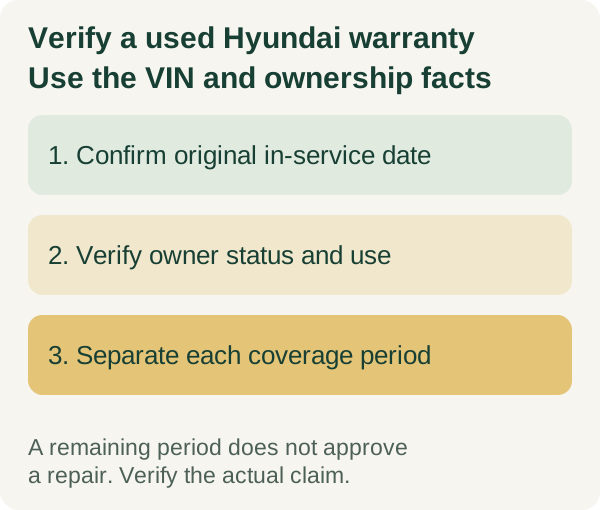
Before valuing a used Hyundai’s warranty, get the VIN, original in-service date, current mileage and correct model-year handbook. Then have a Hyundai dealer identify which programs remain active for you. “It still has the ten-year warranty” is a statement to verify, not a complete buying answer.
What are Hyundai’s main warranty periods?
Hyundai’s official U.S. warranty page describes a five-year or 60,000-mile New Vehicle Limited Warranty and a ten-year or 100,000-mile Powertrain Limited Warranty for eligible original owners. Each ends at its applicable time or mileage limit, whichever comes first.
The broader new-vehicle warranty and the longer original-owner powertrain warranty are different promises. The powertrain section identifies particular components; it does not extend every system’s coverage to ten years. Coverage also addresses qualifying defects under the terms, rather than every expense that can arise while owning the vehicle.
Some components and benefits have separate or shorter periods. Hyundai’s page lists examples such as paint and adjustment coverage. Hybrid and EV batteries, emissions protection and other programs need their own applicable terms. Avoid turning either the five-year headline or the ten-year headline into a universal answer for the entire vehicle.
Does the ten-year warranty transfer to a second owner?
For an ordinary second or subsequent owner, Hyundai’s official page says powertrain components are covered under the five-year or 60,000-mile New Vehicle Limited Warranty. This is remaining coverage within the original period, not a fresh five-year allowance created by resale.
There are important qualifications. The current warranty page identifies a spouse-transfer provision for model year 2024 and newer. The 2026 Hyundai owner’s handbook, printed pages 25–26, says original-owner powertrain coverage may remain when an original owner transfers the vehicle to a spouse who was not listed as a retail purchaser at the original purchase. Do not assume that exception applies to an unrelated private buyer.
The same 2026 handbook says an original lessee who buys the vehicle at the end of the lease retains the powertrain warranty, subject to its terms. It also excludes commercial use such as taxi, route delivery and rental from that powertrain warranty. These distinctions make a short ownership count inadequate on its own.
Use the handbook for the vehicle’s actual model year and have the dealer confirm the recorded facts. A lease buyout, spouse transfer, demonstrator or other unusual history deserves a specific answer, rather than forcing it into a generic “first owner versus second owner” label.
How the remaining coverage clock works
Consider a hypothetical vehicle whose applicable five-year or 60,000-mile coverage began January 15, 2025. An ordinary subsequent buyer purchases it in November 2026 at 48,000 miles. Assuming that coverage otherwise applies, the outer limits would be January 15, 2030 or 60,000 miles, whichever comes first.
The buyer has 12,000 miles before the mileage ceiling, not another 60,000 miles from purchase. Reaching 60,000 before January 2030 would end that period earlier. Passing the date limit first would also end it even if the car still had fewer miles.
This is invented calendar and mileage arithmetic, not a warranty approval for a real car. A specific claim still depends on the component, failure cause, ownership, use and applicable terms. Other programs might have different limits; put them on separate lines rather than stretching this example to cover them.
Check a used Hyundai’s coverage in six steps
Start with the VIN and model year. Match the VIN on the car, title or registration, sale documents and warranty inquiry. Do not accept a coverage printout for a similar vehicle on the lot.
Get the original in-service date. A model year, current sale date or first date you see on a listing is not sufficient evidence of the warranty clock. Ask the dealer to identify the date used in Hyundai’s system and any discrepancy with the vehicle’s records.
Confirm owner status and prior use. Explain whether you are an ordinary used buyer, the original lessee completing a buyout or someone claiming a specific transfer exception. Ask what documentation is needed. Disclose relevant prior commercial use instead of assuming it has no effect.
Record the current odometer reading and each applicable endpoint. Keep the broad vehicle warranty, powertrain protection and separate programs distinct. Ask for the answer in writing, with the inquiry date and the person who provided it.
Check the maintenance and condition evidence. Gather service records and arrange an independent pre-purchase inspection. A remaining coverage period does not tell you whether a specific existing problem is covered or whether the car has been maintained appropriately.
Finally, identify the unresolved issue. For each expensive concern, ask which warranty section could apply, whether inspection or diagnosis is required and what the claim process would be. A VIN inquiry establishes a useful starting point; it is not advance approval of every future repair.
Certified cars, service contracts and engine extensions
A dealer’s certified listing may involve coverage beyond the ordinary used-car answer. Request the exact certification program, proof that the VIN is enrolled and its separate warranty terms. A dealer’s own certification label should not be assumed to establish manufacturer-certified eligibility. The certified pre-owned guide explains the documents to compare.
An optional service contract is another separate product. Record its provider, covered systems, deductible, expiration and authorization requirements. Read the bumper-to-bumper warranty guide before treating a broad sales label as proof that every repair is included.
A recall, campaign, warranty extension or settlement-related program can also have a different eligibility test. Ask Hyundai to check the VIN and identify the exact program, covered condition and required evidence. Do not generalize an engine-extension story about one model or failure into a promise that every Hyundai engine replacement will be free.
If a seller relies on one of these programs to justify a higher price, obtain the actual documents before paying. Keep the ordinary factory warranty answer visible alongside the separate program instead of replacing it with a larger headline.
What to ask before authorizing a repair
Ask the service department to name the proposed diagnosis, the potentially applicable coverage and any inspection or diagnostic charge you would owe if the claim is declined. Establish who authorizes the work and whether additional approval is needed if the repair expands.
If coverage is denied, request the stated reason and relevant handbook or program provision in writing. Keep that answer, the diagnosis, estimate and maintenance records together. This gives you a specific issue to raise with the provider rather than a general dispute over the advertised warranty length.
Do not treat a scheduled appointment, open campaign entry or remaining date on a printout as a promise that your full estimate has been approved. For a buying decision, keep unresolved repairs in the inspection and budget discussion until the provider gives a concrete answer.
Keep a VIN-specific warranty file
Download the Hyundai warranty verification worksheet. It records the original date, owner status, relevant handbook section, separate programs and unanswered claim questions, with room for the source and next action.
Use it to ask a dealer: “For this VIN and my ownership status, which coverage remains, when does each program end, and what evidence supports that answer?” Compare cars after you can answer those questions, rather than comparing only their advertised warranty headlines.
BEFORE YOU TAKE THE NEXT STEP
Practical checklist
Check the VIN, ownership record and seller details.
Arrange an independent inspection and review the written terms.
Confirm the total cost and title-transfer process before paying.
CHECK THE DETAILS
Sources and further reading
Follow the source linked beside a claim for its context. For a transaction, confirm current requirements with the relevant agency, lender or provider.
- official U.S. warranty pagehyundaiusa.com
- 2026 Hyundai owner’s handbookhyundaiusa.com
YOUR NEXT READ