Buying a car
Classic Car Insurance Companies: Compare Hagerty, Grundy and American Collectors
Compare Hagerty, Grundy and American Collectors by actual eligibility, permitted use, value terms, deductibles and complete premium before choosing a policy.
Published
Sources checked . How this guide is prepared.
START HERE
The short answer
Hagerty, Grundy and American Collectors Insurance offer collector-vehicle programs worth comparing against your actual car, driving plans and storage. Start with eligibility and permitted use, then compare the proposed insured value, coverage, deductibles and complete premium. A cheap quote for a use the program does not accept is not a suitable comparison.
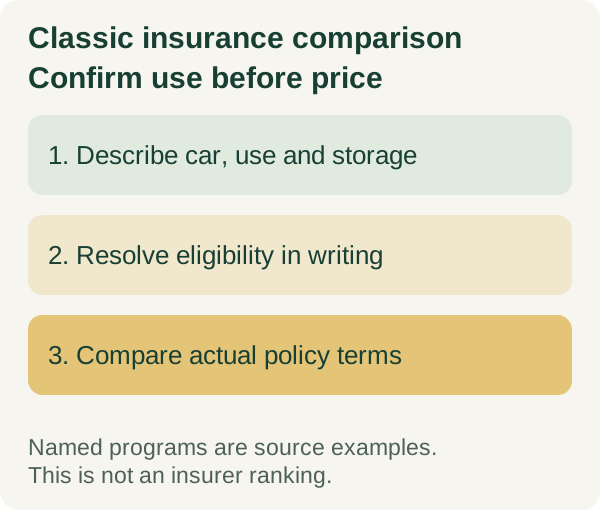
The names below identify the programs being discussed. Confirm the issuing insurer, policy documents and state availability on your actual offer. This is a source-based comparison checklist, not a tested ranking or a personalized insurance recommendation.
Compare your use before comparing premiums
Prepare one description of the car and how you expect to use it. Include the vehicle’s condition and modifications, storage location, estimated mileage, other household vehicles and any planned commuting, events, transport or restoration.
Give each provider the same description. Ask which uses are accepted, which need further review and which are excluded. Record the answer in writing with the relevant quote or policy language. A broad phrase such as pleasure driving should be explained against your actual plans.
An old model year alone does not settle collector-program eligibility. Ask about your specific vehicle and circumstances before assuming it qualifies or changing a description to fit an online form.
Hagerty: clarify use, storage and regular-use vehicles
Hagerty’s qualification page describes collector use including club functions, exhibitions and occasional pleasure driving, while excluding a daily-driver role. It prefers secure enclosed storage but says other storage types may be considered, subject to review and restrictions.
The page also describes household regular-use vehicle and insurance requirements. Ask Hagerty to explain how those conditions apply to your household, storage and vehicle category. Do not assume a driveway automatically disqualifies you or that occasional use automatically qualifies you.
Useful follow-up: “Here is where the car is stored and how each licensed household member travels. Which parts are acceptable, and what evidence or exceptions need underwriting review?” Keep the actual decision separate from the general website description.
Grundy: separate mileage from permission for a particular use
Grundy’s collector-vehicle program page advertises agreed-value protection, no mileage restrictions and collector activities such as exhibitions, parades and pleasure driving. It presents a zero-deductible option as opt-in.
No mileage restriction should not be read as permission for every purpose. Ask the program to confirm your actual commuting, business, event, storage and driver arrangements, plus the deductibles and endorsements in the offer. An optional feature is not automatically part of the quoted policy.
Grundy’s valuation explanation describes underwriting review of a requested value and supporting material such as photos or restoration records. Ask what evidence it needs for your car. A requested value and an accepted insured value are separate stages.
American Collectors: match the mileage plan and actual terms
American Collectors’ classic-car page describes agreed-value coverage and tailored mileage plans. Its feature section explains that a covered total-loss benefit is subject to the applicable deductible. Its eligibility section discusses limited use, condition, storage and regular-use vehicles, with some arrangements subject to consideration.
Ask which mileage plan matches your expected driving and how the policy treats a change in use. Have the provider identify the actual storage acceptance, repair provisions and any towing or spare-parts benefits included in your offer.
The same page discusses additional features and coverage options. Record the selected terms rather than treating every item mentioned on a product page as an unlimited benefit in your own policy.
Agreed value: ask for the actual settlement wording
Grundy’s explanation distinguishes agreed value, actual cash value and stated value. Its agreed-value process involves review before the policy is issued. American Collectors’ product page also describes agreed value while expressly mentioning a deductible in its feature explanation.
For each offer, ask the provider to show the proposed insured amount and the actual loss-settlement provision. Have it explain deductible treatment, exclusions, covered events and what would remain your responsibility. A large number beside the car’s name does not answer every claims question.
Do not treat an appraisal, asking price, loan balance and insured value as interchangeable. If you are financing the purchase, the vintage car loan guide helps organize the separate lender and affordability questions. Confirm any insurance requirements directly with the lender.
An original three-status comparison record
Use three statuses for every important requirement: confirmed in writing, needs clarification, or not accepted. Complete eligibility and intended-use rows before comparing premiums. This is an original organization method, not an insurer approval system.
Imagine a buyer plans to drive a collector car to work regularly. One program’s general description excludes daily-driver use, while another inquiry has not yet produced a clear answer. This is an invented scenario, unrelated to any real applicant or quote.
Mark the first use mismatch and leave the second unresolved. A quote number alone does not turn either entry into confirmed coverage for that plan. Ask for a suitable written offer or reconsider the proposed use before relying on the policy.
Compare benefits on the same specification
Once eligibility and use are clear, request comparable terms for the same car, insured value and policy period. Ask each provider to identify:
- Liability and other required coverages and limits.
- Comprehensive and collision terms and deductibles.
- Loss-settlement wording and treatment of the vehicle’s value.
- Selected towing, spare-parts, restoration or transport provisions.
- Permitted drivers, storage conditions and use restrictions.
- Complete premium, fees, payment terms and effective dates.
Keep a difference visible when the offers cannot be matched. For the general coverage categories, see what full coverage car insurance usually includes. This collector-program guide focuses on eligibility, permitted use and value terms.
Download the classic-car insurance comparison worksheet
Use the blank classic-car insurance company worksheet for sixteen provider, use, valuation and coverage questions. Keep separate copies for each actual offer, with written answers and any unresolved conditions.
Before a purchase or transport handoff, obtain confirmation of the vehicle and coverage effective date from the responsible provider. Do not rely solely on an unfinished application or a general newly-acquired-car statement.
Source check: November 21, 2026. The named program pages describe their own offerings and do not establish every policy’s terms. No live quote, application, license or financial-strength evaluation, claim test or independent insurance-professional review was performed for this guide.
BEFORE YOU TAKE THE NEXT STEP
Practical checklist
Check the VIN, ownership record and seller details.
Arrange an independent inspection and review the written terms.
Confirm the total cost and title-transfer process before paying.
CHECK THE DETAILS
Sources and further reading
Follow the source linked beside a claim for its context. For a transaction, confirm current requirements with the relevant agency, lender or provider.
- Hagerty’s qualification pagehagerty.com
- Grundy’s collector-vehicle program pagegrundy.com
- Grundy’s valuation explanationgrundy.com
- American Collectors’ classic-car pageamericancollectors.com
YOUR NEXT READ