Buying a car
FWD vs. AWD: Which Should You Buy?
Compare FWD and AWD for your route, winter tires and total costs. Use a fuel-budget example and blank worksheet to check the actual used car before buying.
Published
Sources checked . How this guide is prepared.
START HERE
The short answer
FWD powers the front wheels. AWD can supply driving power to the front and rear wheels, with the distribution depending on the vehicle’s system. AWD can help a car get moving on slippery surfaces, but it does not give it an automatic braking advantage. Choose between them using your actual route, tires, vehicle condition and total ownership cost.
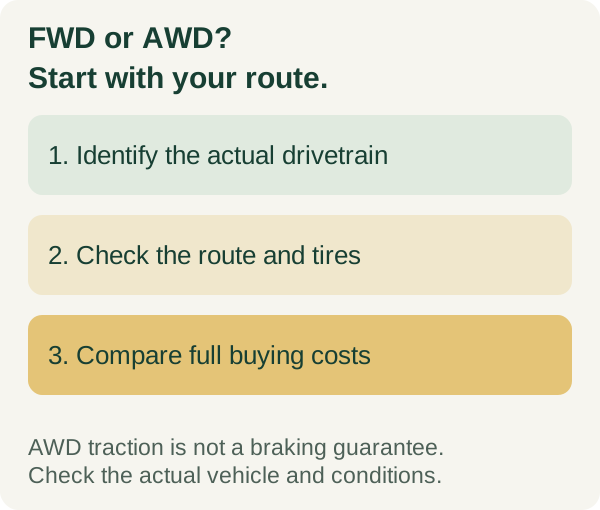
For a buyer who mostly uses maintained roads and can avoid severe weather, an appropriate FWD car may meet the need at a lower purchase cost. A steep snowy driveway or frequent travel on poorly cleared roads may make AWD more useful. Neither badge establishes that a particular used car is ready for winter.
What FWD and AWD actually mean
Nissan’s drivetrain explanation distinguishes front-wheel drive from systems capable of powering both axles. FWD does not mean that the rear wheels are stationary; they roll, but the drivetrain does not propel them.
AWD is a category, not one identical mechanism. Some systems vary power delivery automatically. For example, Toyota’s E-Four owner guidance describes automatic control between front-wheel drive and AWD according to running conditions. Do not assume every AWD car continuously divides power equally between four wheels or uses the same hardware.
A model may offer both FWD and AWD, and the difference can change across model years or trims. Confirm the actual car’s configuration through its manufacturer documentation and VIN-specific equipment information. The make and model identification guide explains how to keep year, trim and configuration separate.
Is AWD better than FWD in snow?
AWD can be useful when you need additional traction to accelerate on snow or ice. That addresses getting moving, not every part of winter driving. AAA’s winter-driving guidance specifically cautions that AWD and four-wheel drive do not make a vehicle brake better simply because it has that drivetrain.
Tires still connect the car to the road when accelerating, turning and stopping. NHTSA’s tire guidance explains differences among tire types, including winter tires for snow conditions. Tire size, pressure, condition and suitability for the weather belong in the comparison alongside drivetrain.
Do not interpret this as a promise that any FWD car with winter tires will outperform any AWD car. Actual tires, road conditions, speed and vehicle behavior matter. Follow the vehicle and tire manufacturers’ instructions, allow more space in poor weather and postpone a trip when conditions exceed what you can safely manage.
Use your route to decide whether AWD is worth it
Write down the difficult part of your normal trip rather than choosing from a general climate label. A plowed city route and an unmaintained uphill access road can create very different needs in the same region.
- Describe your steepest driveway or recurring hill and how promptly it is cleared.
- Record how often you must drive before roads are treated, including early work shifts.
- Decide whether you can delay trips or use another form of transport during severe weather.
- Check the clearance and tire requirements of the actual vehicle, not only its powered wheels.
- Budget for appropriate tires and maintenance before spending the entire allowance on the AWD option.
If you cannot identify a recurring benefit, compare the AWD premium against alternatives such as a better-condition FWD car and a suitable tire plan. If you regularly face a difficult route, have a qualified shop assess the specific AWD candidate instead of accepting the badge as proof of capability.
A hypothetical five-year FWD versus AWD fuel comparison
Here is an invented budgeting example, not an EPA rating or a quote for a current model. Assume two otherwise suitable vehicles, 12,000 miles per year and fuel at $3.50 per gallon. Assume the FWD candidate returns 30 mpg and the AWD candidate returns 28 mpg.
- FWD: 12,000 divided by 30 is 400 gallons, costing $1,400 per year.
- AWD: 12,000 divided by 28 is about 428.57 gallons, costing $1,500 per year.
- The modeled fuel difference is $100 per year, or $500 over five years.
- If the AWD car also costs $2,000 more to buy, those two differences total $2,500 over five years.
That is a partial comparison. It excludes financing, taxes, insurance, tire and service differences, and resale value. Actual driving and fuel prices change the result. Use the EPA’s Find and Compare Cars tool to locate the correct year, engine and drivetrain configuration, then substitute your own mileage and fuel assumptions. Do not apply one model’s fuel difference to every FWD/AWD pair.
What to check on a used AWD or FWD car
Ask for tire information for all four corners: brand, model, size, visible condition and available replacement history. Have the inspecting shop compare the tires with the manufacturer’s requirements, including any limits on differences in tire size or wear. Do not assume every AWD puncture requires four new tires; establish the actual vehicle’s requirements and the proposed repair or replacement options.
Ask the shop to identify the drivetrain, assess relevant components and leaks, and compare documented service with the manufacturer’s schedule for that configuration and use. Missing records are unanswered questions, not proof that a component has failed or that no maintenance is due.
Use the pre-purchase inspection guide to agree on scope and price before the appointment. An inspection should address the whole vehicle, including brakes and tires, rather than focusing exclusively on the AWD system. A newer drivetrain badge cannot offset unresolved condition problems elsewhere.
Does AWD replace four-wheel drive or increase towing capacity?
Do not infer off-road hardware, low-range gearing, ground clearance or a tow rating from the AWD label. Check the actual model’s owner manual and towing documentation for the required equipment and limits. If towing or difficult terrain is the main reason for the purchase, make that a separate vehicle-capability check.
Likewise, do not assume that a FWD car cannot meet an ordinary commuting need. The useful comparison is between two identified vehicles and the conditions you actually face, rather than a universal winner between drivetrain names.
Download the FWD versus AWD comparison worksheet
Use the blank FWD and AWD buying worksheet to record the route, exact configurations, tire evidence, fuel assumptions and inspection questions. It has sixteen prompts with space for evidence, the person responsible and a follow-up date. The diagram above gives the order: identify the car, assess the route and tires, then compare costs.
For model ideas after you have chosen the capability you need, see used AWD cars to compare. Keep the final decision tied to the actual inspected car. Choose AWD when its documented benefits justify its costs for your use, and choose FWD when it meets the same transportation need with a stronger overall deal.
Source check: November 19, 2026. This guide compares buying decisions and uses an expressly hypothetical cost example; it does not report a CarTruvo winter road test or certify a vehicle’s condition.
BEFORE YOU TAKE THE NEXT STEP
Practical checklist
Check the VIN, ownership record and seller details.
Arrange an independent inspection and review the written terms.
Confirm the total cost and title-transfer process before paying.
CHECK THE DETAILS
Sources and further reading
Follow the source linked beside a claim for its context. For a transaction, confirm current requirements with the relevant agency, lender or provider.
- Nissan’s drivetrain explanationnissanusa.com
- Toyota’s E-Four owner guidancetoyota.com
- AAA’s winter-driving guidanceinfo.oregon.aaa.com
- NHTSA’s tire guidancenhtsa.gov
- EPA’s Find and Compare Cars toolfueleconomy.gov
YOUR NEXT READ