Buying a car
Make vs. Model of a Car: Identify the Vehicle Before Comparing It
Understand car make versus model, then verify year, trim, VIN and equipment before comparing prices, reports or quotes. Includes a free identity worksheet.
Published
Sources checked . How this guide is prepared.
START HERE
The short answer
A car’s make is its brand, such as Nissan or Honda. Its model is the named vehicle within that brand, such as Altima or Civic. Model year, trim, body style and powertrain add further detail. The VIN identifies the particular vehicle you need to match across the car, documents and any quote or report.
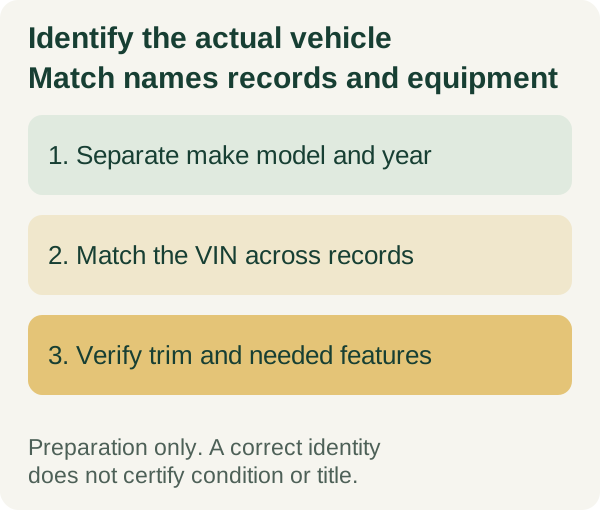
If a form asks for make and model, enter the brand and model name in their respective fields. Keep the year and trim separate when the form provides separate fields. Before comparing prices or buying a report, verify that every record describes the same car.
Make, model, year and trim in plain language
Progressive’s make-and-model explanation describes the brand-versus-model distinction and separates trim and model year. A Nissan Altima SV, for example, uses Nissan as the make, Altima as the model and SV as the trim designation. That example explains naming, not a current vehicle offer or its equipment.
The model year is another field. Record it from the applicable vehicle records rather than substituting the year you bought the car or first saw it advertised. A registration date is a date to investigate, not an automatic answer to every model-year question.
Body style describes the vehicle’s physical form, such as sedan, hatchback or SUV. Engine, transmission, drivetrain and hybrid or electric configuration can add distinctions that a short model name does not resolve. Keep those details attached when they affect the feature or comparison you care about.
Why the full description matters
Two advertisements can name the same make and model while describing different years, trims, mileage or equipment. A shared model name does not establish that the cars are interchangeable or worth the same amount.
Before comparing prices, identify the details that matter for your use. That could mean seating, cargo access, drivetrain, a particular safety feature, charging capability or towing equipment. Ask for evidence of the specific feature instead of inferring it from a trim label alone.
An insurance or financing quote also needs the actual vehicle information. Give the provider the VIN and requested details through its official process, and confirm the resulting quote refers to the correct car. A general model-level estimate is a starting point rather than a finalized quote for an individual vehicle.
Where should you check the information?
Begin with the vehicle and its ownership records. Compare the VIN on the car with the title or registration, sale paperwork and any history report. Our VIN location guide helps organize that check without treating a badge as proof of identity.
NHTSA’s public VIN decoder page explains its identifying-information lookup and the 17-character VIN format described under its regulations. Use the official decoding route to investigate encoded vehicle information. Record the VIN carefully; a transposed character can send your research toward a different or invalid record.
For factory equipment, request the vehicle’s original window sticker, build information or manufacturer/dealer confirmation for that VIN. Then check what is actually installed and functioning. If a decoding result does not resolve the trim or an option, leave it unconfirmed until better evidence is available.
Older vehicles can require different identification research. Do not modify a short historical identifier merely to make a modern form accept it. Ask the responsible provider or titling agency how that particular vehicle should be identified.
Separate three kinds of evidence
Keep the seller’s description, vehicle records and physical observation on separate lines. They answer related questions but are not interchangeable.
The advertisement tells you what the seller is claiming. A title, registration or manufacturer record supplies documented identifying information. The inspection tells you about the vehicle and equipment presently in front of you. None should be silently rewritten to match another source when a difference appears.
Use a simple sequence: write the disputed detail, identify the document or observation that could resolve it, and record the answer. If the seller calls a car a higher trim but cannot supply supporting information, compare and budget with the trim still unresolved rather than assuming the advertised label is correct.
A shortened model entry on a document is a question for the issuing agency or provider; it is not automatic proof of fraud. A VIN mismatch is more serious to resolve before paying or relying on a quote. Ask the responsible party to explain and correct the actual record through its proper process.
A hypothetical comparison with missing details
Suppose two invented listings both say “Nissan Altima, $18,000.” One includes a model year, trim and VIN; the other provides only a name and price. That does not establish that the second car is a bargain or the first is overpriced.
Ask for the missing year, mileage, VIN, trim, body configuration and condition evidence. If the cars turn out to have different years or equipment, separate them in your comparison. If an important feature is still unverified, do not assign it the same value in both rows.
The example contains no actual inventory, valuation or recommendation to buy either car. Its point is that a price comparison becomes useful only after you know what is being compared. The used-car inspection checklist covers the separate condition evaluation.
How does this connect to MSRP and history reports?
A manufacturer’s starting price may describe a different configuration from the car in an advertisement. Match the actual year, trim and options before comparing a claimed discount. The MSRP guide explains how the factory reference and complete transaction price differ.
A vehicle history report needs the correct identifier too. Matching the make and model is helpful, but it does not replace matching the VIN. Use the NMVTIS history-record guide for title-history checks once the identity is established.
A correct identity also does not establish current mechanical condition, ownership authority or a clear title. Keep those checks visible rather than treating a successful VIN decode as approval to buy.
What should you enter when a website’s fields do not match?
Use the form’s actual field labels and available categories. If the exact trim or model is missing, ask the site or provider how to represent it accurately. Do not select a more expensive trim to make the listing look better, and do not invent a model year to bypass a form.
When preparing a sale listing, distinguish confirmed equipment from features that still need checking. When requesting an insurance, loan or parts quote, give the provider the full identifying details it requests and verify the result. If a record is corrected, update the related quote or listing instead of assuming every system will update automatically.
Keep one vehicle identity record
Download the make, model and equipment worksheet. It keeps the VIN, separate naming fields, supporting documents and unresolved equipment questions together. Store private ownership documents securely when sharing a limited description with a seller or provider.
Your next step is to match the VIN and fill in the make, model, year, trim and configuration from evidence. Compare prices, reports and quotes after those details describe the same vehicle.
BEFORE YOU TAKE THE NEXT STEP
Practical checklist
Check the VIN, ownership record and seller details.
Arrange an independent inspection and review the written terms.
Confirm the total cost and title-transfer process before paying.
CHECK THE DETAILS
Sources and further reading
Follow the source linked beside a claim for its context. For a transaction, confirm current requirements with the relevant agency, lender or provider.
- Progressive’s make-and-model explanationprogressive.com
- NHTSA’s public VIN decoder pagenhtsa.gov
YOUR NEXT READ