Buying a car
Lease Buyout Loan: Compare the Price, Financing and Ownership Steps
Compare lease buyout loans using the full purchase quote, lender eligibility, APR and total cost. Includes a hypothetical example and completion worksheet.
Published
Sources checked . How this guide is prepared.
START HERE
The short answer
A lease buyout loan finances the purchase of a vehicle you currently lease, when your agreement and leasing company permit that purchase. You replace the lease arrangement with ownership subject to a new loan. Approval, the full purchase amount and the ownership-transfer process all need confirmation before the transaction is complete.
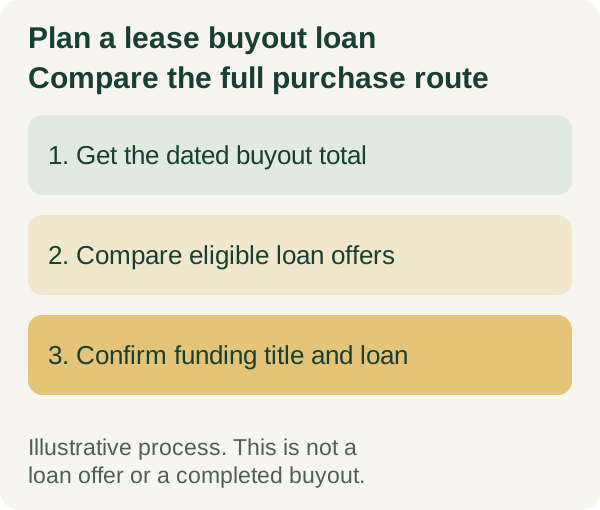
Start with a dated, itemized buyout quote from the leasing company. Then compare loan offers for that exact transaction and calculate the complete cost of keeping the car. The residual value in the original contract is an important reference, but it is not a substitute for a current total that identifies taxes, fees and any other amounts due.
How is a buyout loan different from refinancing?
With a lease buyout, you purchase a vehicle owned by the lessor. With an ordinary auto refinance, you replace an existing loan on a vehicle you already purchased. The lender needs to support the transaction you actually have.
Navy Federal’s lease-buyout explanation describes financing as one way to purchase your leased car and recommends confirming the exact price and additional fees with the leasing company. Ask about an end-of-term purchase separately from an early buyout; do not assume the quote, timing or required payments are identical.
If you intend to resell the car, read whether you can sell a leased car. Buyer restrictions, a second title transfer and resale costs create a different decision from keeping the vehicle. An expected buyer’s offer is not permission to transfer a leased car.
Get the full purchase amount in writing
Request a quote for purchase by you, using the correct account and VIN. Record its expiration date, accepted payment method, payee, required purchase route and document instructions. Ask which payments must continue while the purchase is pending.
Separate the following amounts so nothing is omitted or counted twice:
- Vehicle purchase amount and any purchase-option fee.
- Taxes included in the quote and taxes payable elsewhere.
- Title, registration, processing or other required charges.
- Outstanding payments or other obligations included or excluded.
- Cash you will contribute and the amount requested from the lender.
- Any optional products, shown individually rather than bundled into the vehicle price.
Have the leasing company explain what happens to return-related charges if you purchase. Record the actual answer instead of assuming every disposition, mileage or damage charge automatically disappears in every circumstance. Verify state-specific tax and title treatment with the relevant agency or transaction provider.
Which lenders offer lease buyout loans?
Banks, credit unions and auto-finance companies may support buyouts, with different eligibility and funding processes. Ally’s buyout page provides a current example: it separates existing Ally leases from leases with other companies and distinguishes prequalification from a subsequent application.
The same page identifies geographic restrictions on its online buyout financing, including Indiana, Nevada, Vermont, Wisconsin and the District of Columbia, and directs affected customers toward a dealer route. That is a provider-specific condition, not a statement that residents cannot buy their leased vehicle through any available process.
Star One’s lease-buyout page is a credit-union example that describes coordinating payoff and paperwork with the leasing company. Confirm membership, vehicle and transaction eligibility before comparing an advertised rate with an offer you can actually obtain.
Ask every candidate lender whether it accepts your lessor, VIN, vehicle age and mileage, state, use and requested purchase route. A lender advertising auto refinancing does not establish that it finances lease purchases.
Compare lease buyout loan rates correctly
There is no universal buyout APR. Obtain current written offers for the same amount and term, and identify the actual approval conditions. A lowest advertised rate is not a personalized quote or a promise that the lender will advance the full purchase total.
Compare APR, interest rate, principal, term, payment count, finance charge and total payments. Record upfront costs separately. If an optional product is financed, show its price and borrowing cost so that two offers are not compared as if they contain the same items.
Ask when a credit inquiry occurs. Ally’s page, for example, describes a soft inquiry for prequalification and a hard inquiry for an official application. Do not assume every provider’s eligibility form follows that sequence. Prequalification also does not settle final approval, funding or title acceptance.
For general rate context, use the car-loan rate guide. A market average is a benchmark, not the rate for your buyout.
A hypothetical buyout financing example
Assume an itemized purchase requires $23,000 for the car, $1,700 in taxes and $300 in title and other required charges. The total is $25,000. Assume you contribute $1,000 and finance the remaining $24,000.
At an invented fixed annual rate of 7%, with monthly amortization and no additional loan fees, a 60-month loan would require about $475.23 per month. Unrounded payment arithmetic produces about $28,513.73 in loan payments, including about $4,513.73 in interest. Adding the $1,000 cash contribution gives about $29,513.73 for this modeled acquisition and financing.
At the same rate over 48 months, the payment would be about $574.71, with about $27,586.07 in loan payments. The shorter term has a higher monthly obligation but about $927.65 less interest than the 60-month version.
These figures are hypothetical, not current lender rates, tax estimates, approvals or a vehicle valuation. Actual rounding and a final payment can differ. Insurance, repairs and ongoing ownership expenses are additional. Changing the rate, fees or amount financed changes the comparison.
Is buying out your lease a good deal?
Compare the full acquisition price with comparable vehicles you could actually buy, adjusted for condition, mileage and history. Then evaluate the cost of financing and keeping this car. A purchase price below a retail listing does not by itself prove an easy resale profit or an affordable ownership plan.
Knowing the car’s history helps you ask better questions, but familiarity is not an inspection. Review upcoming maintenance, tires, repair needs and remaining warranty. Include an allowance for costs you could face after coverage expires. Use the inspection checklist to identify concerns before taking on a new loan.
Compare returning the vehicle and replacing it as a separate complete route, including actual return obligations and replacement costs. Keep the same comparison period. Do not compare one buyout payment with another vehicle’s down payment as if either represents the whole decision.
Complete the lease, loan and title steps
Get written instructions showing who sends funds, how the correct amount is verified and what happens if the quote expires. Confirm responsibility for title, registration, any new lender lien and insurance changes. Set a realistic timeline with the actual providers rather than relying on a generic promise of same-day completion.
After funding, confirm that the lessor received and applied the required amount, the lease account is resolved, and the new loan’s first payment and servicing details are correct. Verify the ownership and lien documentation through the responsible provider or motor vehicle agency.
Do not stop a scheduled lease payment solely because a loan application was approved. Ask the lessor how to handle payments while purchase processing is underway and how any overpayment would be reconciled. Keep confirmation of the completed transaction with your loan and vehicle records.
Use a buyout completion record
Download the lease buyout financing worksheet. It keeps the quote, complete price, loan comparison and final account/title confirmations in one place.
Your next step is to request the lessor’s itemized quote and permitted purchase process. Once those are clear, ask lenders to quote the same transaction so you can compare what you will pay and how ownership will be completed.
BEFORE YOU TAKE THE NEXT STEP
Practical checklist
Check the VIN, ownership record and seller details.
Arrange an independent inspection and review the written terms.
Confirm the total cost and title-transfer process before paying.
CHECK THE DETAILS
Sources and further reading
Follow the source linked beside a claim for its context. For a transaction, confirm current requirements with the relevant agency, lender or provider.
- Navy Federal’s lease-buyout explanationnavyfederal.org
- Ally’s buyout pageally.com
- Star One’s lease-buyout pagestarone.org
YOUR NEXT READ