Buying a car
Average Car Loan Interest Rate: 2026 Benchmarks and Quote Checks
Read dated new- and used-car loan rate benchmarks, understand APR and compare actual offers on the same terms. Includes a worked example and free worksheet.
Published
Sources checked . How this guide is prepared.
START HERE
The short answer
Experian reported average auto-loan interest rates of 6.35% for new vehicles and 11.19% for used vehicles in its Q2 2026 data. Those are national quarterly benchmarks, not a November 19 lender quote or a rate you are guaranteed to receive. Your actual offer depends on the borrower, vehicle, transaction and lender.
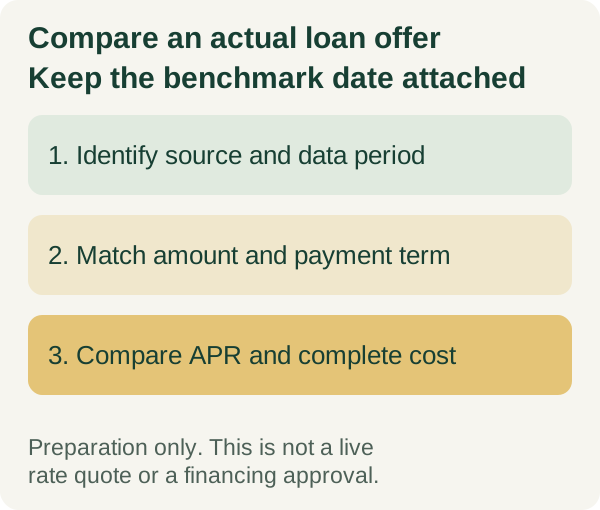
Use an average to frame questions, then compare completed offers for the same amount and repayment period. A rate below the national average can still come with an unaffordable payment, additional charges or a longer term than you intended.
This guide uses AI-assisted research checked November 19, 2026. CarTruvo operates a vehicle marketplace and has a commercial interest in helping buyers and sellers prepare. It does not provide financing, approve applicants or quote personalized loan rates. The calculation below is hypothetical preparation material, not a lender offer, actual transaction or independently reviewed financial recommendation.
What period does the average describe?
The figures above come from Experian's average car payment and financing data, which identifies Q2 2026 as the reporting period. The article's publication or update date is different from the quarter represented by its data. A page checked in November can legitimately describe an earlier quarter without becoming a November rate survey.
Before comparing another average, record four details: publisher, reporting period, new versus used vehicles and the borrower group. Also check whether the figure is a reported average, an advertised starting rate or a personalized approval. Those categories answer different questions.
Do not combine a new-car advertised rate from one lender with a used-car national average and assume the difference represents savings available on your chosen car. Eligibility, loan amount, term, fees and the underlying vehicle can differ. Keep the source label attached to every number you write down.
How much do the credit groups differ?
Experian's used-car rate explanation, checked November 19, reports the following Q2 2026 used-car APR averages by VantageScore 4.0 group:
- 781-850: 6.29%.
- 661-780: 8.81%.
- 601-660: 13.93%.
- 501-600: 19.10%.
- 300-500: 21.62%.
These are averages within that dataset, not lender approval thresholds or available rates. Do not put a score from a different model into a band and treat the result as a quote. Ask the lender which score and model it uses and what else affects the actual offer.
For eligibility and score-model questions, use our separate credit score needed to buy a car guide. This article focuses on interpreting a benchmark and comparing the resulting offers, rather than promising approval at a particular score.
Interest rate and APR are not interchangeable
The interest rate is one part of borrowing cost. APR expresses the cost of credit, including specified fees, as an annual percentage. The CFPB's Truth-in-Lending explanation describes APR, finance charge, amount financed and total of payments. Review the completed disclosures before signing.
Ask each lender for the same set of figures:
- Actual vehicle and seller type the offer permits.
- Amount financed and cash required upfront.
- Interest rate and APR, identified separately.
- Number of payments and payment amounts.
- Finance charge and total of payments.
- Fees, optional products and any special payment or payoff terms.
An advertised “as low as” rate is a starting point for an eligibility inquiry. Ask which qualifications, term, vehicle and discounts produce it, how long the quote remains valid and which conditions must be satisfied. Compare the offer you can actually accept rather than the headline available to some other borrower.
Worked example: compare the same principal and term
These invented figures demonstrate rate sensitivity. They are not current quotes and are separate from the Experian benchmarks. Assume a $20,000 fixed-rate loan, 60 equal monthly payments, no fees and ordinary monthly amortization. In this simplified example, APR equals the stated annual interest rate.
- At 8%, the payment is about $405.53. Total interest is about $4,332, making total payments about $24,332.
- At 12%, the payment is about $444.89. Total interest is about $6,693, making total payments about $26,693.
- The higher-rate example costs about $39.36 more per month and about $2,362 more in interest over the same period.
Rounded amounts can differ slightly from a lender's final payment schedule. The example excludes taxes, registration, insurance, maintenance and other acquisition or ownership expenses. Actual daily-interest timing, fees and payment dates can change the result.
Keeping principal and term constant makes the rate difference visible. If one offer extends the term, changes the down payment or adds a product, compare those changes separately before deciding which financing arrangement fits your budget.
Keep the vehicle price separate from the loan comparison
Get an itemized acquisition price for the exact VIN. Then reconcile the down payment, trade-in and any existing payoff with the amount financed. A lower APR does not correct an inflated vehicle price or an optional product you did not choose.
Use the purchase-agreement review guide to compare the approved quote with the final documents. For a private seller, check that the lender supports private-party transactions and the specific vehicle. A dealer-only approval cannot automatically fund an individual seller's car. Our private-party loan guide addresses those funding restrictions.
If a rate discount depends on automatic payments, membership or another condition, record it and ask what happens if the condition ends. Compare the remaining terms too. Avoid treating a lower monthly payment as proof of a lower complete borrowing cost when the term or balance has changed.
What if your offer is above the average?
Ask the lender to explain the relevant factors and confirm that the application and vehicle information are correct. Compare other eligible offers using consistent assumptions. If you authorize additional credit applications, ask each provider about its inquiry process rather than assuming every preliminary estimate uses the same kind of credit check.
Reconsider the vehicle budget if the complete payment and ownership costs do not fit. Options to evaluate include a less expensive vehicle, a different down payment that preserves your necessary reserves, or more preparation time before purchasing. These are comparison choices, not a guarantee that a changed application will be approved.
Also read the loan's early-payment terms. A seemingly attractive offer can still deserve questions about penalties, extra-payment treatment or its interest method. Our early payoff decision guide explains how to examine those terms without assuming that every loan works identically.
Free rate and loan-offer comparison record
Use the blank auto-loan rate comparison sheet to keep the source period, published benchmark, actual lender offer and complete costs separate. It is a manual worksheet, not a live rate feed, lender application or approval tool.
Choose from current offers you understand and can afford. Keep the dated benchmark for context, the lender's completed quote for the decision and the signed payment schedule for your records.
BEFORE YOU TAKE THE NEXT STEP
Practical checklist
Check the VIN, ownership record and seller details.
Arrange an independent inspection and review the written terms.
Confirm the total cost and title-transfer process before paying.
CHECK THE DETAILS
Sources and further reading
Follow the source linked beside a claim for its context. For a transaction, confirm current requirements with the relevant agency, lender or provider.
- Experian's average car payment and financing dataexperian.com
- used-car rate explanationexperian.com
- CFPB's Truth-in-Lending explanationconsumerfinance.gov
YOUR NEXT READ