Buying a car
Powertrain Warranty: What It Covers and What to Verify
Check what a powertrain warranty covers, its remaining time and mileage, transfer eligibility and claim process. Includes a blank coverage verification worksheet.
Published
Sources checked . How this guide is prepared.
START HERE
The short answer
A powertrain warranty covers specified components that generate and transmit the vehicle’s driving power, subject to its written terms. For a gasoline vehicle, that commonly means covered engine, transmission and drive-system parts. It is not a promise to pay for every problem under the hood or every repair needed to keep the car moving.
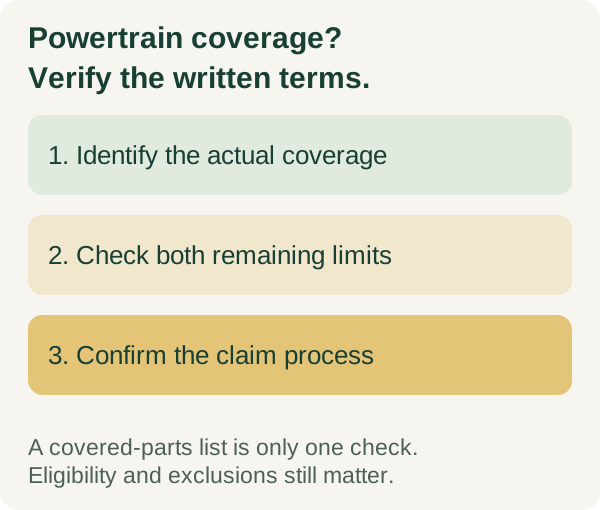
Before relying on coverage, establish five things: the actual covered parts, the time and mileage limits, the vehicle’s eligibility, the exclusions and the process for authorizing a claim. A seller saying “the powertrain is covered” leaves all five partly unanswered.
What does a powertrain warranty cover?
The covered-parts list is the starting point. As one manufacturer example, Nissan’s warranty overview identifies the engine, transmission and drive axle under its powertrain description. That does not establish the parts list or eligibility rules for a different manufacturer, model year or separately purchased plan.
Ask for the actual warranty booklet or contract for the car. Read the definitions and exclusions together. A description of an assembly does not necessarily mean every attached sensor, hose, seal, accessory or cause of failure is covered on the same terms.
If the car is hybrid or electric, establish the applicable coverage for its engine where fitted, drive system, high-voltage battery and other electrical systems. Do not map a gasoline-car parts list onto the entire vehicle or assume every battery issue belongs to powertrain coverage.
Powertrain versus bumper-to-bumper coverage
Powertrain coverage focuses on a narrower set of driving components. A broader new-vehicle limited warranty may cover other systems, but its own exclusions and limits still apply. The phrase bumper-to-bumper is not a literal promise that every item on the car is covered.
Use the bumper-to-bumper warranty guide for that broader comparison. Here, the practical question is which written provision applies to the particular problem. An air-conditioning fault, a transmission complaint and a battery-capacity concern should not be assumed to follow the same coverage path.
Also distinguish a manufacturer's included warranty from an optional service contract. The FTC’s warranty and service-contract guidance explains that separately purchased contracts, often marketed as extended warranties, have their own coverage and administration. A dealer can sell a contract without being the organization that decides or pays claims.
Check both the clock and the odometer
A time limit and a mileage limit are separate ceilings. Obtain the applicable start date, current mileage and original limits from the responsible provider. For a used car, do not assume that your purchase date restarts an existing factory warranty.
Here is an original hypothetical example. The provider confirms a five-year/60,000-mile powertrain term ending when either limit is reached. The car is 42 months into that term and has 52,000 miles. The maximum remaining headroom is 18 months and 8,000 miles, subject to all other terms.
If you drive 12,000 miles a year, those 8,000 miles would take about eight months at that assumed steady rate. The time limit still matters, but advertising only “18 months remaining” could give a very different impression of the useful window. This is an illustration, not confirmation of any actual car’s warranty or a prediction of when it will need repairs.
Does a used car’s powertrain warranty transfer?
Ask the provider to confirm the actual VIN, current owner, original start date and relevant transfer conditions. Some arrangements distinguish owner categories or require particular procedures. Do not turn a general model-family warranty length into a confirmed benefit for the next buyer.
Get a written answer that identifies the warranty or plan. A dealer-provided warranty, manufacturer warranty and certified-pre-owned program can have different terms even on the same vehicle. The Nissan warranty guide illustrates why brand-specific and ownership-specific checks matter.
If the seller supplies only a screenshot or summary, request the controlling document and provider confirmation. A history report, service invoice or model brochure may help identify questions, but none automatically proves that your future claim will be eligible.
Exclusions, maintenance and evidence of a fault
Read how the document treats maintenance, wear, outside damage, modifications and pre-existing conditions. Do not assume a breakdown is covered merely because the damaged part appears on a list; the cause and other terms can matter.
Keep service records with dates, mileage and work performed. The FTC explains that using someone other than the dealer for routine maintenance does not automatically invalidate an auto warranty. That is different from saying maintenance never matters or that damage caused by improper work must be covered.
For a car you are considering buying, ask an independent qualified shop to assess existing symptoms. The pre-purchase inspection guide helps establish scope and limits. Coverage should not replace a condition check, and an inspection does not promise that a later warranty claim will be approved.
Who pays for diagnosis, teardown and related expenses?
Before authorizing work, ask the provider or administrator what approval is needed and who pays if the diagnosis finds an excluded problem. Confirm any deductible, diagnostic charge, teardown responsibility, labor limit, replacement-parts rule and related towing or rental benefit.
Record the authorization reference and the approved scope. If you need an urgent safe transport alternative, keep that decision separate from an assumption that every expense will be reimbursed. Do not approve additional work because a verbal statement sounds like an unlimited commitment.
If a claim is denied, request the reason and applicable provision in writing. Follow the document’s dispute process and keep the estimate, diagnosis, communications and decision together. The FTC guidance identifies the administrator as an important contact for service-contract disputes; the responsible party for your actual arrangement should be established from its documents.
How to evaluate a lifetime powertrain offer
Ask whose lifetime the offer means, which owner and vehicle remain eligible, and what ends coverage. Read mileage, transfer, maintenance, repair-location and claim conditions rather than treating the headline as a calculation of guaranteed future value.
Compare the complete purchase price and the actual written benefit. An offer with a longer label is not automatically more useful if it excludes the fault you are concerned about or cannot be used where you will live. Do not buy a car with unresolved mechanical questions simply because the advertisement emphasizes lifetime coverage.
Download the powertrain coverage worksheet
Use the blank powertrain warranty verification worksheet to record sixteen items from the covered-parts list through transfer eligibility, remaining limits, claim approval and unresolved questions. Keep the actual document beside the worksheet so each answer has a source.
Before committing, you should be able to identify who is responsible for coverage, what vehicle and owner qualify, what limits remain and how a repair request works. If those answers are missing, describe the coverage as unverified while deciding whether the underlying car and complete deal still meet your needs.
Source check: November 19, 2026. This guide explains how to verify coverage; it does not approve a claim or report a vehicle test. Its remaining-coverage calculation is expressly hypothetical.
BEFORE YOU TAKE THE NEXT STEP
Practical checklist
Check the VIN, ownership record and seller details.
Arrange an independent inspection and review the written terms.
Confirm the total cost and title-transfer process before paying.
CHECK THE DETAILS
Sources and further reading
Follow the source linked beside a claim for its context. For a transaction, confirm current requirements with the relevant agency, lender or provider.
- Nissan’s warranty overviewnissanusa.com
- FTC’s warranty and service-contract guidanceconsumer.ftc.gov
YOUR NEXT READ