Buying a car
Toyota Extended Warranty: Compare VSA Terms Before Buying
Compare Toyota VSA purchase windows, covered systems, deductibles and full costs. Includes an original quote comparison and a blank extended-protection worksheet.
Published
Sources checked . How this guide is prepared.
START HERE
The short answer
When shopping for a Toyota extended warranty, first identify who is selling and administering the protection and which written agreement you would receive. Toyota Financial Services calls its optional repair protection a Vehicle Service Agreement, or VSA. It is separate from the factory warranty and is not required to obtain credit.
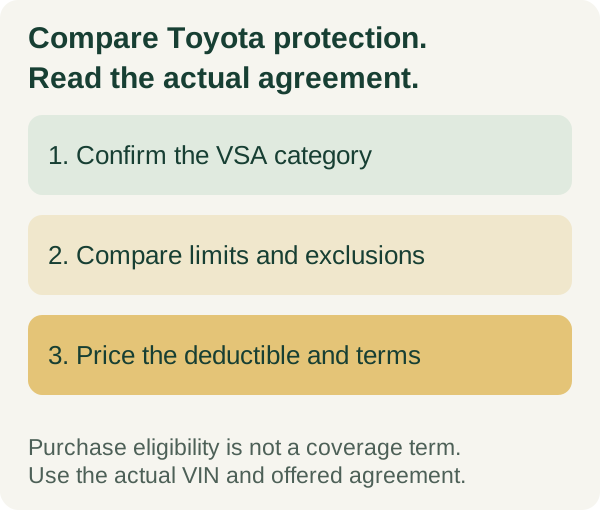
Compare the actual coverage category, purchase eligibility, start and end limits, exclusions, deductible and full price for your VIN. A Toyota badge or a familiar plan name does not establish that two quotes provide the same benefit.
Separate a Toyota VSA from other protection
Toyota Financial Services’ used-vehicle page presents Platinum, Gold and Powertrain VSA options. It identifies the product as optional and subject to the agreement’s conditions. Do not interpret a plan heading or a long component list as approval of every repair involving that system.
Ask separately about remaining factory coverage, any certified-used protection and maintenance benefits. A maintenance plan and a repair agreement answer different questions. Obtain the applicable documents instead of treating every item presented in the finance office as one extended warranty.
The FTC’s warranty and service-contract guidance explains why separately purchased service contracts can have their own limits and administrators. Confirm the agreement provider and claims contact rather than assuming the selling dealer alone decides what will be paid.
Can you buy the VSA after buying the Toyota?
The TFS purchase-eligibility FAQ distinguishes three categories. Its New Vehicle VSA purchase window is the first three years or 36,000 miles, whichever comes first. Its Certified Used Vehicle window is the first 12 months or 12,000 miles from purchase or lease, whichever comes first. Its Used Vehicle VSA must be purchased at the used-vehicle sale.
Those are purchase-window descriptions, not an interchangeable promise of coverage for that length. Ask the participating Toyota dealer which category applies to the actual VIN and how the relevant dates and mileage are measured. Do not assume that a recently purchased ordinary used Toyota has the certified-used purchase window.
The used-plan page also distinguishes model-year eligibility by protection level: current plus nine model years for Platinum and Gold, and current plus twelve for Powertrain, with less than 150,000 miles. Other qualifications still apply. Get the actual eligibility determination rather than choosing a category from age and mileage alone.
Read the coverage clock on the offered agreement
Record the agreement’s effective date and mileage, its expiration rules and the actual end date or odometer limit. Ask whether a stated term is measured from an original vehicle date, agreement purchase or another specified point. Do not silently add every advertised year to today.
TFS describes its used-vehicle coverage as measured from the used purchase or lease. Verify the declarations for the actual offered plan. The powertrain warranty guide explains why time and mileage must be checked separately and why remaining coverage does not approve a particular future claim.
Put any existing factory or certified protection on the same timeline. Overlap may be relevant to your decision, but it is not an automatic reason to accept or reject the VSA. Establish which arrangement would respond to the concern you actually want protection against.
Compare covered parts and exclusions together
Ask for the offered agreement and the relevant component/exclusion information before paying. Check the systems that concern you, the definition of a covered failure and any relevant maintenance, prior-condition or use restrictions.
Hybrid or electric components need their own document check. Do not infer battery coverage from a general powertrain heading or from a list that discusses hybrid components without reading the associated limitations. Obtain a written answer for the particular item if the description is unclear.
A VSA should not replace a condition check on a car you are about to buy. Use an independent pre-purchase inspection to investigate existing symptoms within an agreed scope. Do not assume an optional contract will pay to correct a problem already present at purchase.
Understand a disappearing deductible
The TFS used-plan page describes deductible options and a disappearing deductible tied to covered repairs at the selling dealer. Establish which deductible your quote includes and what you would pay elsewhere before treating two prices as equivalent.
Here is an original hypothetical comparison. Assume two written offers have otherwise equivalent coverage and conditions. Offer A costs $2,400 with a $0 deductible. Offer B costs $1,900 with a $100 deductible on each eligible repair visit that is not waived.
- With four such visits, B’s modeled total is $1,900 plus $400, or $2,300.
- With five, B’s modeled total is $2,400, equal to A’s assumed price.
- With six, B’s modeled total is $2,500, or $100 more than A.
These are invented quotes and visit counts, not predictions of repairs or current Toyota prices. Excluded work and other unequal terms could change the comparison, as could financing costs. If B’s deductible is actually waived under its conditions, that also changes the arithmetic. Establish the real terms before applying the method.
Get a complete price and claims explanation
Request the full contract price separately from the car price and a monthly-payment presentation. If financing it, ask how it changes the amount financed and complete repayment. Keep taxes and other applicable charges visible rather than assuming the quoted premium is the only cost.
Record who authorizes repairs, where eligible work can be done, what happens if you move and who pays diagnostic or teardown charges when a problem is excluded. Ask how related transport benefits are approved rather than assuming every rental bill will be reimbursed.
Check transfer and cancellation provisions in the actual agreement, including state-specific terms, fees, claims effects and the refund recipient if financed. A verbal promise of a full refund should not replace those provisions. This guide does not calculate a cancellation refund or determine a real contract’s eligibility.
Download the Toyota VSA comparison worksheet
The blank Toyota extended-protection worksheet contains sixteen prompts covering category, purchase window, coverage limits, provider, components, exclusions, deductible, price and claims questions. Use one copy for each offer and identify the source of each answer.
Choose after comparing the actual agreement with your needs, budget and existing protection. If a material term is missing, request it before buying rather than filling the gap with another owner’s plan or a generic online price range.
Source check: November 19, 2026. TFS US pages and the FTC guidance were checked for the distinctions above. The quote comparison is hypothetical; no Toyota eligibility inquiry, actual plan quote or independent professional review is claimed.
BEFORE YOU TAKE THE NEXT STEP
Practical checklist
Check the VIN, ownership record and seller details.
Arrange an independent inspection and review the written terms.
Confirm the total cost and title-transfer process before paying.
CHECK THE DETAILS
Sources and further reading
Follow the source linked beside a claim for its context. For a transaction, confirm current requirements with the relevant agency, lender or provider.
- Toyota Financial Services’ used-vehicle pagetoyotafinancial.com
- FTC’s warranty and service-contract guidanceconsumer.ftc.gov
- TFS purchase-eligibility FAQtoyotafinancial.com
YOUR NEXT READ