Buying a car
4-Cylinder vs. 6-Cylinder: Compare the Actual Engine and Car
Compare four-cylinder and six-cylinder cars using actual engine specifications, fuel requirements, service evidence and inspection findings, with a blank worksheet.
Published
Sources checked . How this guide is prepared.
START HERE
The short answer
A four-cylinder engine has four cylinders; a six-cylinder engine has six. Cylinder count describes part of the engine, but it does not determine by itself which car is faster, more economical, more reliable or better for towing. Compare the actual engine, vehicle configuration, service history and complete ownership costs.
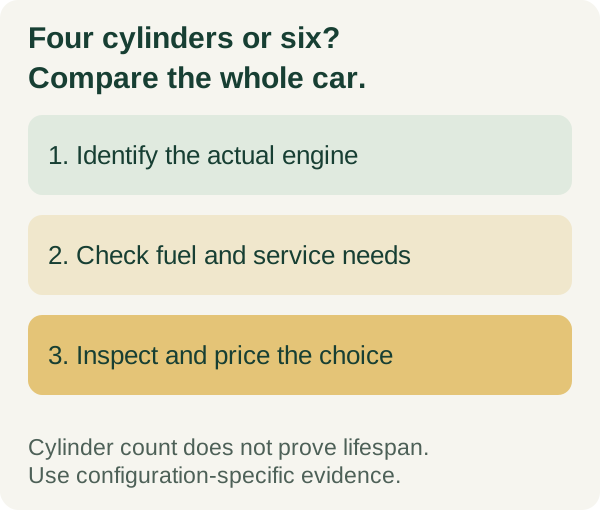
A four-cylinder can suit everyday driving, and a six-cylinder can suit a buyer who prefers a particular powertrain’s response. The useful decision is whether the identified car meets your needs, not whether one cylinder count wins every comparison.
Cylinder count, layout and engine size are different
Ford’s technical glossary defines cylinders as the chambers in which the pistons move and separately defines engine displacement as their combined swept volume. The liter figure describes displacement, not the number of cylinders. Do not infer the cylinder count from a number such as 2.0 or 3.0 alone.
Layout is another specification. I-4 means an inline four-cylinder arrangement; V6 means six cylinders arranged in two banks. Six-cylinder does not always mean V6, because other layouts exist. Keep the count, layout and displacement as separate entries when comparing listings.
The same model name can have different engines across years, trims or markets. Verify the actual VIN-specific configuration with manufacturer information rather than assuming a badge or seller’s broad description identifies the unit. Use the make-and-model guide when the listing leaves the year, trim or engine unresolved.
Does a six-cylinder always have more power?
No. You need the specifications for the actual engines and vehicles. Turbocharging, hybrid assistance, engine tuning, transmission and vehicle characteristics can change the comparison. Ford’s glossary describes a turbocharger as a device driven by exhaust gases; the presence of that equipment is separate from cylinder count.
Read the manufacturer’s power and torque figures with their conditions and units. A hybrid system’s combined output should not be assumed to equal a simple sum of separately listed engine and motor peaks. Likewise, a single advertised peak figure does not explain every part of a car’s response during your ordinary driving.
For a used-car buyer, a normal permitted test drive is an opportunity to judge comfort and suitability. Assess the kinds of driving you regularly do under safe, lawful conditions. Do not use hard launches, high-speed runs or overloaded tests to try to prove which engine is stronger.
Will the four-cylinder use less gas?
It might, but compare the specific configurations. A small turbocharged engine in a heavier vehicle is not the same fuel-economy proposition as a different engine in a lighter car. Drivetrain and transmission also matter.
Use the EPA’s side-by-side comparison, matching year, engine, transmission and driven wheels. Record the rating’s fuel type as well as mpg. Ratings are comparison information, not a promise of what you will achieve.
The EPA’s fuel-economy factors guidance explains that driving conditions, weather, loading and vehicle condition can affect consumption. Compare the figures under the same assumptions, and do not interpret one owner’s unusual trip as a controlled engine comparison.
Check fuel grade before comparing the fuel bill
Read the owner manual’s exact fuel requirement. A required premium grade and a recommendation for best performance are different instructions; use the manufacturer’s full guidance for the actual engine. Do not assume every turbo needs the same grade or that every six-cylinder accepts regular.
FuelEconomy.gov’s octane guidance directs drivers to the manufacturer’s specified rating and explains that higher octane concerns resistance to knocking. It is not a universal upgrade that makes every engine more powerful. If requirements are unclear, resolve them with the manufacturer before planning to use a cheaper grade.
Here is an invented annual fuel-budget example: both cars travel 12,000 miles. Candidate A is assumed to return 30 mpg using its permitted fuel at $4.00 per gallon. Candidate B is assumed to return 27 mpg using its permitted fuel at $3.50. A costs $1,600 per year; B costs about $1,555.56. B’s modeled fuel bill is about $44.44 lower despite its lower mpg.
Those assumptions are not current prices, actual ratings or a statement about which cylinder count requires premium. The lesson is to calculate miles divided by mpg, multiplied by the applicable fuel price. A smaller mpg number does not, by itself, establish the larger dollar bill. Purchase, insurance, financing, maintenance and resale differences remain outside this limited calculation.
Which engine lasts longer or costs less to maintain?
Cylinder count is not a lifespan guarantee. Identify the engine family and version, read the applicable service schedule and compare the actual records and inspection findings. More or fewer cylinders do not settle the history of a particular car.
Ask about documented maintenance, known problems, past repairs and outstanding recommendations. Have a qualified shop assess unclear symptoms or missing evidence. Do not treat a clean-looking engine bay, a short test drive or an owner’s confident claim as proof of internal condition.
The pre-purchase inspection guide helps establish what the shop will examine. Ask whether your concern requires additional diagnosis and what remains outside the agreed scope. Use written findings and estimates for the actual car rather than a generic four-cylinder or six-cylinder repair allowance.
Can you tow with a four-cylinder, or do you need six?
Use the manufacturer’s towing documentation for the actual vehicle and required equipment. Cylinder count alone is not a tow rating. The relevant vehicle, hitch, trailer and loading limits need to work together; have an appropriately qualified professional resolve the combination when necessary.
If towing or utility claims are the main reason for your purchase, the crossover-versus-SUV guide provides a documentation checklist. Do not buy an engine upgrade and assume that every other required component or rating comes with it.
Compare two candidates using the same evidence
- Identify each actual engine, including layout, displacement, turbocharging or hybrid system where applicable.
- Record the manufacturer specifications and correct configuration-specific fuel information.
- Check the owner manual’s fuel and service requirements.
- Try the ordinary driving situations that matter to you, safely and with permission.
- Obtain relevant records and an independent inspection for each used car.
- Compare complete purchase and ownership costs after resolving material questions.
If one car has better documentation and condition, give that evidence weight. If both satisfy your requirements, driving preference can help choose between them. Neither choice requires a universal claim that the other engine design is inferior.
Download the engine comparison worksheet
The blank four-cylinder and six-cylinder buying worksheet has sixteen prompts covering identification, specifications, fuel, service, driving observations, inspection and costs. Keep unresolved questions visible until you have an answer from the responsible source.
Choose the complete vehicle and powertrain that suit your use and budget. A cylinder count is a useful specification; a verified configuration, credible records and an acceptable full deal are what make it actionable.
Source check: November 19, 2026. This guide is based on documentation and an original hypothetical fuel calculation. It does not claim a CarTruvo engine durability study, instrumented performance test or actual repair quote.
BEFORE YOU TAKE THE NEXT STEP
Practical checklist
Check the VIN, ownership record and seller details.
Arrange an independent inspection and review the written terms.
Confirm the total cost and title-transfer process before paying.
CHECK THE DETAILS
Sources and further reading
Follow the source linked beside a claim for its context. For a transaction, confirm current requirements with the relevant agency, lender or provider.
- Ford’s technical glossaryford.com
- EPA’s side-by-side comparisonfueleconomy.gov
- EPA’s fuel-economy factors guidancefueleconomy.gov
- FuelEconomy.gov’s octane guidancefueleconomy.gov
YOUR NEXT READ