Buying a car
Crossover vs. SUV: Check the Construction and Capability You Need
Understand crossover and traditional SUV construction, then verify the actual towing, equipment and route requirements. Includes a blank capability worksheet.
Published
Sources checked . How this guide is prepared.
START HERE
The short answer
A crossover usually uses unibody construction, with the body and underlying structure designed as a unified assembly. A traditional SUV usually has a separate body mounted on a load-bearing frame. In everyday shopping, sellers also use SUV as a broad term that includes crossovers, so the name alone may not identify the construction.
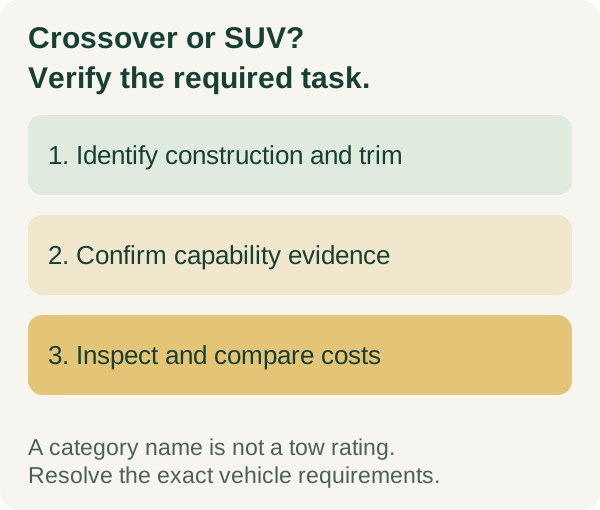
The buying decision is whether the exact vehicle can handle your passengers, cargo, towing or route requirements at an acceptable cost. Neither construction method proves a towing limit, an off-road capability, a safety result or the condition of a used vehicle.
Why crossover and SUV names overlap
Mazda’s crossover-versus-SUV explanation distinguishes unibody crossovers from traditional body-on-frame SUVs while acknowledging that the names are often used interchangeably. Its practical recommendation is to research the specific model’s capabilities rather than apply every general distinction to every vehicle.
That is why a marketplace category, dealer headline or SUV badge is a starting point. Ask for the model year, engine, drivetrain and applicable manufacturer documentation. Confirm construction if it matters to your use, then continue to the actual capability figures and required equipment.
Do not confuse construction with size. A crossover can have three rows, and a smaller traditional SUV can still be awkward for your luggage or passenger arrangement. Use the sedan-versus-SUV fit guide for a passenger, cargo-opening and parking trial. This guide deals with the utility claims that need documentary evidence.
Start with the task before picking a platform
List the demanding activity that is driving the purchase. Is it towing a loaded trailer, carrying several people and their bags, accessing a rough campsite or simply fitting a bulky stroller? Write down frequency and the actual conditions, not a general desire for something rugged.
Then separate must-haves from preferences. A specific trailer requirement may be a firm limit. A higher seating position is a preference you can assess in a normal test drive. A styling package may add appearance without supplying the equipment your task requires.
If most use is commuting on maintained roads, compare ride comfort, entry, parking and complete costs. If a specialized task is essential, resolve its capability requirements before spending time negotiating a vehicle that may not qualify.
Verify towing capacity for the actual configuration
If towing is part of the decision, obtain the manufacturer’s towing instructions and ratings for the correct model year and configuration. Ask which equipment is required for the advertised capability and whether the actual car has it. A fitted hitch, a large engine or a separate frame is not sufficient evidence by itself.
Have an appropriately qualified towing professional help you reconcile the vehicle, hitch, trailer and load information when necessary. Passenger and cargo loading can affect the usable margin. Use the applicable limits together rather than selecting the largest number in an advertisement.
Keep these records before agreeing to buy:
- The exact vehicle configuration and source of its applicable ratings.
- The required factory or approved equipment and evidence that it is present.
- The trailer’s relevant loaded information and your intended passenger and cargo load.
- The applicable vehicle, hitch and trailer limits and the professional’s explanation of compatibility.
- Any unresolved equipment, condition or maintenance issue that affects the task.
This is a documentation checklist, not permission to tow or a towing calculation for a real setup. Do not substitute a generic crossover-versus-SUV article for the manuals and assessment your particular combination needs.
A hypothetical advertised-rating trap
Imagine a listing that advertises “up to 5,000 pounds” for a model family. You later find that the quoted figure applies only to a different engine or required equipment package. The seller has not provided documentation establishing the listed car’s applicable rating. This is an invented example, not a finding about a particular model or seller.
The correct next step is to resolve the actual configuration and documentation. Do not treat the model family’s maximum as this vehicle’s rating, and do not invent a lower figure to fill the gap. If the seller cannot establish the requirement that matters to you, keep the candidate marked unresolved.
A competing crossover with clearly documented capability may be more useful than a traditional SUV with an unanswered equipment question. Construction helps describe the vehicle; evidence determines whether it meets the task.
Off-road styling, AWD and actual route suitability
Check ground clearance, fitted tires, drivetrain features and manufacturer operating instructions for the actual car. Do not assume an off-road appearance package includes low-range gearing or other hardware. Equally, do not assume a unibody vehicle cannot serve a particular maintained access road.
Describe your expected route to the qualified person helping you assess suitability, including surface, obstacles and seasonal conditions. Do not test a seller’s car on difficult terrain or attempt a hazardous maneuver to prove a capability claim.
For road and winter traction questions, the FWD-versus-AWD comparison separates powered wheels from tires and braking. AWD, four-wheel drive, construction and ground clearance are different specifications. Record them separately rather than turning one badge into an answer for all four.
Compare comfort and running costs after the capability check
Once both candidates meet the required task, compare how they work during ordinary use. Assess entry height, road feel, seat comfort, parking access and usable cargo space in the actual vehicle. Do not infer a guaranteed ride quality from the construction category.
Use the EPA side-by-side tool for the correct configurations. Ask for complete purchase quotes, insurance estimates and documented service needs. A platform category alone cannot establish the total cost or fuel consumption of two different vehicles.
If a larger or more specialized vehicle is needed only occasionally, evaluate a practical rental or delivery alternative. Use real availability and complete terms. A theoretical saving does not help if the alternative cannot carry out the required task on the dates you need it.
Check the used vehicle beyond its category
Ask for service and repair records, and have a qualified independent shop inspect the vehicle for your intended use. Explain any towing or difficult-road requirement when agreeing on the inspection scope. A normal general inspection may not answer every specialist capability question.
Use a vehicle history report alongside records and inspection. History information does not certify structural condition or establish that a repair restored every required capability. Resolve material discrepancies with appropriate documentation and professional assessment before purchase.
Download the crossover and SUV capability worksheet
The blank crossover-versus-SUV capability worksheet records sixteen items, including the actual configuration, construction evidence, demanding task, required equipment, load information, inspection questions and cost comparison. Use it to distinguish confirmed, unresolved and unsuitable candidates.
If either construction serves your documented needs, compare the complete deal rather than buying the more rugged description. If a requirement remains unresolved, keep shopping or obtain the missing assessment before committing. The best category is the one supported by the exact vehicle’s capabilities and your real use.
Source check: November 19, 2026. This guide supplies a buying and documentation method. It does not certify a towing combination, publish an off-road test or provide a real vehicle rating.
BEFORE YOU TAKE THE NEXT STEP
Practical checklist
Check the VIN, ownership record and seller details.
Arrange an independent inspection and review the written terms.
Confirm the total cost and title-transfer process before paying.
CHECK THE DETAILS
Sources and further reading
Follow the source linked beside a claim for its context. For a transaction, confirm current requirements with the relevant agency, lender or provider.
- Mazda’s crossover-versus-SUV explanationmazdausa.com
- EPA side-by-side toolfueleconomy.gov
YOUR NEXT READ