Buying a car
Automatic Car Symbols: P, R, N, D and Extra Gear Labels
Understand PRND and common extra selector labels, then verify the actual vehicle’s manual, controls and equipment. Includes a blank used-car controls worksheet.
Published
Sources checked . How this guide is prepared.
START HERE
The short answer
On an automatic car’s gear selector, P means Park, R means Reverse, N means Neutral and D means Drive. Additional labels such as L, S, M and plus/minus controls describe vehicle-specific modes or gear-selection functions. Read the manual for the actual model before using them.
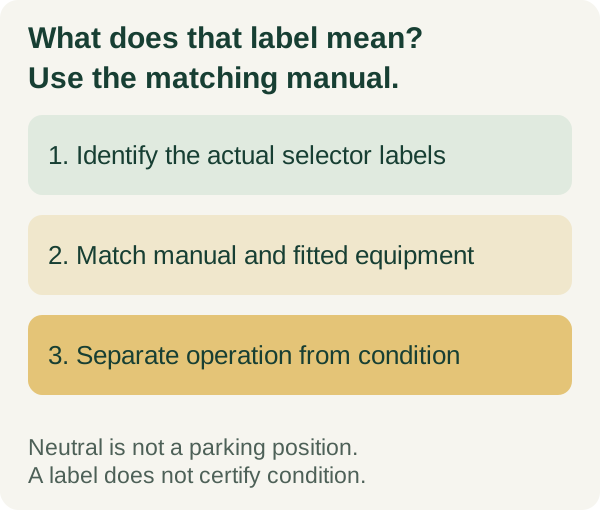
This guide explains gear-selector labels. A dashboard warning pictogram is a different question and needs the relevant warning section of your car’s manual. A letter’s general meaning does not establish that a car is safe to drive or that a feature works correctly.
P, R, N and D: the basic meanings
Ford’s US automatic-transmission manual example describes the familiar selector positions. Use these as a glossary, alongside the operating instructions for your own car:
- P, Park: the transmission’s parking position. Follow the vehicle’s complete parking procedure, including its parking brake instructions.
- R, Reverse: the position for moving backward.
- N, Neutral: the transmission is not delivering drive to the wheels. The car can roll; Neutral is not a secure parking position.
- D, Drive: the normal forward-driving position, with automatic operation as designed for that transmission.
The Ford example instructs drivers to select Park or Reverse only while stationary. A general symbol chart does not replace model-specific brake, starting, shifting or parking instructions. Do not experiment with these positions while moving to find out what a label means.
L, S and M: common extra labels
In that Ford manual, L identifies a low-gear mode and M identifies manual gear selection, where equipped. Those functions are not fitted to every automatic car. A physical label, separate button and instrument-cluster display may work together, so identify the controls using the actual manual.
S commonly identifies Sport in the second Ford manual example. That example describes a different shift strategy and SelectShift functions. It is evidence for that implementation, not a universal rule for all S positions.
Do not assume that Sport makes a car safer, adds engine power or is appropriate for every condition. Ask what the actual manufacturer says the mode changes, when it is intended to be used and which limitations apply. A badge alone does not settle those questions.
What do plus and minus mean?
Plus and minus controls commonly request an upshift or downshift in a manual-selection function, where fitted. The second Ford example uses those symbols for SelectShift. The precise response and protective limits depend on the vehicle.
A request is not a promise that any selected gear will be accepted at every speed. Nor should you assume every manual mode automatically shifts at the same point. Learn the actual instructions before using paddles or a selector’s manual position.
Manual-style controls also do not, by themselves, identify the internal transmission design. The CVT versus automatic guide explains why transmission type is a separate specification to confirm when comparing cars.
What about numbers, B or an unfamiliar label?
Some selectors have additional numbers or manufacturer-specific letters. Find the exact label in the matching owner manual rather than assigning it a meaning from another make. A number on a selector, the displayed selected gear and the total number of available ratios are different pieces of information.
If a listing photo shows an unfamiliar button, ask for a clear photograph and its manual reference. Do not infer equipment from a cropped image or a generic model advertisement. The same model family may have several transmission or control configurations.
Use the make-and-model guide to keep year, trim, engine and other configuration details together. If the manual appears to describe a different selector, resolve that mismatch before using its instructions.
A gear label and a warning symbol answer different questions
A selected-position letter tells you about the control or display. It does not explain a separate warning message or certify transmission condition. If a symbol is unfamiliar, record its shape, wording and the circumstances so the correct manual section or qualified professional can identify it.
Follow the vehicle’s instructions for the actual warning. If the car behaves unsafely or the display and vehicle response do not make sense, stop using it safely and obtain appropriate qualified help. Do not keep driving merely because a generic chart gave a reassuring description of one letter.
A selector that will not move also requires a vehicle-specific assessment. This guide does not give shift-lock bypass, manual Park release, towing or car-wash Neutral procedures. Those tasks need the correct manufacturer instructions and appropriate assistance.
An original used-car controls check
Imagine a listing that says “sport automatic” and shows a plus/minus control. The seller cannot identify the transmission or provide the matching manual. This is an invented example, not an actual listing or finding about a seller.
Record three separate questions: what equipment is installed, what the controls mean according to its manual, and whether any condition concern needs assessment. A plus/minus photograph answers none of those questions completely. It does not establish a particular gear count, internal design or demonstrated operating condition.
Have the seller or a qualified representative explain the layout with the vehicle properly secured and in accordance with its manual. Do not conduct an unfamiliar shifting experiment to verify an advertisement. Use an ordinary lawful test drive only after you understand the relevant controls and the vehicle is suitable to drive.
Keep operation and condition separate before buying
Clear labeling makes a car easier to understand; it does not replace an inspection. If a warning, abnormal response or unclear service history raises a concern, tell the inspecting shop exactly what you observed and ask what assessment is appropriate.
Agree on the pre-purchase inspection’s scope, including any transmission concern that needs additional diagnosis. A normal short drive and a clean-looking selector cannot establish the condition of every internal component.
For the buying decision, keep confirmed equipment, manufacturer operating instructions and current-condition findings in separate entries. Resolve essential unknowns before assigning value to a feature name.
Download the selector and equipment worksheet
Use the blank automatic-car symbols worksheet for sixteen identification, manual, display and follow-up checks. It organizes questions for the seller and inspecting professional; it is not a driving lesson or diagnostic procedure.
Start with the basic PRND meanings, then verify the details on the actual vehicle. Knowing which source applies is more useful than memorizing a universal chart that does not match the car in front of you.
Source check: November 21, 2026. Ford’s manuals are named implementation examples, not instructions for every automatic vehicle. No road test, operating demonstration or mechanical inspection was performed for this article.
BEFORE YOU TAKE THE NEXT STEP
Practical checklist
Check the VIN, ownership record and seller details.
Arrange an independent inspection and review the written terms.
Confirm the total cost and title-transfer process before paying.
CHECK THE DETAILS
Sources and further reading
Follow the source linked beside a claim for its context. For a transaction, confirm current requirements with the relevant agency, lender or provider.
- Ford’s US automatic-transmission manual examplefordservicecontent.com
- second Ford manual examplefordservicecontent.com
YOUR NEXT READ