Buying a car
CVT vs. Automatic Gearbox: What to Check Before Buying
A CVT is an automatic transmission. Compare it with a geared automatic using the actual powertrain, service records, driving observations and inspection evidence.
Published
Sources checked . How this guide is prepared.
START HERE
The short answer
A CVT is a type of automatic transmission. When buyers compare a CVT gearbox with an automatic gearbox, they usually mean a continuously variable transmission versus a conventional automatic with fixed forward gear ratios. Both can handle ordinary driving without the driver operating a clutch pedal; their design and driving feel can differ.
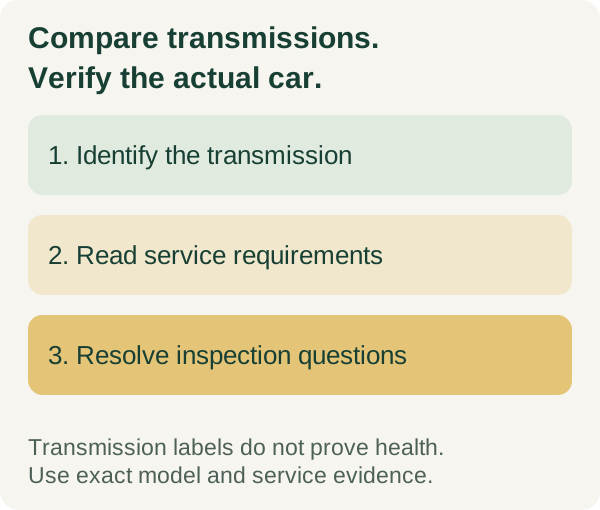
The better used-car purchase depends on the exact transmission, vehicle condition, service evidence, driving needs and price. A transmission label alone does not establish reliability, remaining life or whether a particular car is worth buying.
How a CVT differs from a conventional automatic
A conventional geared automatic selects among fixed ratios. A common belt- or chain-type CVT varies its working ratio through pulleys instead. Nissan’s Xtronic explanation describes that distinction and why acceleration may not feel like a sequence of conventional gear changes.
That basic explanation has exceptions. Toyota’s transmission guide describes a CVT design with a physical launch gear. Some vehicles simulate stepped shifts. Hybrid transmissions described as eCVTs can use different architectures from a belt-and-pulley unit. Confirm the specific powertrain in the manufacturer’s technical or owner information rather than assuming everything called CVT contains identical parts.
Neither a selector marked D nor a manual-shift mode proves that a car has a conventional geared automatic. An advertisement saying only “automatic” leaves the transmission design unresolved. Ask for the exact year, engine, trim and transmission designation before comparing candidates.
Which feels better to drive?
A conventional automatic may produce noticeable changes in engine speed as it shifts. A CVT can hold engine speed more steadily while road speed changes, and some systems imitate shifts. Whether you prefer that response is a legitimate part of the purchase decision.
Use a normal, lawful test drive with the seller’s permission and suitable road conditions. Consider the kinds of driving you actually do: low-speed traffic, ordinary acceleration, highway entry and hills where available. Observe how comfortable and predictable the car feels without trying to provoke a fault or conduct a mechanical stress test.
Do not dismiss a warning light, shudder, delayed engagement, unusual noise or loss of drive as “just how CVTs work.” Nor does noticing a different engine note establish a failure. Record when the behavior occurred and have a qualified shop evaluate it. A short test drive cannot establish the internal condition or remaining lifespan of either transmission type.
Are CVTs less reliable than automatics?
There is no universal reliability verdict in this guide. A meaningful comparison needs the actual model year, transmission version, maintenance history, symptoms and inspection findings. Broad claims that every CVT fails early, or that every conventional automatic lasts longer, do not answer whether the two cars in front of you are sound purchases.
Separate three questions: what the manufacturer requires, what the records show was done, and what a qualified inspection can establish now. An owner’s manual is evidence of a requirement, not evidence that the owner followed it. A service receipt is evidence of a recorded job, not a guarantee against future repairs.
Check the actual VIN for relevant NHTSA safety recalls and ask the manufacturer or its representative about any applicable campaign or warranty information. NHTSA’s lookup has coverage and reporting limits; it is not a comprehensive mechanical-history or warranty-eligibility report. A result without an open recall does not certify transmission health.
Maintenance: identify the fluid and schedule first
Do not buy fluid or authorize a generic transmission service based only on the word automatic. Use the correct owner manual and manufacturer maintenance information for the exact vehicle, including any schedule differences for its use. Ask what service is due, which fluid specification applies and what the shop proposes to do.
For a specific example, the 2023 Honda HR-V owner manual specifies Honda HCF-2 for that vehicle’s CVT and warns against mixing it with other transmission fluids. It directs owners to a dealer for checking and replacement. That is a model-specific example, not a fluid recommendation for other CVTs or conventional automatics.
When reviewing a receipt, match the date, mileage, vehicle and description of the work. If the fluid or procedure is unclear, ask the servicing shop for clarification and let the inspecting professional assess what further evidence is needed. Do not turn an ambiguous receipt into either a clean bill of health or an assumed replacement bill.
Compare fuel economy and ownership cost by configuration
A CVT can be selected as part of an efficiency-focused powertrain, but that does not mean every CVT vehicle uses less fuel than every geared automatic. Engine, body, weight, drivetrain and driving conditions also affect the comparison. Check the actual configurations in the EPA fuel-economy comparison tool.
Use annual miles divided by the applicable mpg figure, multiplied by your assumed fuel price, for a simple fuel budget. Label ratings and assumptions separately from actual measured consumption. Add purchase price, financing, insurance, documented upcoming service and any written repair estimate separately rather than assigning a made-up universal CVT maintenance surcharge.
For AWD candidates, the FWD versus AWD buying guide provides a worked fuel-budget example and explains another configuration difference that can affect your comparison. Transmission type and driven wheels are separate specifications; verify both.
A practical decision when two used cars look similar
Imagine two otherwise suitable cars advertised at the same price. One has a CVT and a service receipt that does not identify the fluid used. The other has a conventional automatic with a documented service record, but its test drive raises a question about delayed engagement. This is an invented evidence example, not a report about actual listings.
Neither car wins from its transmission name. For the first, ask the shop to resolve the receipt and assess the correct service requirements. For the second, ask a qualified inspector to investigate the observed behavior. Obtain a written explanation and any proposed work before comparing the full purchase costs. If material questions remain unresolved, you can keep shopping rather than turning uncertainty into a confident repair estimate.
The pre-purchase inspection guide helps you agree on scope. Ask specifically what the inspection can and cannot evaluate about the transmission. Do not assume a general inspection includes internal disassembly, a guarantee or every specialist diagnostic procedure.
Questions to send the seller before a visit
- What are the exact model year, engine, trim and transmission designation?
- Can you provide the applicable owner manual and available maintenance records?
- Are there known warning lights, unusual behavior, repairs or outstanding service recommendations?
- May an independent qualified shop inspect the car before purchase?
- Which statements about warranty coverage can the provider confirm for this VIN?
Keep each answer attached to evidence and an unresolved-question list. The make versus model guide can help you reconcile incomplete listing descriptions before requesting a quote or inspection.
Download the transmission comparison worksheet
The blank CVT and automatic buying worksheet has sixteen prompts covering identification, driving observations, fluid requirements, service records, inspection scope and cost. Use it for both cars so a persuasive description does not substitute for missing documentation.
Choose the car whose documented condition, operating characteristics and full costs best meet your needs. If you strongly prefer the feel of one transmission, include that preference after checking the evidence. You do not need to declare every example of the other transmission inferior to make a sound purchase.
Source check: November 19, 2026. This is a source-based buying guide, not a transmission durability study, diagnostic finding or report of vehicles personally tested by CarTruvo.
BEFORE YOU TAKE THE NEXT STEP
Practical checklist
Check the VIN, ownership record and seller details.
Arrange an independent inspection and review the written terms.
Confirm the total cost and title-transfer process before paying.
CHECK THE DETAILS
Sources and further reading
Follow the source linked beside a claim for its context. For a transaction, confirm current requirements with the relevant agency, lender or provider.
- Nissan’s Xtronic explanationnissanusa.com
- Toyota’s transmission guidetoyota.com
- NHTSA safety recallsnhtsa.gov
- 2023 Honda HR-V owner manualtechinfo.honda.com
- EPA fuel-economy comparison toolfueleconomy.gov
YOUR NEXT READ