Buying a car
Buying Cars at Auction: Eligibility, Fees and a Maximum-Bid Plan
Prepare to buy a car at auction: confirm lot eligibility, title documents, inspection limits and the complete cost. Includes a maximum-bid example and worksheet.
Published
Sources checked . How this guide is prepared.
START HERE
The short answer
Before buying a car at auction, confirm that you can bid on that specific lot, understand its ownership documents and condition, and calculate a maximum bid that leaves room for fees, transport and repairs. A winning bid can create a purchase obligation under the auction's terms. Read those terms before bidding, not after the sale.
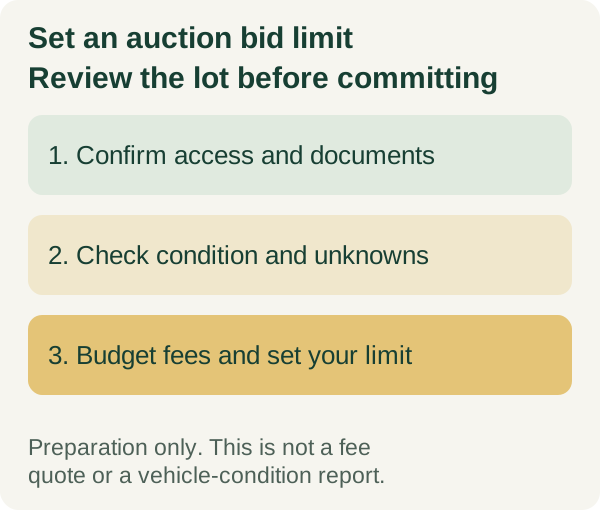
Auctions are different markets with different rules. A public fleet sale, a collector auction and a salvage auction can offer very different vehicles, inspection access and remedies. A low current bid is not the complete purchase cost, and it does not establish that the car can be registered or driven home.
This guide uses AI-assisted research checked November 19, 2026. CarTruvo operates a vehicle marketplace and has a commercial interest in helping buyers and sellers prepare. It does not conduct vehicle auctions or offer auction-broker access. The bid example is hypothetical, not a live lot, repair quote, auction fee schedule or independently reviewed financial recommendation.
Check eligibility for the lot, not just the website
Registering an account does not necessarily make every vehicle available to you. Eligibility can depend on the vehicle's location, document type, your buyer category and the licenses or records on file. Ask the auction to confirm your ability to buy the exact lot before paying for additional services or arranging transport.
Copart's licensing overview distinguishes buyer types and locations and says eligibility is determined using the submitted licenses and documents. Its buying process describes no-license-required vehicles and the possible use of a broker when credentials are needed. Neither means every individual can buy every lot.
If you need an auction broker, get its separate agreement. Identify who bids, who becomes the purchaser, who receives title documents, what fees apply and who handles a dispute. Compare that arrangement with the broader services in our car broker guide. Avoid borrowing another person's credentials or assuming a broker removes restrictions on how you can register or use the vehicle.
Read the sale documents and completion rules
Before evaluating a bargain, identify the selling party, auction operator and actual sale location. Find the governing terms and the lot's special conditions. Record whether the sale needs seller approval, has a reserve or uses another acceptance process. Ask when a bid becomes binding and what happens after a winning result.
Make a short completion record:
- Registration, deposit and bidding-power requirements.
- Accepted payment methods and when full payment must arrive.
- Buyer fees, online bidding charges and other applicable costs.
- Pickup location, release requirements and removal deadlines.
- Storage, late-payment or default charges.
- Any condition-report, arbitration or return process and its exclusions.
Use the auction's current terms for each answer. A cancellation policy for membership is not necessarily a right to cancel a purchased vehicle. An arbitration process also does not automatically cover every defect or every buyer. Read the scope and deadlines before relying on it.
Verify what the ownership document allows
Identify the document actually offered: a current title, a salvage or other branded certificate, a bill of sale, or another specified record. Ask when it will be available and whether a lien or additional transfer step must be addressed. A lot description's shorthand is not the receiving title agency's approval.
Contact the agency where you plan to title and register the vehicle with the VIN, issuing state and exact document description. Ask about eligibility, inspections, repair documentation and any use restrictions. Ask your insurer and lender about the same vehicle and title status before committing. Use our rebuilt-versus-salvage guide to organize the separate questions about damage history and return-to-road requirements.
Do not assume you can solve an ineligible document later with a replacement title or a bond. Those procedures address specific situations and have their own requirements. If the documentation route is unresolved, you have not established the cost or feasibility of putting that vehicle into your intended use.
Separate an auction label from a current inspection
Read the operator's definitions. Copart's vehicle-icon explanation says its Run & Drive designation reflects specified observations at inventory and does not guarantee roadworthiness or the ability to start, engage gear or move at sale or pickup. It is not a substitute for a current inspection.
Ask what access is allowed before bidding: in-person preview, an independent inspection, starting the engine, diagnostic scanning or a test drive. Some checks may be unavailable. Record each uncompleted check as unknown rather than interpreting silence as a good result.
Examine available photographs, condition reports, history and repair evidence together. Ask for specialist assessment when damage, flood exposure, structural work or high-voltage components raise questions beyond your ability. Use the used-car inspection checklist to prepare questions, while respecting the auction's actual access limits.
Build the all-in budget before choosing a bid
List every cost required to acquire the vehicle and make it suitable for your intended use. Include buyer and bidding fees, broker fees if applicable, taxes, title and registration, transport, inspection and estimated repairs. Keep an additional uncertainty allowance for issues the available checks cannot resolve.
Fee schedules may vary by buyer category, payment method, title group and bid amount. For example, Copart's US licensed-member fee schedule has different categories; it is not a universal schedule for every reader. Obtain the schedule that applies to your account and lot. Recalculate at the proposed bid because a higher bid can also change fees or taxes.
Here is a fully invented bid-budget example:
- Maximum complete budget: $12,000.
- Assumed buyer and bidding fees at the candidate bid: $1,100.
- Assumed taxes, title and registration: $700.
- Transport: $600.
- Inspection and immediate work: $2,000.
- Additional uncertainty allowance: $1,000.
Those allowances total $5,400, leaving a candidate maximum bid of $6,600. They are not current auction charges or repair estimates. If fees or taxes change at $6,600, replace the assumptions and solve again. If an actual repair estimate rises by $1,500 with everything else unchanged, the candidate bid falls to $5,100. Do not spend the uncertainty allowance twice to justify a higher bid.
Compare that complete budget with inspected alternatives from other sellers. A car that looks cheaper at the hammer price can cost more after repairs and transport. Even the revised budget can be exceeded if unknown damage is worse than assumed.
Plan payment and removal before sale day
Verify payment instructions through the operator's established channel. Understand which funds are accepted, when they must clear and which fees attach to the method. Keep the invoice and confirmation. Do not rely on a message changing bank details without independently confirming it.
Arrange transport appropriate to the vehicle's actual condition. Ask about loading, keys, pickup appointments, offsite lots and the documents required to release it to a carrier. Do not plan to drive it home until legal operation, insurance and condition are established. Record condition at release and arrival and follow the applicable claim process promptly if there is a discrepancy.
Free auction bid-planning worksheet
Use the blank auction bid-planning record to track eligibility, documents, inspection gaps, fees, allowances and deadlines. It is a manual preparation sheet, not an automatic fee calculator or a prediction of repair cost.
Set your maximum before the auction and stop when the all-in budget or unanswered questions no longer fit your plan. Choosing not to bid is a valid outcome of the review. After a purchase, reconcile the purchase agreement and related documents, payment, transport and title process using the actual sale terms.
BEFORE YOU TAKE THE NEXT STEP
Practical checklist
Check the VIN, ownership record and seller details.
Arrange an independent inspection and review the written terms.
Confirm the total cost and title-transfer process before paying.
CHECK THE DETAILS
Sources and further reading
Follow the source linked beside a claim for its context. For a transaction, confirm current requirements with the relevant agency, lender or provider.
- Copart's licensing overviewcopart.com
- buying processcopart.com
- vehicle-icon explanationcopart.com
- Copart's US licensed-member fee schedulecopart.com
YOUR NEXT READ