Buying a car
Car Broker: What They Do, Fees and Questions Before You Hire One
Compare a car broker’s services, compensation and complete cost before hiring. Includes licensing questions, a worked example and a free comparison sheet.
Published
Sources checked . How this guide is prepared.
START HERE
The short answer
A car broker helps arrange a vehicle purchase, often by finding candidates, contacting sellers or negotiating terms. The exact service depends on the agreement. Before hiring one, establish who they represent, who pays them, what work the fee includes and whether you retain approval of the vehicle and final purchase terms.
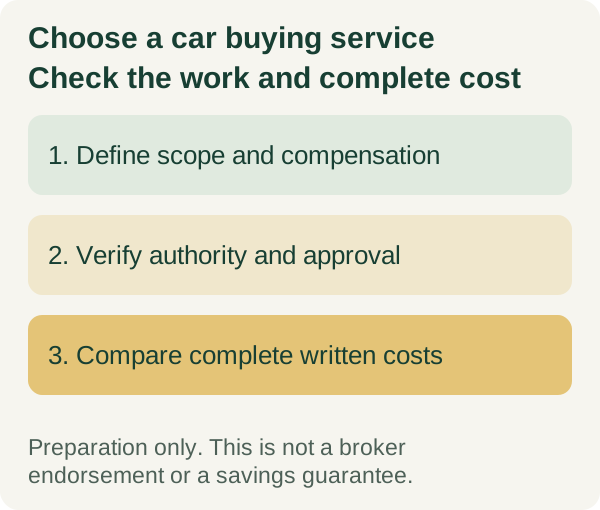
A broker can save you time, but a lower vehicle price or better outcome is not guaranteed. Compare a complete broker-assisted quote with a realistic quote you can obtain yourself. Include the service fee, vehicle condition, transport and any different financing or add-on terms.
This guide uses AI-assisted research checked November 19, 2026. CarTruvo operates a vehicle marketplace and has a commercial interest in helping buyers and sellers prepare. It does not offer buyer brokerage, legal representation or a guarantee of savings. The examples are hypothetical preparation exercises, not customer results or independently reviewed financial advice.
Identify the service behind the label
The words broker, concierge, buying service and vehicle finder can describe different arrangements. A person may negotiate for you, refer you to a participating dealer, resell a vehicle as its owner or help you access an auction. Ask for a description of the actual transaction rather than relying on the business name.
Write down four roles: the person you hire, the vehicle's seller, any lender and the person receiving your money. Ask whether the same business fills more than one role. If the service also sells the car, evaluate its purchase documents and disclosures as well as its service agreement.
Compare the options by responsibility:
- Search assistance: who defines acceptable vehicles and checks availability?
- Negotiation: who requests written prices and can accept or reject an offer?
- Verification: who checks documents, arranges inspection and follows up on problems?
- Transaction support: who prepares paperwork, handles money and coordinates delivery?
A marketplace listing search is different from hiring someone to act for you. On CarTruvo, treat the listing as the starting point for evaluating a vehicle and its seller. Arrange your own independent checks and confirm the seller's terms.
Ask who pays the broker and when
Request a written explanation of every compensation source: your service fee, a dealer referral payment, a seller commission, financing compensation or another commercial relationship. Ask whether compensation changes with vehicle price, seller, financing choice or selected products. A disclosed payment arrangement helps you evaluate incentives; it does not automatically establish that a service is good or bad.
Ask these questions before paying:
- Is the charge fixed, hourly, percentage-based or tied to a stated savings calculation?
- What event earns the fee, and what happens if no acceptable car is found?
- Is any upfront amount refundable, and under exactly what conditions?
- Are inspection, travel, delivery, auction access and paperwork included?
- Will you see the selling dealer's original itemized quote?
- Can you decline a vehicle, loan or optional product without an additional charge?
Do not compare a percentage fee with a flat fee using only the headline numbers. Identify the base for the percentage and any minimum, maximum or extra charge. If savings determine compensation, ask what baseline is used and obtain the baseline quote before the service begins.
Check licensing and authority for the actual work
Requirements depend on the jurisdiction and activity. In California, DMV's autobroker endorsement guidance says vehicle dealers need the endorsement to broker retail sales. It also describes records and trust-account requirements for purchase money the brokering dealer receives. Those are California rules, not a nationwide licensing checklist.
Ask for the legal business name, license or endorsement where applicable, and the jurisdiction responsible for it. California offers an official occupational-license lookup. For another state, ask its motor vehicle licensing authority what registration or license the proposed activity requires and how to verify it.
Match the business on the agreement, license information, invoice and payment instructions. Ask the service to explain discrepancies before sending money. Verify changed payment details through an independently established contact channel. A professional-looking website, social profile or collection of reviews does not replace the applicable licensing and identity checks.
Put your buying instructions in writing
Give the broker a short written brief. Include your maximum complete budget, acceptable models and model years, mileage range, required features, condition expectations and distance limits. State which title histories you will consider and which need further investigation.
Then agree on the decision process:
- You receive the VIN, seller identity and itemized quote before approval.
- Inspection access and the inspector's independence are established before commitment.
- Financing and optional products require your separate consideration.
- Changes to the vehicle, price or delivery plan require another approval.
- The agreement explains when either party can end the search and what remains payable.
If the service asks for a power of attorney or permission to bid, read the exact authority, limits and duration. Ask who can bind you to a purchase and whether a bid can be withdrawn. An auction-access broker's work can differ substantially from a retail negotiation service. See our auction buying guide before authorizing bids.
Compare the complete cost with a direct purchase
Use the same vehicle or genuinely comparable candidates, the same financing assumptions and the same inspection standard. Compare the total amount you would pay to acquire the car, including the broker's compensation charged to you. Keep any trade-in and loan terms visible rather than treating a monthly payment as the vehicle's price.
Here is a hypothetical example, with all figures invented:
- Direct quote: $24,000 vehicle price plus $1,800 in assumed taxes and required charges, totaling $25,800.
- Broker-assisted quote: $23,300 vehicle price plus the same assumed $1,800, a $600 service fee and $250 delivery, totaling $25,950.
- The assisted route is $150 more in this example despite a $700 lower vehicle price.
The equal tax-and-charge assumption simplifies the example; actual taxes and fees need transaction-specific calculation. A service may still have value to you for time or access, but make that choice explicitly. Do not label an unverified asking-price reduction as proven savings.
For quote preparation, use our used-car price negotiation guide. Before committing, compare the purchase agreement with the approved offer. The broker's involvement does not eliminate your need to understand what you are signing.
Who should arrange inspection, history and delivery?
Assign each task to a named person. Ask whether you can choose the inspector, receive the full report and speak directly with them. A broker's opinion, seller photos and a vehicle history report answer different questions from a current independent inspection.
For delivery, confirm who hires the carrier, who pays, when responsibility changes and how pickup and arrival condition will be documented. Ask how delays, rejected vehicles and title-document problems are handled under the applicable agreements. Avoid assuming a broker's service fee includes every problem after purchase.
If the car has a lien or an unusual ownership chain, resolve the documentary path with the responsible parties and title agency. The service should identify the paperwork it will obtain, rather than promising that the title can be fixed after you pay.
Free broker comparison worksheet
Use the blank car broker comparison record to compare scope, compensation, authority, inspection access, cancellation terms and complete costs. It is a preparation sheet, not a service contract or broker endorsement.
Hire a service when its documented work, cost and authority fit your needs. Continue shopping when the agreement leaves material responsibilities unexplained or the numbers do not work for you. The useful outcome is an informed choice about the service, followed by a separately reviewed vehicle purchase.
BEFORE YOU TAKE THE NEXT STEP
Practical checklist
Check the VIN, ownership record and seller details.
Arrange an independent inspection and review the written terms.
Confirm the total cost and title-transfer process before paying.
CHECK THE DETAILS
Sources and further reading
Follow the source linked beside a claim for its context. For a transaction, confirm current requirements with the relevant agency, lender or provider.
- DMV's autobroker endorsement guidancedmv.ca.gov
- official occupational-license lookupdmv.ca.gov
YOUR NEXT READ