Buying a car
Car Loan Interest Deduction: 2026 Eligibility and Used-Car Limits
Check the federal car-loan interest deduction’s vehicle, loan and income requirements, including used-car exclusions. Includes an example and preparation sheet.
Published
Sources checked . How this guide is prepared.
START HERE
The short answer
For tax years 2025 through 2028, eligible taxpayers may deduct up to $10,000 a year of qualified interest on certain loans used to buy a new personal-use vehicle. Used vehicles and leases do not qualify for this particular federal deduction. The vehicle, loan, income and reporting requirements all matter; an auto-loan payment alone does not establish eligibility.
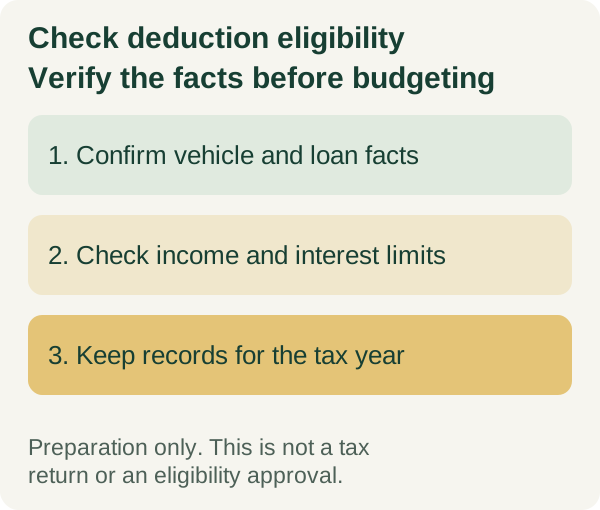
Start with the vehicle and loan facts before estimating a tax benefit. A deduction reduces the income used to calculate tax; it is not a dollar-for-dollar reimbursement of the interest, and it does not eliminate your obligation to pay the lender.
This guide uses AI-assisted research checked November 19, 2026. CarTruvo operates a vehicle marketplace and has a commercial interest in helping people prepare to buy and sell. It does not determine tax eligibility or prepare your return. The checklist and calculation are original educational examples, not an actual taxpayer result or independent professional review.
Check the vehicle and loan before counting the deduction
The IRS interest-expense guidance identifies the temporary deduction, its limits and the requirement that original use start with the taxpayer. It also specifies qualifying purchase indebtedness incurred after December 31, 2024 and secured by a first lien on the vehicle. An unsecured personal loan does not satisfy that first-lien requirement simply because its proceeds bought a car.
Organize your facts into four groups:
- Vehicle: VIN, original-use history, type, gross vehicle weight rating and final assembly location.
- Purchase: buyer, seller, purchase date and documents establishing what was acquired.
- Loan: origination date, purpose, secured interest and statements separating interest from principal.
- Taxpayer: filing status, modified adjusted gross income and the tax year being claimed.
Mark an unanswered item as unresolved rather than assuming that a dealer's promotion or a lender statement confirms every requirement. Mixed business and personal use, joint borrowers and unusual ownership histories deserve the relevant IRS instructions or advice from a qualified tax professional.
Which vehicles meet the basic requirements?
The IRS's November 3, 2026 explanation covers qualifying vehicle types, a gross vehicle weight rating below 14,000 pounds and final assembly in the United States. It explicitly excludes used vehicles and leases.
A brand name, dealership location or model's reputation does not prove where your particular vehicle underwent final assembly. Check the actual VIN and available vehicle label. The NHTSA VIN decoder instructions explain how to find the reported build plant and country. Follow up with the manufacturer if that information is incomplete or inconsistent.
Keep a copy of the relevant label or lookup result with the purchase records. A VIN lookup supplies vehicle information; it is not an IRS eligibility approval. A model year alone also does not establish when original use began. Ask for the documents that support the actual history instead of substituting an assumption about how new the car looks.
Can you deduct interest on a used car or vintage car?
An ordinary used-car purchase does not meet this deduction's new-vehicle requirement. Buying from a dealer, choosing a certified pre-owned car or obtaining a new loan does not turn a previously used vehicle into a new one for this rule. The same issue applies to an ordinary used classic-car purchase.
Our vintage car financing guide addresses lender eligibility and acquisition costs separately. A financing product marketed for collectors is not itself a federal tax qualification. Business-related interest and other tax provisions have their own rules; this article covers the specific personal vehicle-loan deduction rather than deciding every possible treatment of vehicle expenses.
Before choosing between a new and used car, compare the complete purchase and ownership costs. An expected tax benefit should be a separately verified input, not a replacement for price, borrowing cost, condition and budget checks.
Income limits and the amount of interest matter
The IRS says the deduction begins to phase out above modified adjusted gross income of $100,000, or $200,000 for joint filers. Those are phaseout starting points, not a promise that every person below them receives the maximum deduction. The available amount also depends on qualified interest and the applicable calculation.
Separate interest from the rest of your payment. Principal repayment, the vehicle price and a monthly payment total are not interchangeable with qualified interest. Ask the lender for the appropriate annual information and reconcile it with your records. If a statement appears wrong, request clarification rather than entering an amount you cannot support.
Do not multiply $10,000 by the number of vehicles or borrowers and assume that is the return's allowance. Check the limit and allocation rules for the actual return, filing status and loans. Use the current IRS instructions to determine any reduction rather than guessing from an ordinary salary figure, which is not necessarily modified adjusted gross income.
Worked example: a deduction is different from a credit
This invented example illustrates only the distinction. Assume all eligibility requirements are met, $1,200 of interest is fully deductible after applicable limits, and that deduction reduces income otherwise taxed at a constant hypothetical 22% marginal rate. Ignore interactions with other tax provisions.
- Qualified interest paid: $1,200.
- Assumed deduction used: $1,200.
- Simplified federal income-tax reduction: $1,200 × 22% = $264.
- Interest paid less that simplified tax reduction: $936.
The example does not promise a $1,200 refund, establish your bracket or predict your return. Your actual result can differ because of income limits, taxable income, other provisions and the facts of the loan. Paying interest remains a cost even when some tax benefit is available.
Keep the purchase decision grounded in the full numbers. Do not count a hypothetical deduction as cash available for a down payment or monthly payment. If you compare an eligible new-car purchase with an ineligible used-car purchase, use verified tax assumptions and comparable acquisition costs rather than assuming the eligible vehicle must be cheaper overall.
What happens if you refinance?
The IRS's individual taxpayer guidance says interest on a refinanced qualifying vehicle loan can generally remain eligible. That does not mean every dollar in every replacement loan qualifies or that refinancing changes an ineligible used-car purchase into an eligible new-car purchase.
Keep the original purchase and loan records together with the refinance agreement and payoff evidence. Ask your preparer how the rules apply if the replacement balance includes additional amounts or the borrowers or use changed. Our car refinancing guide compares the borrowing decision separately from any tax treatment.
Keep the records needed for the correct tax year
The IRS makes this deduction available to both itemizing and non-itemizing taxpayers and requires the VIN on the return for a year it is claimed. Use the forms and instructions for that tax year. A prior-year screenshot or someone else's completed return is not a substitute for the current filing instructions.
Keep the purchase agreement, vehicle identifiers, assembly evidence, loan documents, lender interest information and any refinance records privately. Ask about state treatment separately rather than assuming the federal deduction determines the state result. For cash-payment reporting questions, use our distinct cash-purchase tax guide.
Free deduction preparation record
Use the blank car-loan interest preparation worksheet to record the supporting facts, source documents and questions for your preparer. It is not a tax return, deduction calculator or approval certificate. Check the unresolved requirements before using a tax benefit in your vehicle budget.
BEFORE YOU TAKE THE NEXT STEP
Practical checklist
Check the VIN, ownership record and seller details.
Arrange an independent inspection and review the written terms.
Confirm the total cost and title-transfer process before paying.
CHECK THE DETAILS
Sources and further reading
Follow the source linked beside a claim for its context. For a transaction, confirm current requirements with the relevant agency, lender or provider.
- IRS interest-expense guidanceirs.gov
- IRS's November 3, 2026 explanationirs.gov
- NHTSA VIN decoder instructionsnhtsa.gov
- IRS's individual taxpayer guidanceirs.gov
YOUR NEXT READ