Buying a car
Vintage Car Loans: Compare Classic Car Financing Before You Apply
Compare vintage car loan eligibility, accepted value, cash needs and repayment cost before applying. Includes lender examples and a free financing worksheet.
Published
Sources checked . How this guide is prepared.
START HERE
The short answer
Vintage car loans are financing arrangements intended for vehicles a lender accepts as classic, antique or collectible. There is no single definition or approval rule shared by all lenders. Confirm the exact vehicle, title, condition, purchase route and valuation method before assuming a normal used-car approval will fund the purchase.
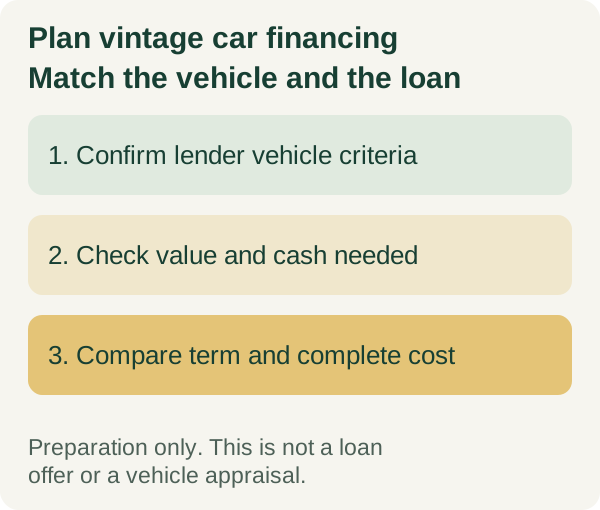
Compare both the borrowing and the car. A lender's accepted value does not establish mechanical condition or guarantee future appreciation. A lower payment from a longer loan also does not automatically mean lower total cost.
This guide uses AI-assisted research checked November 19, 2026. CarTruvo operates a vehicle marketplace and has a commercial interest in helping buyers and sellers prepare. It does not provide classic-car financing, appraisals or insurance. The examples are hypothetical preparation exercises, not lender quotes, actual transactions or independent professional advice.
Ask what the lender means by classic or vintage
Give each lender the actual year, make, model, VIN or accepted vehicle identifier, title jurisdiction and intended use. Explain modifications, restoration status and whether the vehicle runs. An advertised product name does not establish that a particular project car, kit car or modified vehicle is eligible.
Ask for answers to these questions before choosing a price range:
- What vehicle age or collectible-value criteria apply?
- Is this exact model accepted, including its modifications and title history?
- Are non-running vehicles or restoration projects eligible?
- Can the loan fund a private seller, dealer or auction purchase?
- What borrower, membership, location and credit conditions apply?
- What valuation and inspection evidence is required?
For an individual seller, read our private-party financing guide. A product that supports one seller type may have different funding and title instructions for another. If purchasing at auction, review the auction bid and eligibility guide before making a binding bid.
Named lender examples show why the criteria matter
Star One's classic-car page, checked November 19, describes vehicles listed in the Cars of Particular Interest guide, financing up to 80% of average CPI value and terms up to seven years. These are product features, not your approved loan amount. Confirm the full current conditions, membership and vehicle acceptance directly.
Redwood Credit Union's disclosures specify vehicles at least 20 model years old, an operable vehicle, California title and current registration. They exclude kit cars and certain specially constructed or modified vehicles and require insurance proof before funding. A vehicle acceptable to another classic-car lender may therefore fall outside this program.
These examples are not rankings or a recommendation to apply to either institution. No advertised APR is reproduced. Ask how the actual loan would be structured for you and the vehicle, including down payment, term, costs and all approval conditions.
Separate asking price, accepted value and loan amount
The seller's price, an appraisal, an insurer's agreed value and a lender's accepted collateral value answer different questions. Ask which figure limits financing, who determines it, what evidence is accepted and whether a separate purchase-price or borrowing cap also applies.
Here is a fictional valuation example:
- Purchase price: $50,000.
- Value accepted for the hypothetical loan calculation: $45,000.
- Assumed financing ceiling: 80% of that accepted value.
- Calculated ceiling: $45,000 × 80% = $36,000.
- Difference between price and that loan amount: $14,000, before taxes, fees and other cash needs.
This is arithmetic, not a Star One or Redwood offer. Actual underwriting, valuation definitions and other limits can produce a different amount or a denial. Do not budget a 20% down payment against the asking price without checking the accepted-value calculation and the complete financing conditions.
Keep inspection and valuation assignments separate. Ask an independent specialist what they will examine, which documents they need and what they will report. A value opinion is not necessarily a comprehensive mechanical, structural or authenticity inspection. Record checks that cannot be completed before committing.
Compare repayment length, not only the payment
This separate fictional repayment comparison assumes $36,000 financed at a fixed 8% annual interest rate, ordinary monthly amortization, equal payments and no fees. It is not an available offer from either lender above. In this simplified case, APR equals the stated rate.
- Over 60 months: payment about $729.95, total payments about $43,797 and interest about $7,797.
- Over 120 months: payment about $436.78, total payments about $52,414 and interest about $16,414.
- The longer example lowers the payment by about $293.17 but adds about $8,617 in interest if paid as scheduled.
The example excludes tax, registration, insurance, storage, maintenance and restoration. Add those costs to your ownership budget. Long repayment leaves an obligation that continues even if repairs become expensive or the car's resale value falls. Do not fund a purchase on the assumption that appreciation will repay the loan.
Use the lender's completed disclosures for the actual decision. The CFPB's Truth-in-Lending explanation covers APR, finance charge, amount financed and total of payments. Compare those figures alongside collateral requirements and early-payment terms.
Budget the costs of owning the vehicle
Ask an insurer about the exact vehicle, use, storage and financing requirements before purchase. Discuss the coverage and valuation basis, restrictions and required evidence. Do not assume the insurer's definition of collectible use matches the lender's definition or that a policy suitable for occasional driving covers every intended use.
Set aside a separate estimate for specialist inspection, transport, immediate work, parts availability, storage and recurring maintenance. An attractive monthly loan payment should not consume the cash needed to keep the car safe and usable. Keep restoration estimates distinct from a seller's statement that a project is nearly finished.
For an ordinary used vintage purchase, do not assume the personal car-loan interest deduction applies. That deduction has a new-vehicle requirement and other restrictions. Investment hopes, collector marketing and the size of the loan do not determine tax eligibility.
Prepare the title and payment sequence
Compare the vehicle identifiers with the ownership documents and ask the relevant agency about any irregularity before funding. An older vehicle can have different identifiers or documentation from a modern car, so explain the actual records rather than trying to force them into a form that does not fit.
If the seller has a lien, agree on the lender-confirmed payoff and release path. Ask the financing institution who receives funds, what documents it requires and when it records its own interest. Our car lien guide separates these evidence questions from the vehicle's condition and title brands.
Keep inspection access, deposit conditions, financing approval, purchase acceptance and delivery timing consistent with one another. Confirm the actual agreement before committing to a nonrefundable cost or a pickup date. An application or preliminary estimate is not the same as completed funding.
Free vintage-loan comparison record
Use the blank vintage car financing worksheet to compare eligible vehicles, valuation methods, cash gaps, repayment costs, insurance and funding steps. It is not an appraisal, insurance quote or loan application.
Choose a vehicle and financing arrangement that fit together on verified terms. Keep the inspection, valuation and ownership records with the completed loan documents. The useful result is a complete acquisition plan rather than simply the lowest advertised payment.
BEFORE YOU TAKE THE NEXT STEP
Practical checklist
Check the VIN, ownership record and seller details.
Arrange an independent inspection and review the written terms.
Confirm the total cost and title-transfer process before paying.
CHECK THE DETAILS
Sources and further reading
Follow the source linked beside a claim for its context. For a transaction, confirm current requirements with the relevant agency, lender or provider.
- Star One's classic-car pagestarone.org
- Redwood Credit Union's disclosuresredwoodcu.org
- CFPB's Truth-in-Lending explanationconsumerfinance.gov
YOUR NEXT READ