Buying a car
How Do I Refinance My Car? Compare Offers and Complete the Switch
Learn how to refinance a car by checking eligibility, comparing remaining costs and confirming payoff and title updates. Includes examples and a free worksheet.
Published
Sources checked . How this guide is prepared.
START HERE
The short answer
To refinance a car, gather your existing loan and vehicle details, confirm eligibility with prospective lenders, compare complete replacement offers, and follow the selected lender's payoff and title instructions. Confirm the old loan is satisfied and the new payment schedule is active. Refinancing replaces a loan; it does not automatically reduce the total cost or change the vehicle's owners.
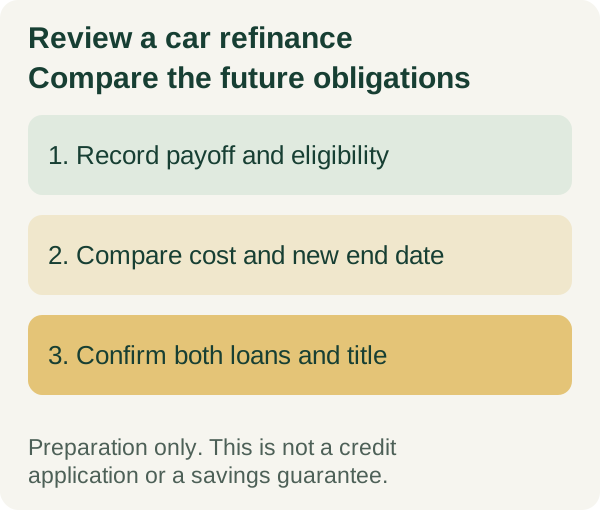
Start with your goal: less total future cost, a lower required payment, a shorter repayment period or another specific change. Those outcomes can conflict. A lower rate with a much longer term can reduce the payment while increasing what you pay overall.
This guide uses AI-assisted research checked November 19, 2026. CarTruvo operates a vehicle marketplace and has a commercial interest in helping owners, buyers and sellers prepare. It does not refinance loans or approve applicants. The comparison below uses hypothetical terms, not current offers, customer savings or independent professional advice.
Step 1: record the current loan and the change you need
Collect the latest statement, loan agreement, remaining payment schedule, vehicle identifiers, mileage and ownership documents. Ask the servicer for a dated payoff covering the intended completion date. Record the quote's expiration, payment instructions and any amounts that can change before receipt.
Write down the number of payments left, payment amount, rate, current principal and any penalty or fee for ending the agreement. A statement balance and a dated full payoff can differ. Our early-payoff guide explains those contract and cash questions; this guide addresses replacing the loan rather than paying it off from your own funds.
If you are struggling to make the next payment, contact the current servicer promptly. The CFPB's auto-payment guidance describes options to discuss and warns that a longer refinance term can increase interest. An unfinished refinance application is not a payment arrangement or permission to skip a due date.
Step 2: check the borrower, vehicle and existing-loan rules
Ask prospective lenders about the exact VIN, mileage, title history, use and current creditor before assuming you qualify. Lenders can also limit balances, repayment terms, location, borrower eligibility and loans they will replace. An existing lender may offer a modification or another route instead of its own refinance product; ask what is actually available.
For example, Capital One's refinance FAQs list vehicle-age and other eligibility restrictions and exclude refinancing an existing Capital One auto loan. Its process distinguishes preliminary qualification from later verification and a hard credit inquiry. Those are that provider's terms, not a universal soft-check promise for every refinance inquiry.
Ask each provider when a credit inquiry occurs, what documents it needs, whether it supports the current title and loan, and which conditions remain after a preliminary estimate. For an older collectible vehicle, ordinary refinance criteria may be unsuitable; use our vintage financing guide to frame the vehicle-specific questions.
Step 3: compare future cost from today
Compare the current loan's remaining obligations with the proposed replacement. Interest already paid is a past cost; the decision is about future cash flows and obligations. Include the replacement loan's fees, any old-loan payoff charges and whether new costs are paid upfront or financed.
Request these figures in writing:
- Dated amount required to satisfy the current loan.
- Amount of the replacement loan, including any financed costs.
- APR, stated interest rate and repayment term.
- Payment count, amounts, finance charge and total of payments.
- Cash due upfront and costs outside the loan.
- Any change to coverage, collateral requirements or early-payment terms.
Use actual offers rather than a national benchmark or a provider's best-case advertisement. Our rate comparison guide separates published averages from completed loan disclosures. Check that both comparisons use the same payoff date and clearly identify different repayment end dates.
Worked example: a lower payment can increase total cost
All figures below are invented. Assume an $18,000 payoff, no penalty or additional accrued interest, a fixed 10% annual rate and 36 equal monthly payments remaining. The existing payment is about $580.81 and the remaining scheduled payments total about $20,909.14.
Now assume a refinance at a fixed 7% annual interest rate, with a separate $300 fee paid in cash. No other charges are included, and the loan uses ordinary monthly amortization.
- New 36-month loan: payment about $555.79. Loan payments total about $20,008.36; adding the cash fee gives about $20,308.36 in future cost, or about $600.78 less than keeping the assumed current schedule.
- New 60-month loan: payment about $356.42. Loan payments total about $21,385.29; adding the fee gives about $21,685.29, or about $776.16 more than keeping the current schedule.
The longer example has the lowest payment while costing more overall. It may address a different cash-flow goal, but call that tradeoff what it is. Actual timing, fees, payment rounding and tax effects can change the comparison. If a fee is financed instead of paid in cash, recalculate with the higher principal.
In the same-term example, the roughly $25.02 monthly payment reduction offsets the $300 cash fee after about 12 payments as a simple cash-flow measure. If you plan to sell or repay sooner, compare both loans' balances at that exit date too. Payment savings alone do not establish the full early-exit result.
Step 4: review coverage, tax and ownership questions
Ask whether refinancing changes any GAP, service-contract or other associated arrangement. Check with the actual provider about continuity, cancellation, a possible refund and replacement options. Do not assume a refund is automatic or that a new lender supplies the same coverage.
If you claim the personal car-loan interest deduction, keep the original qualifying purchase and loan records with the refinance documents. Ask how the specific tax rules apply. A new agreement does not by itself turn a used-car purchase into an eligible new-car purchase.
Clarify who remains obligated on the loan and who is shown as an owner. Releasing a co-borrower or changing an owner can require a separate approval and documentation path. Do not assume refinance approval also resolves a title dispute, removes every existing borrower or authorizes an ownership change.
Step 5: complete payoff and confirm both account states
Navy Federal's refinance explanation describes the replacement-loan process. Follow your selected lender's actual instructions for the payoff, title and lien transfer. Confirm who sends funds, what happens if the payoff expires and when the new payments begin.
Keep meeting the existing obligations until the servicer confirms how they are satisfied or otherwise changed. Coordinate automatic payments and due dates with both institutions so an assumption does not create a missed payment or an unexplained duplicate debit. Retain payment confirmations and ask how any overpayment is handled.
After funding, verify the old account's payoff, the new balance and payment schedule, and the required lien or title updates. Our car lien guide helps separate those records. Contact the responsible institution promptly if the money, balance or ownership records do not match the agreed sequence.
Free refinancing comparison and completion record
Use the blank car refinancing worksheet to compare the current schedule, new offers, fees, end dates and completion evidence. It is not a live quote calculator, credit application or approval tool. Complete the switch when the actual terms fit your goal and the payoff, new account and title steps are confirmed.
BEFORE YOU TAKE THE NEXT STEP
Practical checklist
Check the VIN, ownership record and seller details.
Arrange an independent inspection and review the written terms.
Confirm the total cost and title-transfer process before paying.
CHECK THE DETAILS
Sources and further reading
Follow the source linked beside a claim for its context. For a transaction, confirm current requirements with the relevant agency, lender or provider.
- CFPB's auto-payment guidanceconsumerfinance.gov
- Capital One's refinance FAQscapitalone.com
- Navy Federal's refinance explanationnavyfederal.org
YOUR NEXT READ