Inspections & condition
Car Shaking While Driving: What to Do and What to Tell the Shop
Understand possible vibration causes, arrange appropriate help, and record useful observations without provoking the fault. Includes a blank worksheet for the shop or inspection.
Published
Sources checked . How this guide is prepared.
START HERE
The short answer
A car shaking while driving can have tire, wheel, steering, suspension, brake, engine or driveline causes. The speed or place where you feel it can help a technician investigate, but it cannot establish a diagnosis or prove that continuing to drive is safe.
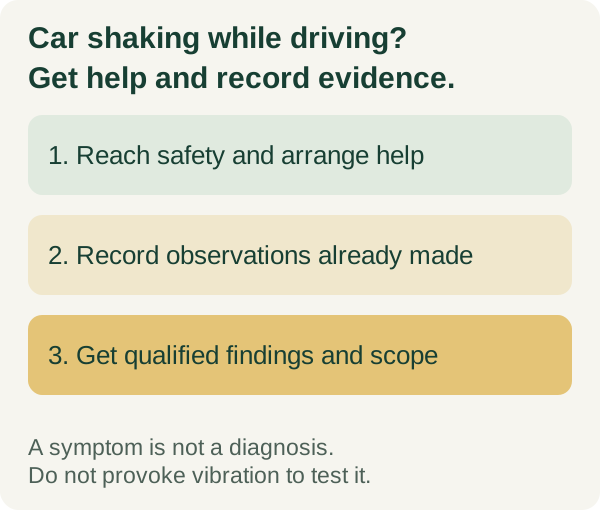
If shaking is new, severe, worsening or accompanied by unpredictable handling, safely pull out of traffic and obtain appropriate professional or roadside assistance. Do not keep driving or accelerate to reproduce a vibration for this guide. Follow the vehicle’s instructions for any warnings.
First decide how to get help safely
Michelin’s tire FAQ advises responding to vibration or suspected damage by reducing speed, cautiously reaching a safe stopping place and obtaining a thorough inspection if the cause is unclear. It identifies tires, steering and suspension as areas needing assessment.
Once safely stopped, describe the symptoms to the assistance provider or qualified shop and ask about appropriate transport. Do not assume that “the shop is only a few miles away” makes driving there safe. This article cannot assess the actual vehicle or roadside conditions.
Keep yourself away from traffic and moving components. Do not crawl beneath the vehicle, lift it at the roadside, remove a wheel or reach into a running engine compartment to investigate shaking. Arrange suitable qualified help.
Why a vibration can have several causes
MOOG’s vibration explanation describes possible wheel and tire faults, worn steering or suspension components, engine or transmission mounts, and brake-related concerns. It also distinguishes observations such as acceleration, braking, road speed, location of the sensation and vibration while stopped.
That is a set of investigation categories, not a parts-order list. Similar symptoms can arise from different faults, and more than one condition can be present. Ask the professional to explain what the inspection established before authorizing a repair on the assumption that a familiar internet description must fit.
A statement such as “it probably just needs balancing” remains a proposed explanation until someone evaluates the actual car. Do not convert a seller’s confidence into a diagnosis or an agreed repair price.
What to record without conducting another test drive
Use observations you already have. After reaching a safe place, write down:
- When the shaking began and whether it followed an impact, service visit or other known event.
- Whether you noticed it during acceleration, steady travel, braking or while stopped.
- The approximate speed and conditions already observed, without repeating them deliberately.
- Where it was felt, such as the steering wheel, seat, floor or pedal.
- Any warning messages, unusual sounds or change in steering or braking response.
- Recent tire, wheel, brake or other relevant work, with available invoices.
Be precise about uncertainty. “I felt it during normal braking once” is more useful than declaring the rotors bad. “It started after a tire visit” records timing; it does not establish which work caused the problem.
Do not film, take notes or operate a phone while driving. A passenger’s earlier observation can be recorded afterward, but do not organize another drive solely to capture a symptom.
Shaking at a particular speed
Tell the shop the range you already observed and whether the sensation changed with ordinary speed changes. MOOG identifies wheel/tire balance, tire condition and wheel damage among possible causes of road vibration. A speed-specific symptom still needs an actual assessment.
There is no universal rule in this guide that shaking at 40, 60 or 70 mph identifies one component. Do not drive faster, coast in Neutral or release steering control to narrow the problem yourself.
Ask what inspection the shop proposes and whether any further diagnostic work is needed. A wheel-balance receipt documents a service; it does not, by itself, prove the entire cause of the vibration has been found and corrected.
Shaking during braking, acceleration or at idle
Describe the circumstance rather than choosing a repair. MOOG explains that braking-related vibration can justify brake-system assessment, while vibration that also exists with the car stopped can direct attention toward engine or transmission concerns. These patterns are clues, not exclusive diagnoses.
Do not assume every braking vibration means a warped rotor or that every idle vibration means one particular mount. Ask the qualified technician what measurements or findings support the proposed work for your vehicle.
Likewise, an acceleration-related symptom does not establish a transmission failure or justify adding fluid without the correct assessment and manufacturer instructions. This guide supplies no fluid, fastener, alignment or repair procedure.
A recent impact or handling change deserves attention
Michelin’s handling guide, updated November 16, 2026, describes how tire condition, pressure and impact-related damage can affect the car’s response. It treats severe vibration and unpredictable handling as urgent concerns.
Tell the shop about a known pothole, curb strike or collision, even if the visible mark seems small. Ask what the proposed assessment includes and what it cannot rule out. A photograph or the absence of an obvious exterior defect does not establish that the tire, wheel or related components are sound.
If collision or structural questions remain, use the frame-damage buying guide for the separate repair-record and specialist-assessment task. Vibration alone does not diagnose structural damage.
An original used-car appointment example
Imagine a used car begins shaking during an ordinary viewing drive. The seller says the car has new tires and therefore “only needs an alignment.” This is an invented example, not an actual seller claim or inspection result.
End the drive safely and arrange appropriate assessment rather than carrying out more driving experiments. Record the observation, request the tire and service invoices, and ask an independent shop what evaluation is needed. New tires and a proposed alignment do not establish the cause or complete repair scope.
If the seller obtains work before you reconsider the car, request the findings and itemized completion records. Have the qualified professional explain what was corrected and any remaining limitations. A changed advertisement saying “fixed” is not the same evidence as that explanation.
Ask for findings, scope and an actual estimate
Agree on diagnostic scope before authorizing repairs. Ask which condition was established, what work is recommended, what further investigation remains and how additional work will be approved. Obtain the actual written estimate rather than assuming a universal vibration-repair price.
For a purchase, discuss the concern when arranging the pre-purchase inspection. Ask whether the standard inspection includes the needed assessment or whether specialist diagnosis and safe transport must be arranged separately.
Keep current findings separate from a broad vehicle-history report. A missing history entry or a clear title does not certify the present condition of tires, brakes or steering equipment.
Download the vibration observation worksheet
Use the blank car shaking observation worksheet for sixteen symptom, service-history, diagnostic-scope and follow-up prompts. It records what already happened and what the responsible professional found; it does not instruct you to provoke a fault.
Treat unexplained shaking as a reason to get appropriate help, then use specific observations and documented findings to make the service or buying decision. An internet cause list cannot determine safe continued use of the actual car.
Source check: November 21, 2026. This source-based guide is not a remote diagnosis, road test, mechanical inspection or actual repair quote. No universal safe driving distance, speed threshold or repair outcome is claimed.
BEFORE YOU TAKE THE NEXT STEP
Practical checklist
Check the VIN, ownership record and seller details.
Arrange an independent inspection and review the written terms.
Confirm the total cost and title-transfer process before paying.
CHECK THE DETAILS
Sources and further reading
Follow the source linked beside a claim for its context. For a transaction, confirm current requirements with the relevant agency, lender or provider.
- Michelin’s tire FAQmichelinman.com
- MOOG’s vibration explanationmoogparts.com
- Michelin’s handling guidemichelinman.com
YOUR NEXT READ
Keep reading