Buying a car
What Does Full Coverage Car Insurance Cover? Check the Actual Policy
See what full coverage usually means, compare liability, comprehensive and collision, and check the actual deductibles, limits, exclusions and optional coverage.
Published
Sources checked . How this guide is prepared.
START HERE
The short answer
Full coverage car insurance usually means liability, comprehensive and collision coverage, along with any other coverage required for the policy. It is an informal label, not a promise that every loss, repair or expense is covered.
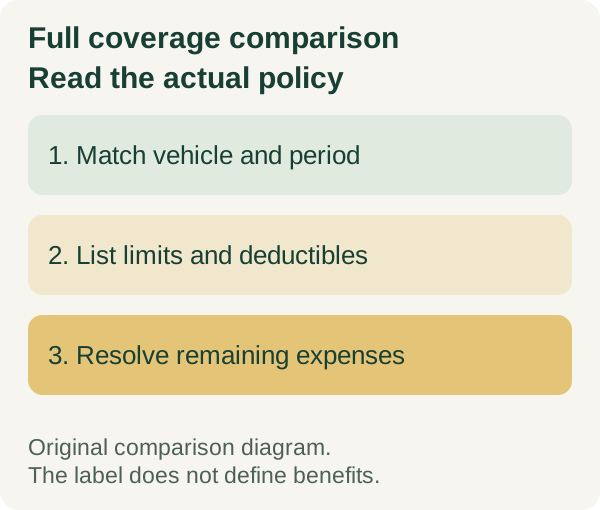
Before choosing an offer, compare the actual coverage schedule, limits, deductibles and exclusions for the same vehicle and policy period. Ask the insurer to resolve unanswered questions in writing. A familiar label cannot show what a particular claim would pay.
What people usually mean by full coverage
Progressive’s full-coverage explanation says there is no single policy or coverage called full coverage. It describes the term as generally combining liability, comprehensive and collision with other required coverage.
Start by asking for the actual quote and policy documents. Record each coverage separately rather than accepting full coverage as a complete description. A quote describes an offer; confirm the effective coverage and dates before relying on it for a purchase or delivery.
Two offers using the same label can leave you with different expenses. The useful question is which defined loss is covered, with what limit, deductible and conditions, on this vehicle and policy.
Liability, collision and comprehensive answer different questions
The National Association of Insurance Commissioners’ coverage guide distinguishes bodily injury and property damage liability from coverage for your own car. Liability addresses injuries or property damage you cause to others, subject to the actual policy.
Collision generally addresses damage to your car in a collision. Comprehensive generally addresses other covered events such as theft, hail, fire or an animal impact. Do not use those category names to decide a disputed claim without the policy’s definitions and conditions.
For your comparison, write one question beside each coverage: whose loss does this address, and which expense could remain mine? That creates a useful conversation with the insurer without pretending a generic list settles every scenario.
Deductibles change your cash exposure
Progressive describes comprehensive and collision payments as subject to their applicable deductibles. Check both figures; they need not be identical. Also record the actual limits or valuation provisions shown in the documents.
Here is an invented premium comparison for the same six-month period and otherwise assumed matching coverage. Offer A costs $780 with a $500 collision deductible. Offer B costs $700 with a $1,000 collision deductible.
B saves $80 in premium for that period and has a collision deductible $500 higher. Those two differences are separate entries. An $80 premium saving does not cancel a $500 increase in the modeled deductible exposure.
This example does not calculate a claim, predict an accident or identify the right policy. Real offers can differ in more than price and deductible. Ask the insurer which deductible applies to a particular covered event and how it works under that policy.
What should you check beyond those three coverage names?
NAIC separately discusses uninsured and underinsured motorist protection, medical payments or personal injury protection, rental and roadside coverage, and GAP. Availability and requirements depend on the actual coverage and jurisdiction.
Ask the provider to identify which of the following are included, separately priced, required, excluded or unavailable in your offer:
- Protection involving an uninsured or underinsured driver.
- Medical payments or personal injury protection.
- Rental reimbursement, including any stated limits.
- Towing or roadside assistance and the service terms.
- Loan or lease shortfall protection and its separate conditions.
A checklist question does not mean the item must be bought or is available in every policy. Record the answer and supporting document. If an offer uses an unfamiliar endorsement name, ask what it changes instead of assuming the marketing name describes the whole benefit.
For the distinct loan-shortfall question, see what GAP insurance for cars is intended to cover. GAP should not be assumed included just because the car has comprehensive and collision coverage.
Does full coverage pay for every repair?
No. Progressive explicitly rejects the idea that the term promises protection for every situation. Ask the insurer how the actual policy treats the event you are concerned about. Do not infer mechanical-breakdown protection, ordinary maintenance payments or a replacement-car budget from the label.
If your concern is a car that already has a mechanical problem, obtain a condition assessment and a repair scope. Buying an insurance policy is a separate decision from establishing the car’s current condition. Describe known circumstances accurately when requesting coverage.
Keep exclusions and permitted vehicle use in the comparison. Ask about your actual drivers and intended use instead of assuming the same quote works for personal, business or other arrangements. Let the provider explain the policy’s application to your situation.
What does a lender or lease require?
Progressive notes that lenders and lessors commonly require comprehensive and collision. Confirm your own financing or lease contract and ask the responsible lender or lessor to explain any specific requirement.
Get the required coverage, deductible restrictions and evidence requirements in writing before binding the policy. Do not assume a seller’s use of full coverage satisfies the lender’s terms. Optional GAP and the underlying auto policy also need separate consideration.
The car-financing guide helps organize borrowing terms. It does not replace the lender’s coverage requirements or your insurer’s policy documents.
Compare offers on one consistent record
Use the same vehicle, drivers, use and period when requesting comparable offers. For each offer, keep the complete premium, payment terms, coverage limits, deductibles, endorsements, effective dates and unresolved questions together.
If one offer changes a limit or omits a coverage, mark it as a different specification until the provider supplies a matching comparison. Do not declare it cheaper for the same protection from the headline premium alone.
Download the blank full-coverage policy comparison worksheet for sixteen document and coverage checks. Finish with a written explanation of what remains your responsibility, then decide using the actual offer and your needs.
Source check: November 21, 2026. This is preparation for comparing policy documents. No personalized insurance recommendation, live quote, claims decision or independent insurance-professional review was performed for this guide.
BEFORE YOU TAKE THE NEXT STEP
Practical checklist
Check the VIN, ownership record and seller details.
Arrange an independent inspection and review the written terms.
Confirm the total cost and title-transfer process before paying.
CHECK THE DETAILS
Sources and further reading
Follow the source linked beside a claim for its context. For a transaction, confirm current requirements with the relevant agency, lender or provider.
- Progressive’s full-coverage explanationprogressive.com
- The National Association of Insurance Commissioners’ coverage guidecontent.naic.org
YOUR NEXT READ