Buying a car
GAP Insurance Refund: How to Check, Request and Track It
Check a possible GAP refund after payoff, refinance, sale or cancellation. Verify contract terms, calculation and payment destination with a free tracking sheet.
Published
Sources checked . How this guide is prepared.
START HERE
The short answer
You may be entitled to a GAP refund when you sell, refinance or pay off an auto loan early, or cancel an eligible agreement. The amount, cancellation process and refund recipient depend on the actual product, contract, claim history and applicable state rules. A refund for unused coverage is different from a GAP claim after a covered loss.
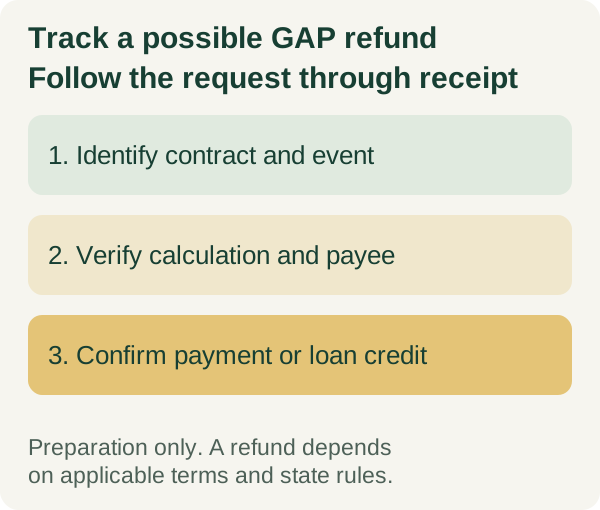
Start with your GAP agreement and the date of the event that changed the coverage. Ask the administrator to identify the cancellation route, calculation and payee in writing. Then follow the money through to a check or account credit rather than treating a submitted request as a completed refund.
What is being refunded?
The CFPB’s GAP explanation describes GAP as an optional product intended to address a loan shortfall after a vehicle is stolen or totaled, subject to its terms. It also says a refund may be available after a sale, refinance or early payoff, and points buyers without paperwork to the lender, provider or selling dealer.
Products commonly called GAP insurance can be insurance policies or contractual waivers. Protective’s GAP FAQ distinguishes those forms. Identify the document you purchased, its provider and administrator before assuming a procedure for one product applies to yours.
An unused-coverage refund concerns the price paid for protection. It does not automatically reimburse all interest paid while financing that price, return the vehicle down payment or cancel the remaining car loan. Keep those amounts separate when you review an explanation of the refund.
When should you check for a refund?
Check when you pay the loan early, refinance, sell or trade the car, or choose to cancel the product. If an old loan is being replaced, ask what happens to the old GAP agreement and whether any protection is needed for the new loan. Do not assume the old product transfers automatically.
If you are considering cancellation while the covered loan remains active, first understand the protection you would lose and whether another policy or agreement applies. A refundable premium and a useful remaining benefit are separate parts of the decision.
If there has been a theft, total loss or possible GAP claim, contact the administrator about that situation before submitting a routine cancellation. Claim history can affect refunds. A claim paying some debt and a cancellation returning unused product charges should not be treated as interchangeable processes.
Read your provider’s actual cancellation terms
Two current examples show why a universal refund promise is unreliable. Ally’s GAP cancellation section, checked November 19, 2026, describes a full refund within 60 days when no claim has been filed. Outside that situation, it says a refund may be prorated and an administrative fee may apply.
Protective’s FAQ generally describes a full refund within the first 30 days, then a partial refund less a cancellation fee, subject to its stated no-claim condition. It directs customers to the selling dealer for cancellation information and says that when financing remains in place, the refund is sent to the financial institution.
Those are provider examples, not nationwide deadlines or terms for every product those companies have ever issued. The applicable agreement and state requirements matter. Ask the administrator to identify the provision it is applying, including any automatic-refund obligation, effective date or request deadline relevant to your situation.
Gather the records before requesting cancellation
Use the provider’s official contact route from your agreement or account. Keep sensitive account identifiers in secure records and send supporting documents through the requested channel.
Prepare these items or ask which are needed:
- GAP agreement, product price, contract number and administrator.
- Vehicle VIN and current lender or servicer information.
- Original purchase date, coverage term and relevant mileage limits.
- Payoff confirmation, refinance completion or sale documents, as applicable.
- Requested cancellation date and supporting date or odometer evidence.
- Claim status and any prior cancellation correspondence.
- Required form, signatures, submission address and delivery confirmation.
A trade agreement or refinance application is not proof the old loan has been paid. Obtain the completed account record or other evidence the administrator requires, and resolve a date mismatch before accepting the calculation.
Ask for the calculation and payment route
Request the original charge, coverage period used, cancellation effective date, refund method, deductions and net amount. Some calculations can depend on time, mileage, claims or other terms. Do not assume that unused calendar months alone determine your entitlement.
Ask who receives the refund and how you can confirm it. If it goes to a lender, request the expected account-credit process. If the loan is paid off, ask how any remaining amount will be delivered and whether a check can be tracked. Update your contact information with the responsible provider when needed.
Keep the administrator’s calculation separate from a rough estimate you made yourself. An estimate is useful for spotting an unexplained difference; it does not replace the contract’s method or establish a legal right to a particular dollar amount.
A hypothetical prorated refund example
Assume an invented agreement costs $1,000 for 60 months and uses a straight-line time calculation. Assume cancellation after 24 months leaves 36 unused months, with no claim adjustment and a permitted $50 cancellation charge. The illustrative gross refund is $1,000 × 36 ÷ 60 = $600. After the assumed charge, the net is $550.
This is not Ally’s or Protective’s formula, a state-law fee limit or a refund quote. A different agreement may use mileage, a different calculation, another permitted adjustment or a different refund period. Use the administrator’s documented terms for your actual request.
If that hypothetical $550 is credited entirely to an $18,000 loan balance and nothing else changes at posting, the balance becomes $17,450. That does not establish that the scheduled monthly payment falls by any amount. Ask the servicer how the credit is applied and what happens to the repayment schedule.
How long does a GAP refund take?
There is no verified national processing time that fits every agreement and event in this guide. Ask the responsible party for the applicable timeline, what starts it and whether a missing document is holding up the request. A provider’s advertised claim-processing speed is not necessarily its cancellation-refund timeline.
Record when you submitted the request, when it was acknowledged, the accepted effective date, the amount approved and the date and destination of payment. Follow up using the written reference number if the stated date passes. Confirm receipt in the destination account rather than relying only on “sent” status.
If the explanation is incomplete, request the calculation and relevant contract provision in writing. For unresolved concerns, the CFPB’s GAP page provides a complaint route; the appropriate state insurance or financial regulator can also depend on whether the product is insurance or a waiver. Do not assume a complaint itself guarantees a refund or a specific outcome.
Keep loan and coverage changes separate
Continue handling the loan according to the servicer’s instructions while a refund is pending. A cancellation request does not erase a scheduled payment. When the loan closes early, the early-payoff guide helps organize that separate calculation and completion process.
For a replacement loan, use the refinancing guide. For a sale with an outstanding balance, use the financed-car sale guide. A GAP refund is one item to reconcile, not evidence that payoff, ownership transfer or new financing has been completed.
Use a refund tracking record
Download the GAP refund request and tracking worksheet. It separates the provider, triggering event, calculation, documents and actual payment destination without asking you to publish sensitive account information.
Ask the administrator: “Which cancellation and refund terms apply to my agreement, what effective date and calculation are you using, and where will the refund go?” Keep following the documented process until the amount is received, credited or specifically explained.
BEFORE YOU TAKE THE NEXT STEP
Practical checklist
Check the VIN, ownership record and seller details.
Arrange an independent inspection and review the written terms.
Confirm the total cost and title-transfer process before paying.
CHECK THE DETAILS
Sources and further reading
Follow the source linked beside a claim for its context. For a transaction, confirm current requirements with the relevant agency, lender or provider.
- CFPB’s GAP explanationconsumerfinance.gov
- Protective’s GAP FAQprotectiveassetprotection.com
- Ally’s GAP cancellation sectionally.com
YOUR NEXT READ