Buying a car
Should I Pay Off My Car Loan Early? Compare Savings and Cash Needs
Compare a dated car-loan payoff with remaining payments, contract terms and the cash you would retain. Includes a worked example and free planning sheet.
Published
Sources checked . How this guide is prepared.
START HERE
The short answer
Paying off a car loan early can make sense when it avoids meaningful interest, the agreement permits it on acceptable terms and you retain enough cash for necessary expenses. Check a dated payoff quote, the interest method and any penalty before deciding. A low remaining balance does not automatically make payoff your best use of cash.
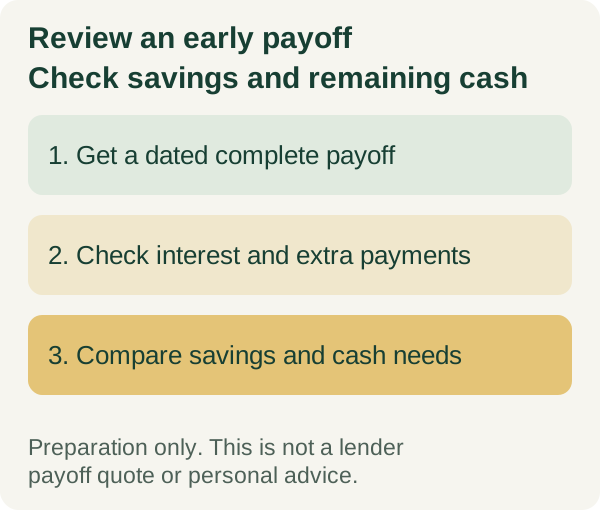
Compare the actual cost of keeping the loan with the cash required to end it. Then consider your other debts, near-term obligations and repair or emergency needs. You can also ask about a smaller extra payment, provided you understand how the servicer applies it.
This guide uses AI-assisted research checked November 19, 2026. CarTruvo operates a vehicle marketplace and has a commercial interest in helping people prepare to buy and sell. It is not a lender or financial adviser. The examples are hypothetical planning exercises, not a personalized recommendation, actual borrower result or independent professional review.
Get a payoff quote instead of relying on the statement balance
Ask the servicer for the amount that would fully satisfy the loan on your intended payment date. Record when the quote expires, how additional interest is handled, accepted payment methods and when the account will be confirmed closed. Keep the quote separate from an ordinary monthly statement or projected principal balance.
Request an explanation of every difference between the quoted payoff and the balance you expected. It may involve accrued interest, fees or other contract-specific amounts. If something appears wrong, resolve it before sending a lump sum. Verify payment instructions through the servicer's established channel, especially if a message unexpectedly changes them.
Also ask how the lien will be released and where the resulting documents or electronic confirmation will go. Ending the payment obligation and completing the title-record steps are different parts of the process. Our car lien explanation helps organize that evidence.
Check the contract's prepayment terms
The CFPB's prepayment guidance says the agreement and state law determine the applicable early-payment rules. Check for a penalty or fee rather than assuming every auto loan permits a cost-free payoff. If you are still choosing a loan, ask about those terms before signing.
For an existing loan, ask the servicer:
- Is there a prepayment penalty, and how is it calculated?
- Is the quoted amount a complete payoff for the stated date?
- Are there separate charges or amounts that can change before receipt?
- Does a full payoff affect any associated product or refund process?
- What confirmation and lien-release evidence should arrive afterward?
Do not treat an expected refund as available cash until its terms, amount and process are confirmed. Keep any coverage decision separate: paying off a loan does not by itself tell you which insurance coverage remains appropriate or legally required.
Find out how interest and extra payments work
The CFPB's simple-versus-precomputed interest explanation describes why the interest method matters. Simple-interest calculations depend on outstanding principal and timing. Precomputed-interest arrangements can treat early repayment differently, including a possible unearned-interest refund. Use the actual contract and payoff calculation rather than applying one savings formula to both.
If considering extra payments instead of a full payoff, ask exactly how to direct them. The CFPB's payment-allocation guidance explains that payments generally address fees and interest before principal. Check the servicer's instructions and verify the resulting balance afterward.
Record whether an extra payment reduces principal, advances the next due date or does something else under the agreement. Confirm whether you must continue the normal scheduled payment. Do not assume that sending more money automatically produces the principal reduction or payment schedule you intended.
Compare remaining payments with the actual payoff
For a straightforward fixed-payment loan, list the remaining scheduled payments and compare their total with the dated payoff, including any relevant charges. Use this as an estimate of future cash avoided, not as a promise of investment return. Irregular payment schedules, fees, tax effects, product refunds and other conditions require separate treatment.
Here is an invented monthly-amortization example:
- Principal remaining: $12,000.
- Fixed annual interest rate: 8%, with 24 equal monthly payments remaining.
- No fees, prepayment penalty, past-due amounts or additional accrued interest assumed.
- Monthly payment: about $542.73.
- Remaining scheduled payments: about $13,025.46.
- Assumed immediate payoff: $12,000, avoiding about $1,025.46 in future interest.
The example uses unrounded payment values for its totals. Real daily-interest timing and final-payment rounding can differ. If an actual dated payoff were $12,100 while the remaining-payment total stayed the same, the difference would be about $925.46. Find out why the payoff differs rather than labeling the entire difference a penalty.
The $542.73 payment would stop after payoff in this example, but the car would still need insurance, maintenance, registration and repairs. Budget for the vehicle after the loan ends instead of treating every former payment dollar as permanently available for another commitment.
Check what cash would remain afterward
Write down your available cash and subtract the full payoff. Compare the remainder with your chosen reserve for near-term obligations and unexpected costs. There is no universal reserve amount appropriate for every household; use the actual expenses and income uncertainty you face.
Continuing the invented example, suppose available cash is $18,000 and you have deliberately reserved $7,000 for upcoming obligations and contingencies. A $12,000 payoff leaves $6,000, which is $1,000 below that chosen reserve. That does not make the interest savings disappear, but it shows the cash tradeoff clearly.
Consider whether a smaller principal payment, more time to build cash or repayment of another costly obligation deserves comparison. Check fees, due dates and contract restrictions for each choice. Avoid using an assumed stock-market return or an unavailable promotional rate as if it were a certain alternative benefit.
Is keeping, selling or refinancing the car a different decision?
Yes. Paying off while keeping the car ends a loan obligation but leaves you with the vehicle and its costs. Selling requires a price, payoff, release and transfer plan. Refinancing replaces the existing debt with a new agreement whose fees, term and total cost must be compared.
If selling, use our financed-car sale guide. Do not pay off solely because you assume the future sale proceeds will immediately restore your cash; the sale date and price remain uncertain. If considering a different loan, compare the rate and complete financing terms, not just a lower monthly payment.
Avoid keeping debt solely because you expect a guaranteed credit-score benefit from having an open account. Ask how the servicer reports closure, check your records afterward and keep the payoff decision grounded in verified costs and your own cash needs rather than an unverified score prediction.
Free early-payoff decision worksheet
Use the blank car-loan early payoff record to compare the remaining schedule, dated payoff, interest method, penalties, cash reserve and completion evidence. It is a manual worksheet, not a lender payoff calculator or personal financial advice.
After any payoff, confirm receipt, check for a zero balance and obtain the applicable release evidence. Follow up on missing or incorrect records. Make the decision using the actual agreement and current cash position, then keep the documents showing that the planned result occurred.
BEFORE YOU TAKE THE NEXT STEP
Practical checklist
Check the VIN, ownership record and seller details.
Arrange an independent inspection and review the written terms.
Confirm the total cost and title-transfer process before paying.
CHECK THE DETAILS
Sources and further reading
Follow the source linked beside a claim for its context. For a transaction, confirm current requirements with the relevant agency, lender or provider.
- CFPB's prepayment guidanceconsumerfinance.gov
- CFPB's simple-versus-precomputed interest explanationconsumerfinance.gov
- CFPB's payment-allocation guidanceconsumerfinance.gov
YOUR NEXT READ