Buying a car
How Does Financing a Car Work? From Price to Final Payment
Understand how car financing works from purchase price to final payment. Compare amounts, APR, repayment terms and approval conditions with a free worksheet.
Published
Sources checked . How this guide is prepared.
START HERE
The short answer
Financing a car means borrowing money to buy it, then repaying the amount borrowed plus the agreed cost of credit over time. Your payment depends on how much you finance, the interest terms and the repayment schedule. You need to understand the purchase price and the loan separately before deciding what is affordable.
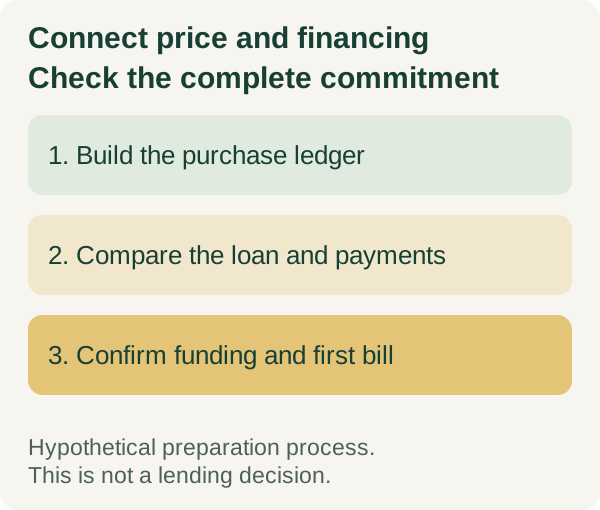
Start with a written total price, identify how much cash or trade equity you will contribute, and compare loan offers for the remaining amount. Before taking the car, confirm the financing is final, the contract matches the offer and you know who will collect the payments.
Who provides the money?
The CFPB’s explanation of dealer-arranged and direct financing describes two common routes. You can approach a bank or credit union directly, or a dealer can submit your information to potential lenders and arrange financing. Comparing routes gives you more information than accepting the first payment quoted.
Ask who the lender will be, which application you are authorizing and whether the offer is preliminary or final. An eligibility estimate is not the same as completed funding for a specific vehicle. Confirm any conditions involving the VIN, mileage, seller, income verification, down payment or title.
For a private sale, ask whether the lender supports that transaction and how funds and ownership documents will move. A loan intended for participating dealerships may not work for a private seller. The private-party auto loan guide covers that separate funding sequence.
How much will you actually borrow?
Build a purchase ledger before looking only at the monthly payment. Start with the vehicle price, then itemize taxes, required charges and any optional products you actually choose. Subtract cash and applicable positive trade equity once. If an old loan is involved, show its payoff and trade allowance separately so a shortfall is visible.
Consider a hypothetical $22,000 vehicle, $2,000 in taxes and other purchase charges, and an $800 optional product. The total is $24,800. With $2,800 paid in cash, the modeled amount to finance is $22,000. Those tax and fee amounts are invented, not an estimate for any state or transaction.
If you decline the $800 product and everything else stays unchanged, the amount to finance becomes $21,200. Do not assume an add-on is free because the dealer presents it as a small payment increase. Ask for its individual price and its effect on the borrowing total.
Use the dealer doc-fee guide when reconciling dealer charges. If a trade has a shortfall, use the negative-equity guide rather than treating the full trade allowance as a down payment.
What do APR, interest and term mean?
Principal is the unpaid amount borrowed. The interest rate determines the charge for borrowing under the contract’s calculation method. APR is a broader annual measure that reflects interest and applicable credit charges. The CFPB’s APR explanation explains why an APR comparison should use APRs on both sides, rather than comparing one offer’s APR with another’s interest rate.
The term is the repayment period. A longer term can reduce the payment while increasing total interest when the other assumptions remain the same. Neither the lowest payment nor the smallest percentage, by itself, tells you the complete purchase and financing cost.
Ask for the amount financed, APR, interest rate, number of payments, payment amount, finance charge and total payments. Keep any upfront cash separate. An advertised rate is a reference until the provider confirms the terms available to you for the actual car.
A hypothetical 60-month versus 72-month loan
Assume the $22,000 amount financed carries a fixed 7% annual interest rate, monthly amortization and no additional loan fees. At 60 months, the payment is about $435.63 and unrounded payment arithmetic produces about $26,137.58 in total loan payments. That includes about $4,137.58 in interest.
At the same rate over 72 months, the payment falls to about $375.08, but total loan payments rise to about $27,005.63. Interest is about $5,005.63. The lower payment comes with another year of payments and about $868.04 more interest, calculated before rounding the displayed totals.
These are invented loan terms, not current rates or an approval. They exclude ongoing insurance, fuel, maintenance and repairs. The earlier $2,800 cash contribution is additional to the loan-payment totals. Actual payment rounding, fees, payment timing and contract methods can change the result.
How does each payment reduce the balance?
The CFPB’s simple-versus-precomputed interest explanation distinguishes methods that calculate interest on the outstanding balance from precomputed arrangements. Check your contract before assuming every payment or extra dollar is allocated the same way.
For a simplified daily-interest illustration, assume a $20,000 balance, 7% annual rate, 30 days and a 365-day basis. Interest would be $20,000 × 0.07 × 30 ÷ 365, or about $115.07. If a $420 payment covers that interest first and there are no fees or other amounts due, about $304.93 reduces principal.
This illustration is not a statement for your account. Verify the applicable day-count basis, accrual dates and allocation order. Ask the servicer how extra payments are applied and how to obtain a dated payoff. A displayed principal balance and the complete amount required to close a loan may differ.
What should you check before signing?
The CFPB’s Truth-in-Lending disclosure guide explains the cost and payment disclosures to review before signing. Match the completed documents to the written purchase and loan offer.
Check these items together:
- VIN, seller, borrower names and agreed purchase price.
- Taxes, fees, optional products, trade figures and cash contribution.
- Amount financed, APR, payment schedule and total payments.
- Any late-payment, early-payment or other contract provisions.
- Remaining approval conditions and the actual funding process.
- Copies of signed documents and the lender or servicer’s contact information.
Ask about anything that changed. If a lower payment comes from a longer term or a larger down payment, record that change before calling it a better offer. Do not sign a blank or unexplained document to preserve an advertised deal.
What happens after you buy the car?
Confirm the first payment date, servicer, account access and insurance requirements. Verify the title and lender-lien process through the responsible provider or agency. Financing a purchase is different from paying for a lease; the lease-versus-buy guide explains that comparison.
Review statements and keep payment confirmations. If you later want to change lenders, use the refinancing guide. If you want to pay early, check the contract and dated payoff before deciding the savings. Neither a future refinance nor a future sale should be assumed to solve an unaffordable payment today.
Keep the purchase and loan on one record
Download the car financing comparison worksheet. It separates the purchase ledger, loan terms, approval conditions and first-payment setup so you can compare equivalent offers.
Your next step is to get the written total purchase price and ask a lender to quote that actual transaction. Judge the car, amount borrowed and repayment obligations together, rather than starting with a monthly payment and working backward into a commitment you did not intend.
BEFORE YOU TAKE THE NEXT STEP
Practical checklist
Check the VIN, ownership record and seller details.
Arrange an independent inspection and review the written terms.
Confirm the total cost and title-transfer process before paying.
CHECK THE DETAILS
Sources and further reading
Follow the source linked beside a claim for its context. For a transaction, confirm current requirements with the relevant agency, lender or provider.
- CFPB’s explanation of dealer-arranged and direct financingconsumerfinance.gov
- CFPB’s APR explanationconsumerfinance.gov
- CFPB’s simple-versus-precomputed interest explanationconsumerfinance.gov
- CFPB’s Truth-in-Lending disclosure guideconsumerfinance.gov
YOUR NEXT READ