Buying a car
What Is MSRP? Compare the Suggested Price With the Full Deal
Learn what MSRP means and compare base price, configured sticker total and actual purchase cost. Includes two hypothetical dealer quotes and a free worksheet.
Published
Sources checked . How this guide is prepared.
START HERE
The short answer
MSRP means manufacturer’s suggested retail price. It is the manufacturer’s recommended retail price for a new vehicle, not a promise of what a particular dealer will charge or the total you will pay to drive it home. Identify which price is being quoted, what it includes and how it connects to the written purchase total.
For a used car, the original MSRP is historical information. It does not establish today’s value, condition or fair asking price. Use it to understand the vehicle’s original configuration, then compare the actual car and current purchase terms.
MSRP, base price and sticker price
Mazda’s MSRP explanation distinguishes the manufacturer’s suggested price, a base configuration and the total shown on a new-car window sticker. Factory options and a destination charge can appear as separate lines in the sticker total. Read the labels rather than assuming every number called MSRP includes exactly the same items.
A starting price on a manufacturer’s model page may describe a different trim or configuration from the vehicle on a dealer’s lot. Ask for the actual VIN’s factory window sticker or configuration record. Compare year, trim, powertrain and options before judging one price against another.
If those terms are unclear, use the make-versus-model guide. The brand and model name alone may leave important differences unresolved, particularly when two advertisements show different equipment.
Does MSRP include destination, tax and dealer charges?
Check the particular document. A base-MSRP line can exclude destination while a total-MSRP or sticker-total line includes it. Adding destination again when it is already inside the quoted total would count the charge twice.
Mazda’s explanation also separates taxes, government charges and dealer-added items from the manufacturer’s reference price. Ask the seller to itemize the actual transaction rather than assuming the sticker total is an out-the-door quote.
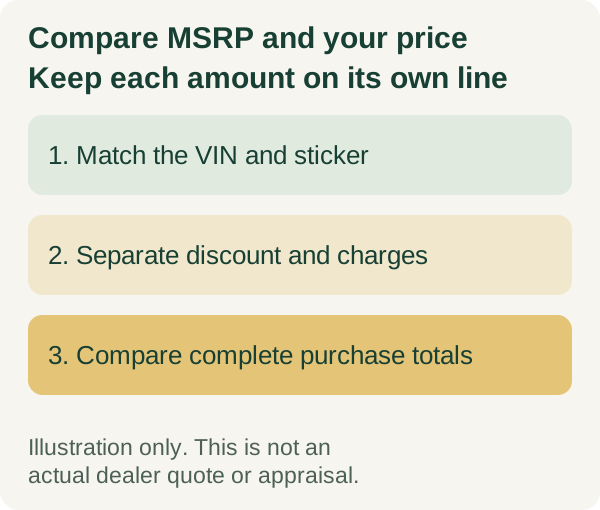
Keep three groups visible in your record: factory price components, changes to the selling price, and transaction charges. Record every amount once. If the dealer adds an accessory or protection product, establish what it is, its separate price and whether you want it. Do not treat a product as factory equipment merely because it appears beside a window sticker.
MSRP versus invoice and asking price
MSRP is the manufacturer’s retail recommendation. An invoice is a different manufacturer-to-dealer pricing document. Neither number, standing alone, tells you the complete cost of your transaction or establishes that a particular asking price is a good purchase.
Kelley Blue Book’s MSRP definition explains that a dealer’s sale price may be above or below the suggested price. There is no universal discount percentage in this guide that proves a bargain. Compare actual competing offers, vehicle configuration and purchase conditions.
If a seller uses an invoice or a discount claim in negotiation, ask which vehicle, date, price and included items it refers to. Keep the discussion focused on the amount you would pay for the car you actually want rather than trying to infer a dealer’s entire economics from a single document.
A hypothetical sticker-to-purchase calculation
Assume a fictional vehicle has a $30,000 base price, $1,800 in factory options and a $1,400 destination charge. Its assumed configured sticker total is $33,200. Those figures are invented, not a manufacturer quote or current inventory.
Dealer A offers $1,200 off that total, producing a $32,000 selling price, then lists $900 in dealer charges, $2,300 in taxes and $300 in title and registration charges. The modeled purchase total is $35,500.
Dealer B offers only $700 off the same $33,200 total, producing a $32,500 selling price, then lists $100 in dealer charges and the same assumed $2,300 tax and $300 government-charge amounts. Its modeled purchase total is $35,200.
Dealer B’s discount is $500 smaller, but its assumed dealer charges are $800 lower, leaving a total $300 lower. The tax figures are simplified placeholders, not a state calculation; actual tax treatment can differ. The comparison assumes the same car, identical included equipment and equivalent eligibility. Neither example includes borrowing costs or an old-loan shortfall.
Compare equivalent written offers
Ask each seller for the total purchase price for the same VIN and your actual transaction circumstances. The FTC’s used-car buying guide recommends obtaining out-the-door prices in writing before visiting a dealer, including checking discounts and added charges.
Use these fields to reconcile the offers:
- Exact VIN, year, model, trim and included equipment.
- Reference price and whether destination is already included.
- Actual selling price and every applicable discount or rebate.
- Qualification conditions for incentives or a financing-linked price.
- Dealer charges and individually identified optional products.
- Taxes, title and registration amounts for your transaction.
- Trade allowance and payoff, shown separately from the vehicle price.
- Cash required, amount financed and any remaining conditions.
For the detailed fee question, use the dealer doc-fee guide. For the loan calculation, use how financing a car works. Keep the purchase comparison separate from the repayment comparison so a longer loan term does not disguise a higher price.
What does original MSRP tell you about a used car?
An original sticker can help identify the car’s original equipment and explain a seller’s description. It cannot show that all equipment is still installed or working, that the vehicle has been maintained or that the present asking price is justified.
Compare current listings for genuinely similar vehicles, then account for mileage, condition, history, location and the actual offer terms. If an option matters to you, inspect and test it. A feature listed on an old sticker and a feature functioning on today’s car are different pieces of evidence.
A seller’s “huge discount from original MSRP” can be mathematically correct and still leave the value question unanswered. Ask whether another comparable car costs less today, what repairs are needed and what you will pay after charges. Use the used-car negotiation guide to keep those facts organized.
Is paying above MSRP always a mistake?
An above-MSRP quote needs the same complete comparison as any other quote. Identify the actual premium, added items and alternative vehicles. Decide whether the vehicle’s availability and configuration justify the complete cost for your needs and budget.
Do not assume the premium will return to you when you resell the car. Likewise, do not assume a below-MSRP offer is affordable after insurance, financing and ownership expenses. MSRP is one reference point, not a rule that determines every buying outcome.
If the seller changes the price or conditions before signing, reconcile the final documents with the written offer. Leave an unexplained line as an unresolved question rather than assigning it a reassuring name yourself.
Use a price reconciliation record
Download the MSRP-to-purchase comparison worksheet. It separates the factory reference, actual selling price, charges, eligibility and full purchase total.
Ask the seller: “Which MSRP or sticker total are you using for this VIN, what is already included, and what is my complete written purchase price?” Compare the answers before deciding how much a stated discount is worth.
BEFORE YOU TAKE THE NEXT STEP
Practical checklist
Check the VIN, ownership record and seller details.
Arrange an independent inspection and review the written terms.
Confirm the total cost and title-transfer process before paying.
CHECK THE DETAILS
Sources and further reading
Follow the source linked beside a claim for its context. For a transaction, confirm current requirements with the relevant agency, lender or provider.
- Mazda’s MSRP explanationmazdausa.com
- Kelley Blue Book’s MSRP definitionkbb.com
- FTC’s used-car buying guideconsumer.ftc.gov
YOUR NEXT READ