Buying a car
Sedan vs. SUV: Choose for Your Passengers, Cargo and Budget
Compare sedans and SUVs using real passenger, cargo and parking checks. Includes safety-rating limits, an occasional-rental example and a blank fit worksheet.
Published
Sources checked . How this guide is prepared.
START HERE
The short answer
Choose a sedan when its seats, trunk and road manners meet your everyday needs at the better complete cost. Choose an SUV when its actual access, seating or usable cargo space solves a recurring problem you cannot reasonably solve with the sedan. Compare identified vehicles, not a promise that every SUV is roomier, safer or better in winter.
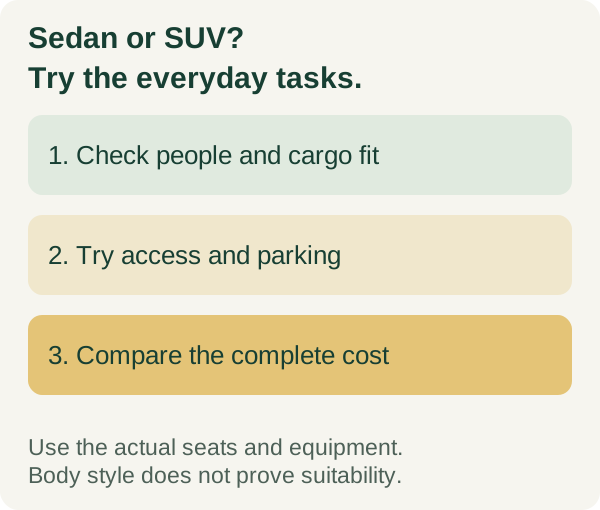
A useful test is simple: bring the people and permitted everyday items you need to carry, try the same tasks in both vehicles and record the result. Then price the differences that matter to you. Body style helps organize the shortlist; it does not finish the purchase decision.
What is the difference between a sedan and an SUV?
A sedan typically has a lower passenger-car body and a separate trunk. An SUV generally combines the passenger and cargo areas under a taller, rear-access body. There are exceptions and overlapping marketing names, so inspect how the actual doors, seats and luggage space work.
Mazda’s sedan-versus-SUV guide describes differences in space, access and driving position while emphasizing model-specific comparisons. A compact SUV and a large sedan can serve different needs from the stereotype attached to their labels. Do not assume that choosing SUV gives you a third row or that choosing sedan prevents you from finding AWD.
If your question is instead how a crossover differs from a traditional SUV, see the crossover versus SUV construction guide. This guide focuses on everyday passenger, luggage and parking fit rather than the platform beneath the vehicle.
Test passenger comfort with your real seating arrangement
Set the driver’s seat for the person who will normally drive. Then have the usual rear passenger sit behind it. Check headroom, knee room, foot space and whether the passenger can enter and leave comfortably. Repeat on both sides if different adults regularly drive.
Check entry and exit with the people who will use the car. A taller seat can suit one person and create a difficult step for another. Avoid choosing for an older relative or a person with a mobility limitation from measurements alone; their own comfortable, safe trial is more useful.
If using child restraints, check the vehicle and restraint manuals and confirm that the actual installation and seating positions work. Do not infer that five seat belts mean three particular child seats will fit across. A seating trial is a buying check, not a substitute for correct restraint selection and installation.
Cargo volume does not tell you whether your items fit
Agree with the seller before bringing a clean stroller, mobility aid, instrument case or sports bag to a viewing. Check the opening as well as the space behind it. A large listed volume is less useful if the opening will not accept the item you need to carry.
- Keep the seats in the positions your passengers require during the comparison.
- Check whether the trunk lid or hatch closes properly without forcing it against the item.
- Record which items fit together rather than testing each in an otherwise empty car.
- Note lifting height, reach and whether you can load without an awkward movement.
- Check the owner manual for load limits and cargo-securing instructions before travel.
Keep the distinction between cargo space behind occupied seats and maximum space with seats folded. If a stroller fits only when a needed seat is unavailable, that configuration does not solve the normal trip. Record the limitation instead of treating the largest advertised cargo number as the answer.
Try the parking and visibility tasks you actually face
Measure your parking space and compare the vehicle’s length, width and height from its documentation. Allow room for doors, an opening hatch, mirrors and the people getting out. Check garage-door and height restrictions where relevant rather than assuming an SUV is too big or a sedan will automatically fit.
During an ordinary permitted test drive, assess your view from the correctly adjusted seat and your comfort with the controls. Try a lawful parking maneuver in a suitable location. A higher seating position changes the view, but it does not eliminate blind spots or replace looking carefully around the vehicle.
Use the actual cameras and sensors if fitted, and learn their limits from the manual. Confirm the equipment on the particular car; an advertisement for the model family may describe features absent from that trim or year.
Compare safety using the correct evidence
Look up the exact model year in NHTSA’s safety ratings. Read the individual tests, any safety concerns and the explanation of what can be compared. NHTSA limits comparisons of frontal crash ratings and Overall Vehicle Scores to vehicles in the same class and within 250 pounds of each other. Matching star counts across an arbitrary sedan and SUV are not an equal-conditions safety comparison.
Condition and fitted equipment still need attention. Check tires, brakes, warning lights, repair history and open recalls as part of the actual vehicle assessment. This guide does not declare either body style universally safer or convert a test rating into a guarantee about a used car.
For winter use, assess tires, route and the actual drivetrain through the FWD-versus-AWD guide. An SUV badge alone does not establish traction capability or stopping performance.
A hypothetical everyday car versus occasional rental comparison
Suppose both candidates meet your normal passenger needs, but only the SUV can carry equipment you need three weekends a year. Assume the SUV would cost $2,400 more to buy and $480 more per year to own over a four-year holding period. Those are invented complete-cost differences for this example, not market averages.
The modeled difference is $2,400 plus four times $480, or $4,320. An assumed suitable rental for three weekends a year at an all-in $240 per weekend would total $2,880 over four years. Under these assumptions, the sedan-plus-rental plan is $1,440 cheaper.
This is a decision illustration, not a rental quote. Confirm availability, insurance, taxes, mileage limits and collection arrangements, and include any resale or financing differences not already inside your estimates. If rentals are unavailable when needed, or the larger capacity is required every week, the plan may not be practical even if its arithmetic looks attractive.
Compare the actual full costs before choosing
Get complete purchase quotes and insurance estimates for both cars. Use the EPA’s configuration-specific comparison tool for the correct engine, transmission and drivetrain rather than assuming a particular fuel advantage from body shape alone. Ask an inspecting professional about documented upcoming work instead of assigning every SUV the same maintenance premium.
The pre-purchase inspection guide explains how to agree on inspection scope before committing. A suitable layout does not compensate for unresolved condition or paperwork questions.
Download the sedan and SUV fit worksheet
Use the blank sedan-versus-SUV fit worksheet to record sixteen passenger, cargo, parking, evidence and cost checks. Keep an explicit must-have list and decide which compromises are acceptable before negotiating.
For model ideas after those checks, explore used sedans and used small SUVs. Choose the actual car that meets the recurring task at a cost you can sustain. If both fit, comfort and personal preference are reasonable deciding factors once the evidence is sound.
Source check: November 19, 2026. The fit method and rental scenario are original buying tools. CarTruvo has not conducted a comparative road test or obtained actual vehicle, insurance or rental quotes for this example.
BEFORE YOU TAKE THE NEXT STEP
Practical checklist
Check the VIN, ownership record and seller details.
Arrange an independent inspection and review the written terms.
Confirm the total cost and title-transfer process before paying.
CHECK THE DETAILS
Sources and further reading
Follow the source linked beside a claim for its context. For a transaction, confirm current requirements with the relevant agency, lender or provider.
- Mazda’s sedan-versus-SUV guidemazdausa.com
- NHTSA’s safety ratingsnhtsa.gov
- EPA’s configuration-specific comparison toolfueleconomy.gov
YOUR NEXT READ