Inspections & condition
Timing Belt vs. Timing Chain: What to Check Before Buying
Identify the actual timing system, check its manufacturer schedule and verify service records. Includes a hypothetical buying-cost comparison and blank worksheet.
Published
Sources checked . How this guide is prepared.
START HERE
The short answer
A timing belt and timing chain both help synchronize the engine’s crankshaft and camshaft motion. A belt is a flexible toothed component; a chain uses linked metal elements. For a used-car buyer, the important difference is the actual engine’s maintenance requirements and evidence that necessary work has been done, not a universal rule that one design is always the better purchase.
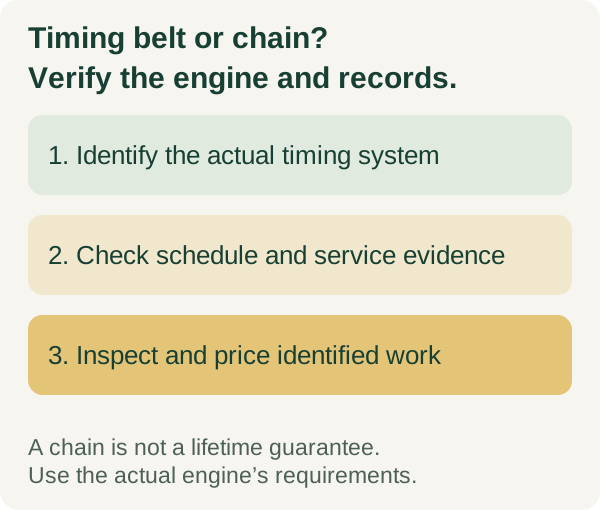
Confirm the exact engine, obtain its manufacturer maintenance information and review identifiable service records. Then compare the car’s present condition and any documented upcoming work with the complete purchase cost.
What the timing system does
Honda’s timing-belt explanation describes how the belt keeps crankshaft and camshaft movement synchronized so the valves operate at the appropriate point relative to piston movement. Its timing-chain explanation describes the same essential synchronization using a metal chain.
These Honda explainers were published in 2020. Their general mechanism descriptions are useful, but their old model lists are not a current VIN-specific identification tool. Do not apply a broad mileage range or a familiar model name to a different year or engine without checking the applicable manual.
A receipt saying only “belt replaced” also needs clarification. Ask which belt and related work it describes. Do not assume a generic belt-service entry proves that the engine timing belt was replaced.
Does the car have a belt or a chain?
Start with VIN, model year, engine and market-specific configuration. Ask the manufacturer or a qualified service professional to identify the timing arrangement and the maintenance information that applies. Keep the source with the answer.
The make-and-model guide explains why year, trim and engine should be recorded separately. A badge or an advertisement describing only the model family can leave the important engine question unresolved.
Do not remove covers or work around a running engine to identify the system during a viewing. If documentation does not settle it, have the qualified inspecting shop resolve the actual configuration safely. An unsupported seller statement should remain an unanswered question.
Is a timing chain maintenance-free?
Do not treat that phrase as a guarantee. Honda’s chain explanation emphasizes engine-oil care and the condition of timing components and acknowledges that a chain can require repair. The absence of a routine belt-style replacement schedule does not prove that every chain or associated part will last indefinitely.
Use the actual manufacturer schedule and specifications for the engine. Ask about the records and any known symptoms or prior timing-system repairs. Do not assume that every chain problem proves neglect or that a well-documented car is immune from future faults.
For either design, have a qualified professional investigate unusual noise, warning lights or abnormal running. Those observations can have several causes. This guide does not diagnose a timing fault from a sound, dashboard light or mileage figure.
When does a timing belt need replacement?
Use the correct manufacturer maintenance instructions, including applicable time, mileage, operating-condition or maintenance-system requirements. There is no universal 60,000-, 90,000- or 100,000-mile interval for every car in this guide.
Ask the shop to establish what is due now and what evidence would demonstrate that earlier required work was completed. A low odometer reading alone should not replace a schedule that also considers age or other conditions. Likewise, a high reading does not prove the work was missed if credible records establish it was done.
If related components are part of the proposed service, request an itemized explanation and estimate for the actual engine. Do not assume every timing service has the same parts list, or that a quoted water-pump job automatically included all timing work you expected.
Read the service record as evidence, not a guarantee
Match each invoice to the car’s identification, date and mileage. Check the description of the work and ask the servicing shop to clarify ambiguous entries with the owner’s permission where needed.
A completed job supports a statement about recorded past service; it does not establish the condition of every engine component today. A missing invoice leaves a gap, but it is not, by itself, proof that the belt or chain has failed.
Keep three entries separate: the manufacturer requirement, the evidence of past work and the qualified assessment of current condition. That structure makes it harder for a confident claim such as “it has a chain, so nothing is due” to replace the actual questions.
An original comparison of immediate buying costs
Imagine two otherwise suitable cars with equivalent comparison terms. Car A is priced at $15,000 and has an outstanding timing-service requirement that a qualified shop has assessed and estimated at an assumed $1,200. Car B is priced at $15,800, has documented timing service and has other assessed immediate work estimated at an assumed $300.
- A’s modeled purchase plus identified immediate work is $16,200.
- B’s modeled purchase plus identified immediate work is $16,100.
- B is $100 lower in this limited comparison despite an $800 higher asking price.
These cars and estimates are invented. Taxes, financing, insurance, other condition differences and future repairs are outside the example. Actual service scope, evidence and written estimates must replace the assumptions; a timing-chain badge alone supplies no repair-cost credit.
Keep timing questions inside a whole-car inspection
Discuss the timing concern when agreeing on the pre-purchase inspection. Ask what the shop can assess within the proposed scope and whether further diagnosis or access is needed. A normal inspection is not an internal engine guarantee.
If a symptom suggests the car may be unsafe or at risk of damage, stop the test drive and arrange appropriate qualified assessment or safe transport. Do not repeatedly start or drive it to provoke a failure. The point is to gather reliable evidence before purchase, not conduct a stress test.
The four-cylinder versus six-cylinder guide covers another specification that should not become a shortcut for condition. Compare the exact engine and records rather than assuming cylinder count identifies the timing system or remaining life.
Download the timing-system buying worksheet
Use the blank timing belt and chain evidence worksheet for sixteen identification, schedule, invoice, inspection and cost checks. Keep unresolved items visible until the responsible source supplies an answer.
Choose the actual car whose maintenance evidence, assessed condition and complete costs meet your needs. A belt can be a manageable scheduled-service consideration; a chain still needs its applicable care and condition checks. Neither label replaces the work of evaluating the vehicle in front of you.
Source check: November 19, 2026. Honda’s dated general explainers are used for mechanism and maintenance distinctions, not current model coverage or universal intervals. The cost example is hypothetical; no engine test, diagnosis or actual service quote is claimed.
BEFORE YOU TAKE THE NEXT STEP
Practical checklist
Check the VIN, ownership record and seller details.
Arrange an independent inspection and review the written terms.
Confirm the total cost and title-transfer process before paying.
CHECK THE DETAILS
Sources and further reading
Follow the source linked beside a claim for its context. For a transaction, confirm current requirements with the relevant agency, lender or provider.
- Honda’s timing-belt explanationcrmshonda.my.salesforce-sites.com
- timing-chain explanationcrmshonda.my.salesforce-sites.com
YOUR NEXT READ
Keep reading