Buying a car
What Is GAP Insurance for Cars? Coverage, Limits and Buying Checks
Understand what GAP is intended to cover, compare insurance and payoff-product limits, and separate a loan shortfall from an eligible benefit. Includes a blank worksheet.
Published
Sources checked . How this guide is prepared.
START HERE
The short answer
GAP, or Guaranteed Asset Protection, is an optional product intended to address an eligible shortfall between an auto-loan balance and an insurance settlement after a theft or total loss. Whether it pays, and how much, depends on the actual product and its terms. It does not replace the car’s underlying auto insurance.
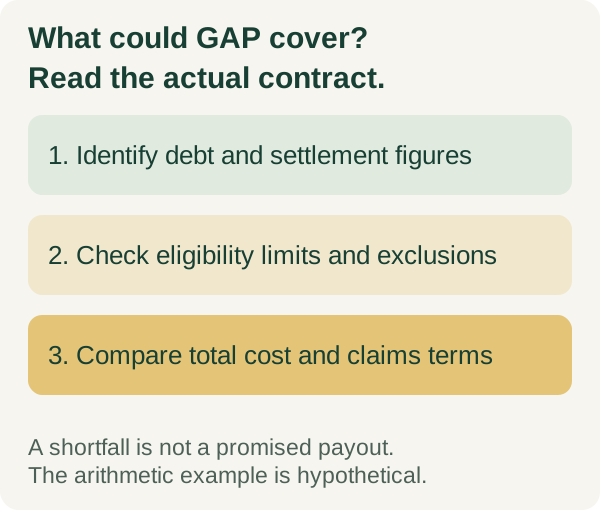
Before buying, identify the contract type, compare its price and limits, and check whether it addresses the risk in your actual loan or lease. A product called GAP, a debt-cancellation agreement and a loan/lease payoff endorsement should not be assumed to have identical benefits.
What is the gap it is meant to address?
The CFPB’s GAP explanation describes an optional product for the difference between an auto-loan balance and what insurance pays when a car is stolen or totaled. It notes that eligibility restrictions can affect value and recommends comparing price and coverage.
The important comparison is the actual debt and settlement relevant to the loss, not simply the original sticker price or the sum of every future monthly payment. Ask the lender and product provider which balance and settlement figures the contract uses.
GAP is not a general repair warranty, a replacement-car budget or a promise to reimburse your down payment. Read the covered-event definition and claims terms rather than applying the word protection to every expense after an accident.
An original three-figure shortfall record
Imagine an assumed loan payoff of $22,000 and an assumed insurance settlement of $18,500. The difference is $3,500. These are invented figures, not a real loan, valuation or claim.
Keep three entries:
- Loan figure: $22,000 in this illustration, subject to the actual lender’s payoff information.
- Insurance figure: $18,500 in this illustration, subject to the actual settlement and its treatment under the contract.
- Eligible GAP benefit: unknown until the provider applies the product’s terms.
The $3,500 subtraction is not an automatic claim payment. The example does not model deductibles, overdue amounts, rolled-in debt, exclusions or payout limits. Do not assume the product erases every item appearing in a loan balance because the arithmetic shows a shortfall.
Use this record to ask the provider which amounts are eligible, which are excluded and what evidence it needs. Keep a written answer with the actual contract rather than relying on a simplified checkout explanation.
GAP insurance and debt-cancellation products
The Texas Department of Insurance warns that some GAP products sold through a dealer or bank are not insurance and directs consumers to the product documents for the appropriate help route. It also describes exclusions that may reduce a benefit, including certain overdue amounts, finance or warranty costs and deductibles.
This is Texas agency guidance, not a statement that every product in every state has the same legal form or exclusions. Identify the provider, administrator and contract type. Ask who is responsible for a claim and which regulator or complaint process applies to that actual product.
A title such as GAP waiver or debt cancellation deserves a document-specific explanation. Do not decide which agency regulates the agreement from the sales label alone.
Loan/lease payoff coverage can have different limits
Progressive’s GAP explainer describes its loan/lease payoff coverage as similar to GAP while explaining a percentage-based limit and state variation. Its page also describes underlying coverage requirements for that product.
The useful lesson is to compare the actual benefit formula, not to treat Progressive’s example as a rule for every insurer. Ask each provider whether its limit is based on vehicle value, loan amount, a fixed dollar ceiling or another defined measure.
Record the applicable deductible treatment, vehicle eligibility, covered events and maximum benefit. A lower price may buy a different amount of protection, and a familiar product name does not resolve that difference.
Is GAP required to get a car loan?
The CFPB describes GAP as optional. If someone presents it as a financing requirement, ask where that condition is written and confirm it directly with the lender before agreeing. Do not rely solely on a salesperson’s statement or the appearance of a prefilled charge.
Request the complete financing documents and identify which products you selected. The auto-financing guide helps separate vehicle price, add-ons and borrowing terms. Your decision should be based on the actual offer and product documents.
This guide does not decide the legality of a particular financing condition or replace the lender’s required disclosures. Resolve an unclear requirement with the responsible lender or appropriate consumer-protection authority before signing.
Compare the total cost, including financing
The CFPB notes that financing a GAP purchase increases the amount borrowed and the interest paid over time. Compare the product price and the complete financing terms, not only a small change in the monthly payment.
Ask whether a quote is a one-time amount, a recurring policy charge or a financed purchase. Record the covered period, cancellation terms and any conditions for eligibility. Do not assume that two differently priced offers cover the same period or remaining balance.
If you are comparing a dealer product with an insurer or lender offer, keep the underlying auto coverage and benefit limits visible. This guide does not identify a universally cheapest provider or a price that applies to every car and borrower.
Questions to settle before you buy
Get written answers to the points that matter for your contract:
- Which vehicle, borrower and financing arrangement are eligible?
- What loss event activates the product, and what underlying coverage is required?
- Which debt and settlement figures are used to calculate a benefit?
- What limits, exclusions and deductible rules apply?
- Who receives a payment, and how is any remaining balance handled?
- Which documents and deadlines apply to a claim?
- What happens after refinancing, payoff, sale or cancellation?
Do not create a universal exclusion list from another buyer’s policy. If a seller’s explanation conflicts with the contract, ask the provider to resolve it. Keep unresolved coverage questions open until the responsible source answers.
Revisit the product as the loan changes
A product that appeared relevant at purchase may need reassessment after the balance, vehicle, financing or coverage changes. Use current lender information and the provider’s actual terms rather than assuming a fixed anniversary determines when it is useful.
For cancellation or possible unused charges after payoff, sale or refinancing, use the separate GAP insurance refund guide. This article explains the purchase and coverage comparison; it does not promise a refund amount or claims outcome.
Download the GAP product comparison worksheet
The blank GAP coverage comparison worksheet records sixteen contract, benefit, exclusion, cost and claims questions. Use one copy per actual product and identify the document supporting each answer.
Choose based on the shortfall you are considering and the terms actually offered. A clear explanation of what could remain unpaid is more useful than a blanket promise that GAP pays off the whole car.
Source check: November 21, 2026. CFPB, Texas and Progressive information is used within its stated scope. No actual loan evaluation, insurance recommendation, policy quote, legal determination or claim calculation was performed for this guide.
BEFORE YOU TAKE THE NEXT STEP
Practical checklist
Check the VIN, ownership record and seller details.
Arrange an independent inspection and review the written terms.
Confirm the total cost and title-transfer process before paying.
CHECK THE DETAILS
Sources and further reading
Follow the source linked beside a claim for its context. For a transaction, confirm current requirements with the relevant agency, lender or provider.
- The CFPB’s GAP explanationconsumerfinance.gov
- The Texas Department of Insurancetdi.texas.gov
- Progressive’s GAP explainerprogressive.com
YOUR NEXT READ